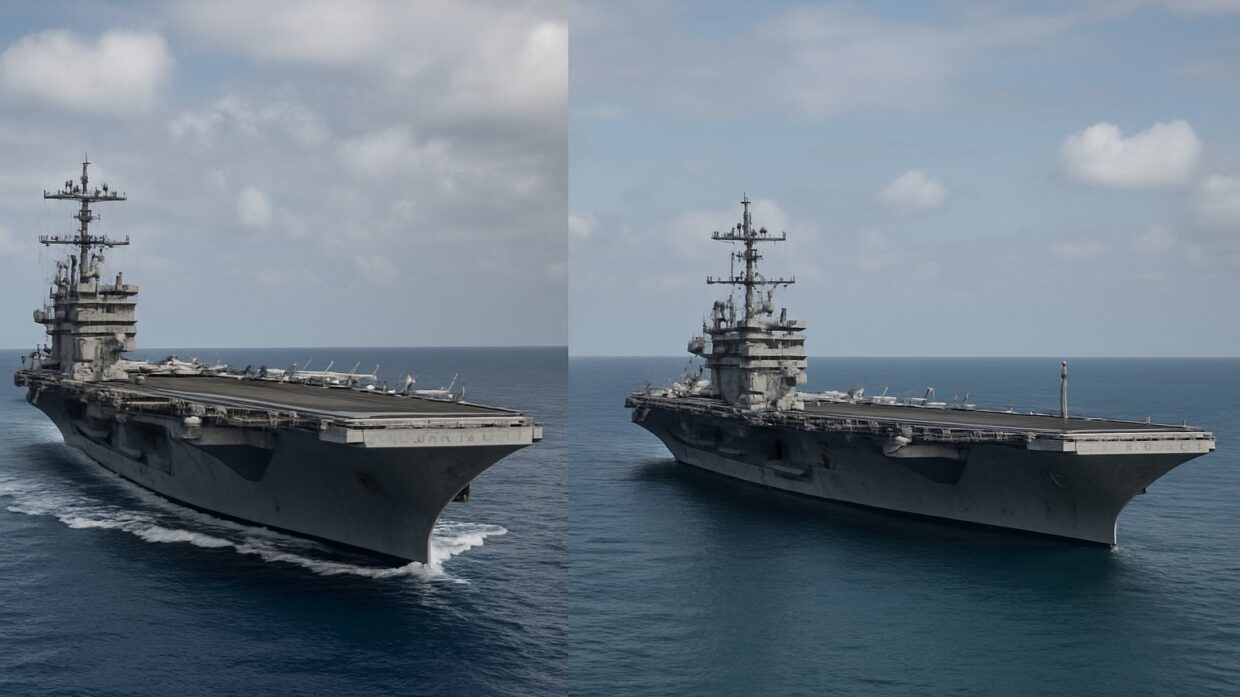
Photo: Well This Is News
Aircraft carrier USS Abraham Lincoln to return home as families report poor living conditions for sailors
Sailors attempt suicide aboard USS Abraham Lincoln plagued by food and water shortages
USS Abraham Lincoln heading home as USS George Washington replaces it amid crew condition reports
Key Takeaways
- The Navy characterized the carrier replacement as a standard scheduled rotation, but the reporting never establishes whether the USS Abraham Lincoln's departure was accelerated or followed the normal timeline for carrier rotations.
- Both sides point to the same facts, reported conditions and crew concerns, but neither explains whether those conditions caused the Navy's decision to replace the carrier or whether the decision was made independently on a pre-existing schedule.
- The public record documents what sailors and families reported experiencing but does not establish whether the reported material conditions directly caused the mental health crises or whether other factors were involved.
The Analysis
The USS Abraham Lincoln is being replaced by the USS George Washington in Middle East operations following crew condition reports that both sides frame through opposing lenses, while the actual sequence of command decisions remains partially obscured.
The documented facts are these: The USS Abraham Lincoln has been deployed to the Middle East in support of operations in the region. Families of crew members have reported concerns about living conditions aboard the carrier. The Wall Street Journal reported mental health concerns among crew members, including at least two sailors who attempted to jump overboard. The USS George Washington, a Nimitz-class carrier, has been ordered to the theater as a replacement. U.S. officials characterize this rotation as part of scheduled carrier operations.
NBC News frames this primarily around family complaints and poor conditions. The language emphasizes concern and departure, using the phrase "families report poor living conditions" as the central tension. The framing invites the question: was the carrier allowed to deploy too long? The reporting does not establish whether the conditions reported represent a departure from standard carrier operations or an escalation tied to specific circumstances like extended deployment duration.
The Daily Wire emphasizes crisis language and severity. The headline leads with attempted suicides and uses the phrase "plagued by food shortages, water problems" as the defining characteristic. This framing assigns urgency and systemic failure to the situation. The Daily Wire's language suggests the conditions were dire enough to trigger self-harm, which carries political weight regarding military readiness and Navy leadership. The reporting does not establish whether the suicide attempts were caused by or merely coincident with the reported material conditions.
The Hill occupies middle ground, describing the situation as one of "poor conditions" and "questions" without amplifying either the family concern frame or the crisis frame. The language "amid questions over conditions" acknowledges dispute or uncertainty rather than confirming the severity either side asserts.
What neither framing addresses is the basic operational question: was the carrier rotation accelerated because of conditions, or was it already scheduled? U.S. officials told multiple outlets this was a planned rotation, but the reporting does not establish whether planned rotations can be accelerated, or whether the Navy was responding to external pressure from families or internal assessments of crew readiness. The available coverage does not explain the standard timeline for carrier rotations or whether this one deviated from it.
The underlying tension is different from how either side frames it. The left emphasizes family suffering and conditions; the right emphasizes mental health crisis; but both are responding to the same underlying event: the Navy made a decision to replace the carrier. The question the public record does not fully answer is whether that decision was made because of the reported conditions or despite them being known, and whether the replacement was accelerated or proceeded on schedule.
Carrier rotations typically follow five-year planning cycles with little flexibility, making this replacement's timing a test of whether the Navy can prioritize crew welfare over operational scheduling or whether public pressure forces reactive decisions that military planners resist. If the George Washington deployment was genuinely accelerated due to conditions aboard the Lincoln, it establishes precedent that documented crew mental health crises and material deficiencies can interrupt the carrier fleet's rigid force-projection schedule. If it proceeded on original timeline, it signals the Navy absorbed crew complaints without operational consequence. The ambiguity about which occurred matters because it determines whether families have leverage to force institutional change at the service level or whether current structures allow the military to acknowledge problems while maintaining normal operations regardless of reported conditions.