Photo: Well This Is News
Trump administration greenlights Saudi nuclear program while ramping up Iran aggression
Historic Saudi nuclear deal risks Middle East destabilization without uranium enrichment restrictions
House approves Iran war budget as U.S. strikes Saudi nuclear deal without traditional enrichment safeguards
Key Takeaways
- The Trump administration withdrew from the Iran nuclear deal in 2018, then funded military operations against Iran, and now is removing enrichment restrictions for Saudi Arabia without appearing to coordinate these decisions or justify how they fit together strategically.
- Pentagon briefings to Congress about the $95 billion Iran war authorization did not address the implications of the simultaneous Saudi nuclear agreement, suggesting these two major policy decisions were treated as separate matters rather than parts of a single regional strategy.
- The nuclear cooperation agreement with Saudi Arabia represents the first time the U.S. has allowed enrichment on foreign soil without the safeguards that have been standard practice since the 1970s, making this a genuine break from established policy rather than an incremental change.
The Analysis
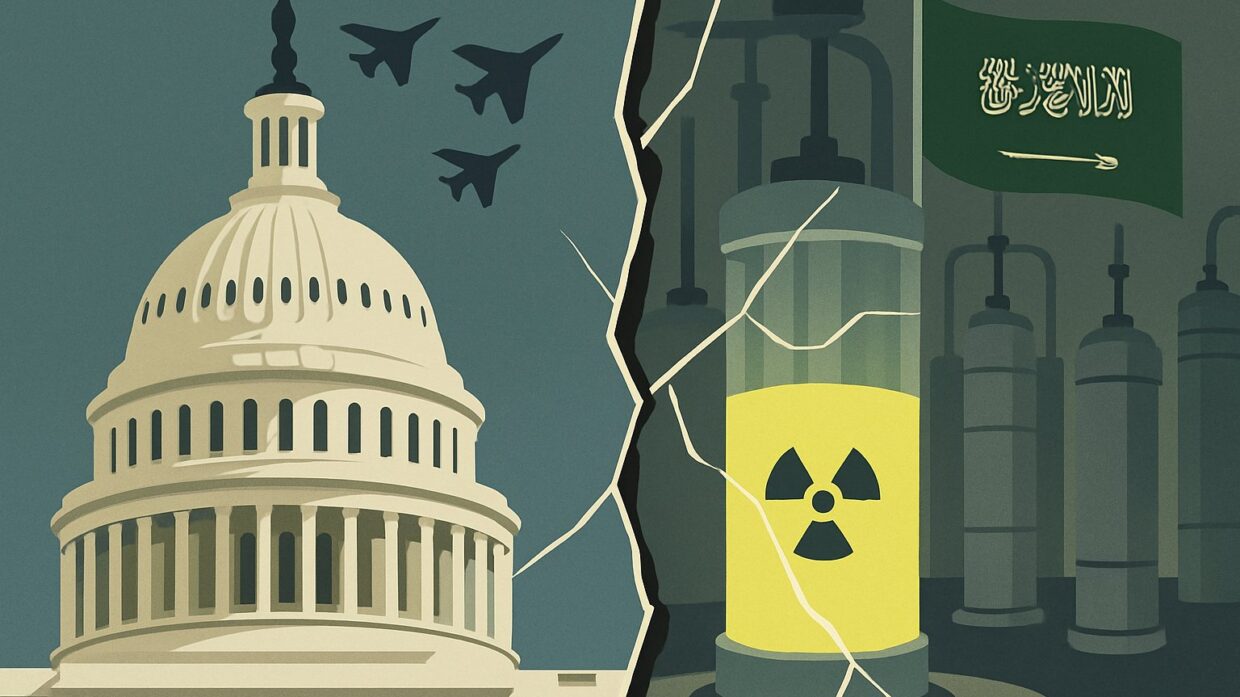
The Trump administration has announced a nuclear cooperation agreement with Saudi Arabia that permits uranium enrichment on Saudi soil, while simultaneously the House approved $95 billion in funding for military operations against Iran. These two developments are being reported separately by most outlets, but they represent a single strategic choice with contradictory long-term consequences.
The factual record is straightforward. According to the Wall Street Journal reporting cited in multiple summaries, the U.S.-Saudi nuclear agreement allows Saudi Arabia to enrich uranium domestically without the enrichment restrictions that have been standard in American nuclear cooperation agreements since the 1970s. The House Pentagon funding bill, passed with bipartisan support according to NPR Politics, includes explicit budget authority for what multiple sources term an "Iran war." Bloomberg reports the figure at $95 billion specifically allocated for Iran operations, with reporting that some Republicans expressed concern about the political cost of the unpopular conflict.
The left frame, exemplified by NPR's summary, emphasizes Trump "ramping up aggression against Iran" while simultaneously granting nuclear capability to Saudi Arabia, presenting this as a contradictory or reckless dual strategy. The language choice here is significant: "ramping up aggression" assigns intentional escalation rather than describing specific military operations. That framing leaves out the stated justification for both decisions: the Trump administration's argument that Iran poses a regional threat that justifies both military action and alliance-building with Saudi Arabia as a counterweight. The left's presentation also does not address why the U.S. might view Saudi Arabia as a necessary regional partner precisely because Iran is the stated adversary.
The right frame, from the Washington Examiner, focuses on the nuclear deal as a destabilization risk but does not emphasize the Iran war funding component at all. It foregrounds the "historic agreement" language and the removal of "stringent safeguards," treating the Saudi deal as the primary story. This framing emphasizes proliferation risk and the departure from Non-Proliferation Treaty norms. What this emphasis leaves out is the geopolitical calculation that may have driven both decisions: if Iran is viewed as an expanding regional threat, Saudi Arabia's nuclear capacity might be seen as necessary deterrence. The right frame does not explain or contest that reasoning.
What neither framing adequately addresses is the specific history that makes this moment significant. The U.S. has historically used the NPT framework and enrichment restrictions as leverage to prevent regional nuclear proliferation. The 2015 Iran nuclear deal, formally known as the Joint Comprehensive Plan of Action, imposed strict limits on Iranian enrichment in exchange for sanctions relief. The Trump administration withdrew from that agreement in 2018. Now, with Iran having resumed enrichment since that withdrawal, the administration is simultaneously funding military operations against Iran while removing enrichment restrictions for Saudi Arabia. The sequence matters: the U.S. first abandoned the diplomatic framework that constrained Iran, then funded military action, and now is granting nuclear enrichment rights to Iran's regional rival without traditional oversight.
The available reporting does not establish whether this represents a calculated strategic doctrine or separate decisions with compounded consequences. The Pentagon briefing to House lawmakers mentioned in The Hill coverage does not appear to have addressed the nuclear agreement's implications. That silence itself may be significant.
Removing enrichment safeguards from the Saudi nuclear agreement while simultaneously funding military operations against Iran abandons the diplomatic tools that constrained regional proliferation for fifty years. The U.S. first withdrew from the Iran nuclear deal in 2018, then accelerated Iranian enrichment by reimposing sanctions, and now grants Saudi Arabia the nuclear capability to match its rival without the oversight that American agreements required since the 1970s. This establishes a precedent that nuclear cooperation with the U.S. no longer requires Non-Proliferation Treaty compliance, undermining the framework that has prevented a cascade of regional nuclear programs across the Middle East. When future nations seek nuclear technology, they will point to this Saudi agreement as evidence that enrichment restrictions are negotiable rather than foundational, accelerating proliferation that military budgets alone cannot contain.