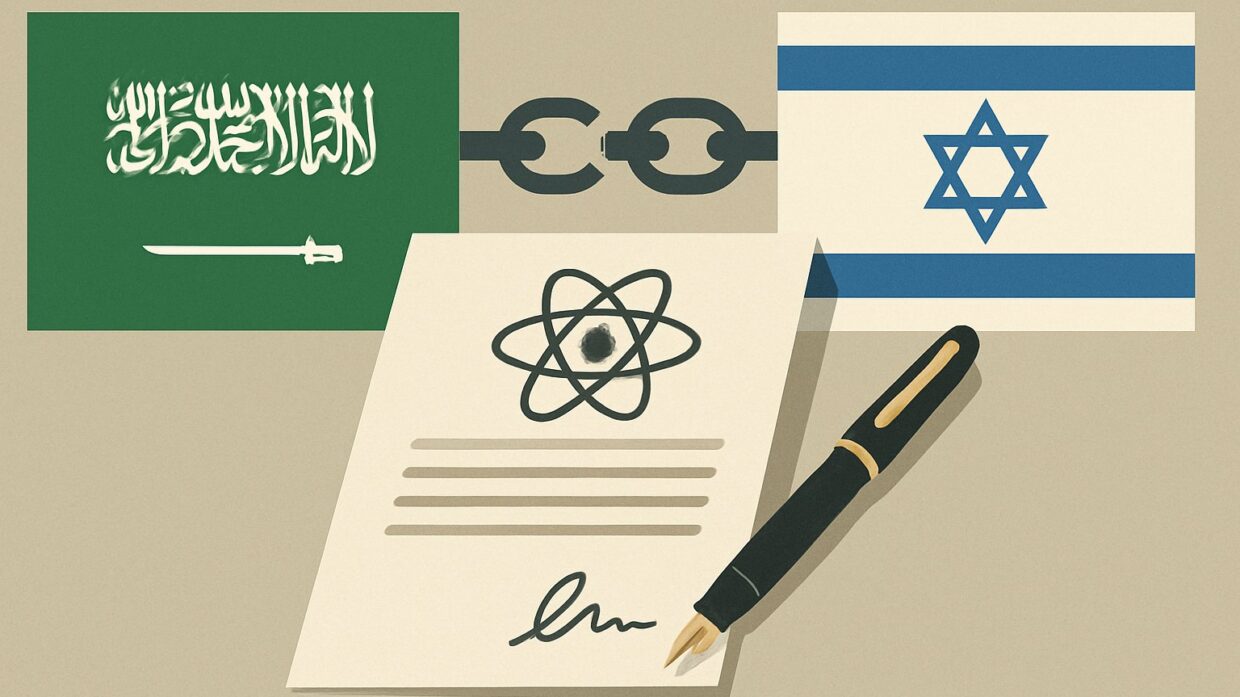
Photo: Well This Is News
Trump undermines his own nuclear deal by adding last-minute Israel normalization demand
Trump administration secures historic multi-billion-dollar nuclear deal with Saudi Arabia
Trump conditions Saudi nuclear deal on Abraham Accords membership after formal signing
Key Takeaways
- The Department of Energy announced the nuclear agreement as finalized, but the same day Trump publicly made it conditional on the Abraham Accords, creating a documented contradiction between the formal announcement and the public condition that raises questions about what was actually agreed to.
- White House officials framed the Abraham Accords requirement as something Trump has raised repeatedly in private negotiations, but no public record establishes whether Saudi Arabia formally understood or accepted this condition when the agreement was signed.
- Attaching a public condition to an already-signed agreement may either pressure Saudi Arabia to comply or give them a stated reason to delay or avoid joining the Abraham Accords framework, depending on how they interpret the requirement and whether the condition was negotiated in advance.
The Analysis
Trump announced on social media that a nuclear agreement with Saudi Arabia, formally concluded by the Department of Energy on Wednesday, is now conditional on the kingdom joining the Abraham Accords framework normalizing ties with Israel. The announcement contradicts the administration's formal public statement the same day confirming the deal as complete, raising a specific question: what changed between the formal signing and the public condition, and why was it not included in the official announcement.
The documented sequence matters. The Department of Energy confirmed the civil nuclear cooperation agreement as finalized. Hours or the same day, Trump posted that the deal is "totally subject" to Saudi Arabia joining the Abraham Accords. When asked at a White House briefing why this condition was not mentioned in the initial announcement, press secretary Karoline Leavitt stated that Trump is the "final dealmaker" and has raised the Abraham Accords requirement "on numerous occasions." That framing addresses the timing question but leaves unresolved whether the condition was formally understood by the Saudi side when the agreement was signed, or whether it was presented afterward.
The left framing emphasizes disorder and dealmaking incompetence. Vox's headline asked "Did Trump just kill his own nuclear deal?" and reported that Trump "seemingly called off a nuclear deal" after his energy secretary "already formally signed it." That language frames the announcement as a reversal that undermines what was already concluded. The MSNBC coverage notes the condition was made conditional without explaining how a deal can be simultaneously "concluded" and then made subject to new requirements. What that framing leaves out is whether the Abraham Accords requirement was part of private negotiations all along and simply not disclosed publicly until Trump chose to emphasize it.
The right framing emphasizes achievement and strategic clarity. Breitbart reported the deal as "decades-long, multi-billion-dollar" and described Trump's condition as a restatement of a priority he has "numerous occasions" raised with Saudi leadership. That framing positions the announcement as consistent messaging rather than a reversal. What the right framing leaves unexamined is the tactical question of whether attaching a public condition to an already-signed agreement actually pressures the Saudis to comply or allows them to cite the condition as a reason not to sign.
Neither framing addresses the underlying diplomatic reality. The Abraham Accords represent a specific diplomatic framework that Saudi Arabia has not publicly committed to joining, despite its normalization of relations with Israel and participation in Abraham Accords-aligned initiatives. The public record does not establish whether Trump's condition signals a hardening of U.S. policy toward the Saudis, a tactical negotiating move to pressure them on a separate issue, or a clarification of something already negotiated in private. What it does establish is that a formally signed agreement now carries a publicly stated condition that may complicate ratification or implementation, depending on how the Saudi government interprets the requirement.
The question that follows is whether this reflects Trump's negotiating style, internal administration coordination gaps, or strategic recalibration of Middle East diplomacy. The sources provided do not answer that.
This deal now exists in legal limbo. A formally signed civil nuclear cooperation agreement cannot simultaneously be final and conditional without creating ambiguity about what either party actually committed to. If Saudi Arabia did not know the Abraham Accords membership was required when it signed, the condition functions as a unilateral revision that may give the kingdom grounds to suspend implementation. If it did know, the public announcement serves no negotiating purpose and instead signals internal disunity within the administration about what was actually agreed. Either interpretation creates friction with a critical regional partner at a moment when U.S.-Saudi coordination on Iran policy, energy markets, and Middle East stability depends on clear mutual understanding. Congress will struggle to ratify an agreement whose terms remain disputed between the parties who supposedly concluded it.