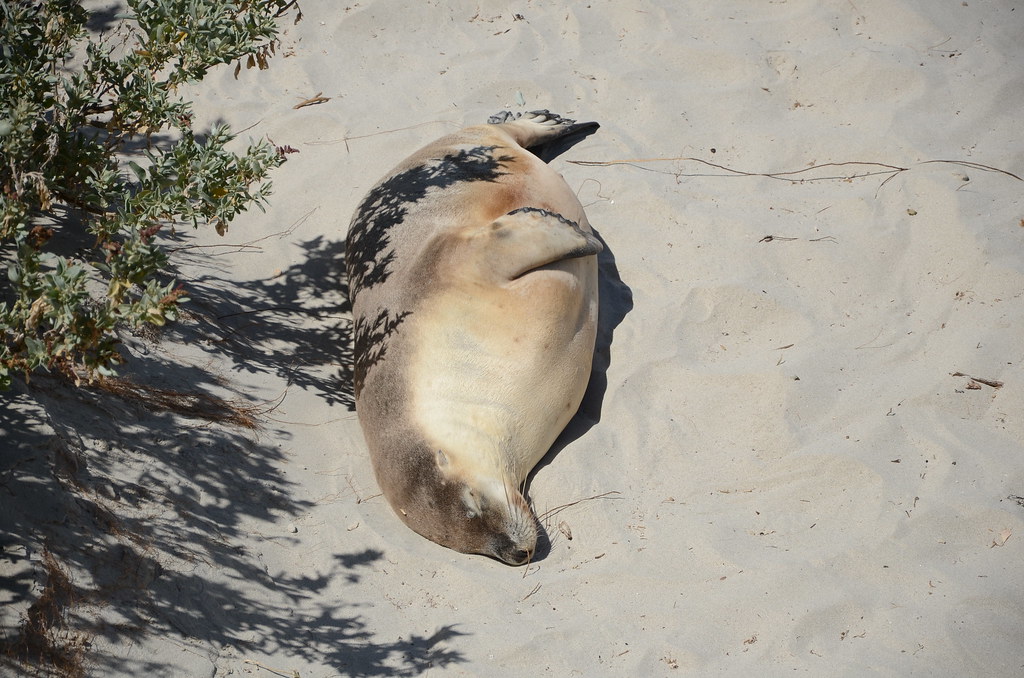
Photo: JohnJennings995 / Flickr (CC BY 2.0)
Climate crisis deepens as bird flu reaches Australia's most vulnerable species
Australia's sea lion population faces new threat as H5 strain detected
H5 bird flu kills endangered Australian sea lion in first recorded case
Key Takeaways
- The case represents a documented spillover event, but authorities have not yet publicly disclosed how frequently H5 circulates in wild birds near Kangaroo Island or what specific transmission route infected this sea lion.
- Neither climate causation nor containment protocols can be meaningfully evaluated without clearer surveillance data on H5 prevalence in Australian wildlife populations and the conditions that enabled cross-species transmission.
- This death may signal either an isolated incident or the beginning of H5 establishment in Australian marine ecosystems, but the available public record does not yet distinguish between those scenarios or explain why wildlife surveillance has not mapped the virus more comprehensively.
The Analysis
An endangered Australian sea lion has died from H5 bird flu on Kangaroo Island, the first recorded case in a species numbering fewer than 12,000 individuals globally. What makes this significant is not just the death itself, but what it signals about disease transmission pathways in marine ecosystems and the exposure of critically endangered populations to pathogens originally associated with avian species.
South Australian authorities confirmed the case on Kangaroo Island, where a stable breeding colony of sea lions exists. The animal's cause of death was identified through diagnostic testing as H5 influenza, the highly pathogenic strain that has circulated in wild bird populations and occasionally spilled into mammals across multiple continents. The sea lion is the first documented marine mammal of this species to die from the virus in Australia. No additional cases have been confirmed, though authorities are conducting surveillance of the colony.
The left frame emphasizes this death as evidence of cascading ecological breakdown driven by climate change, arguing that warming oceans and habitat degradation leave vulnerable species defenseless against emerging zoonotic threats. That framing captures the real vulnerability of small populations but leaves out the specific evidence needed to establish direct causation between climate patterns and this particular infection event. The reporting does not establish whether climate conditions directly enabled this transmission or whether it represents incidental exposure from environmental overlap with infected bird populations.
The right frame treats this primarily as a biosecurity management challenge and a conservation risk specific to an already fragile population. That approach grounds the story in concrete threat assessment but underplays the broader context: H5 has been detected in wild bird populations across Australia for months, raising questions about why terrestrial and marine wildlife interaction has not been more explicitly flagged as a transmission risk. The emphasis on the sea lion population as uniquely vulnerable subtly shifts attention away from the wider ecological circulation of the virus.
What neither framing addresses directly is the incomplete picture of H5 transmission in Australian wildlife. The available reporting does not establish how frequently the virus has been detected in wild birds on or near Kangaroo Island, what the infection rate is in populations that could serve as transmission sources, or what specific conditions allowed cross-species spillover to an aquatic mammal. The discovery of this case may indicate gaps in surveillance rather than a new phase of disease spread. The public record does not disclose whether the sea lion had contact with infected birds, contaminated food sources, or other transmission routes.
The underlying question is whether this represents an isolated incident or a pattern suggesting H5 has become established in Australian wildlife ecology in ways that threaten marine populations. The actual headline reflects both the confirmed risk and the diagnostic gap: a species already on the brink of extinction has demonstrated vulnerability to a pathogen that authorities have not yet fully mapped in wild populations. That vulnerability is real regardless of its cause, but understanding the mechanism matters for managing the threat going forward.
Australian sea lions are already struggling to recover from historical hunting that reduced their population to fewer than 12,000 individuals globally. A single H5 death on Kangaroo Island exposes a critical surveillance blind spot: authorities have detected the virus circulating in Australian wild birds for months yet lack baseline data on infection rates in potential reservoir species or documented transmission pathways to marine mammals. If H5 becomes endemic in Australian wildlife, breeding colonies on isolated islands could face cascading mortality events from a pathogen that wildlife management protocols never anticipated targeting pinnipeds. The discovery itself signals that current monitoring systems cannot distinguish between isolated spillover and the early stages of ecological establishment, leaving managers unable to implement preventive measures for a population with virtually no recovery margin.