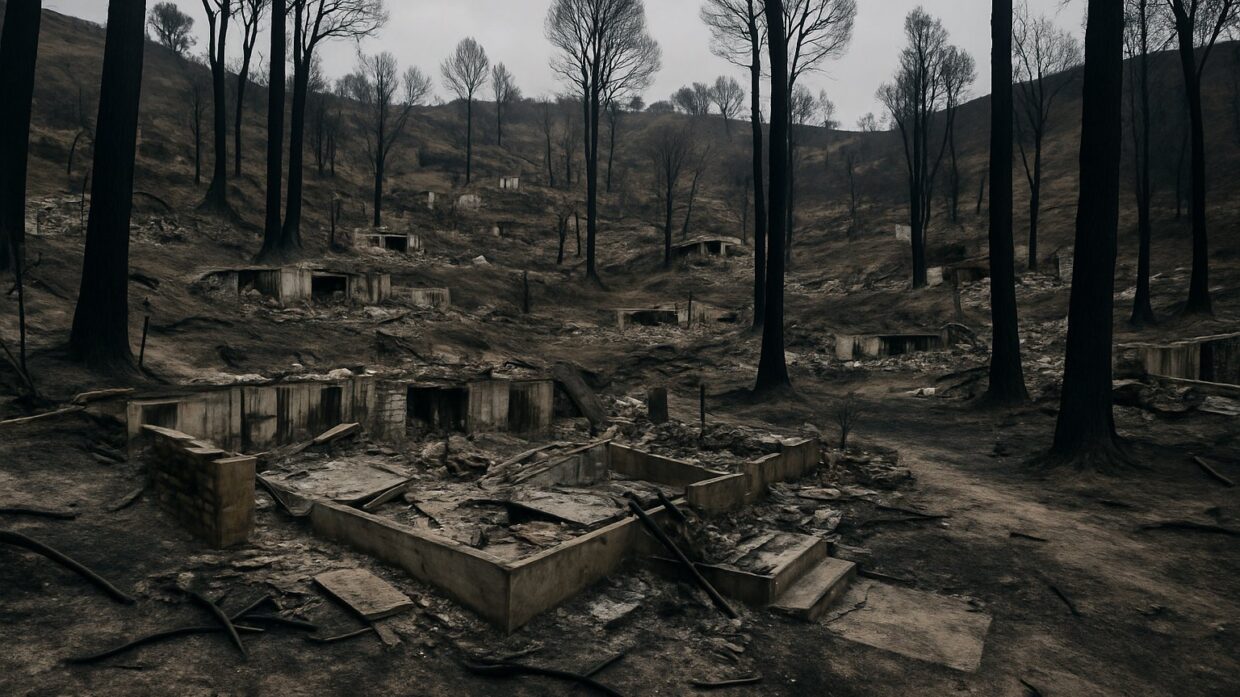
Photo: Well This Is News
Jury deadlocks in Palisades Fire case, blocking path to accountability
Judge declares mistrial after jury unable to convict in Palisades Fire arson trial
Federal judge declares mistrial in Palisades Fire arson case after jury deadlock
Key Takeaways
- The jury's 13-hour deadlock likely reflects genuine disagreement about whether Rinderknecht's alleged ignition directly caused the catastrophic damage, rather than a failure by either side.
- Prosecutors faced an evidentiary burden requiring proof that a single individual's action caused a fire's spread across thousands of acres during extreme drought, heat, and high winds, which is substantially different from proving ignition alone.
- The public record does not disclose what the jury actually disagreed on: whether Rinderknecht ignited a fire, whether that fire caused the documented damages, or whether the environmental conditions rather than his actions drove the catastrophe.
The Analysis
A federal jury's inability to reach consensus in the Jonathan Rinderknecht arson case reveals a fundamental evidentiary problem that neither the prosecution's framing nor the defense strategy fully addresses: the difficulty of establishing individual causation in a natural disaster of unprecedented scale.
What actually occurred: On Friday, after deliberating for more than 13 hours, a federal jury informed the court it could not agree on whether Rinderknecht, 29, intentionally or recklessly ignited the fire that became the Palisades Fire, one of California's deadliest. Federal Judge declared a mistrial, leaving unresolved the question of Rinderknecht's liability for the fire that killed multiple people, destroyed thousands of structures, and caused billions in damages. Rinderknecht pleaded not guilty to three federal arson-related charges. The specific charges and evidence presented remain undisclosed in available reporting.
The left framing, evident in The Guardian's coverage, emphasizes "accountability" language and describes the mistrial as a barrier to justice for victims. That language leaves out critical context: the jury's deadlock does not establish what evidence prosecutors presented or whether jurors disagreed on facts or on legal standards. The left frame treats the mistrial as a failure to hold "someone accountable," but it does not examine whether the evidence actually supported conviction beyond reasonable doubt, or whether the jury's division reflected legitimate reasonable doubt about causation itself.
The right framing, as presented in the Washington Examiner, describes the mistrial as a jury unable to "convict" and notes Rinderknecht pleaded not guilty. That framing foregrounds the lack of conviction but does not examine the evidentiary burden prosecutors faced or whether the jury's position might reflect the actual difficulty of proving that a specific individual's action directly caused a fire that spread across thousands of acres in conditions of extreme heat and low humidity.
What neither side fully captures is the underlying problem the mistrial exposes: attributing causation in a wildfire to a single human action involves proving not only that the defendant ignited a fire, but that the fire would not have spread catastrophically without that ignition. In January 2025, Los Angeles experienced severe drought conditions and record-breaking temperatures. Wind speeds and fuel availability are documented factors in wildfire propagation. The jury's deadlock may reflect not prosecutorial weakness or defense victory, but genuine disagreement about whether evidence established that Rinderknecht's actions, rather than the convergence of weather and environmental conditions, caused the specific damage.
The available reporting does not disclose the jury's stated reason for deadlock, the specific charges prosecutors pursued, or the evidence presented. Without those details, the mistrial's significance remains unclear. A retrial is possible but carries institutional costs. The question facing the court is whether a new jury confronted with identical evidence would reach a different result, or whether the deadlock reflects a legitimate failure of proof.
What remains unresolved is the causal mechanism. Did prosecutors argue that Rinderknecht's ignition source was necessary and sufficient to cause the Palisades Fire's path and scope? Did the jury believe the ignition occurred but disagreed on whether it caused the documented damage? The public record does not establish this.
Prosecutors face a structural evidentiary problem that will persist through any retrial: proving individual causation in a wildfire of unprecedented scale requires establishing not only that a defendant ignited a fire, but that the fire's catastrophic spread resulted from that ignition rather than from the documented weather conditions, drought, and fuel availability present on the day. The jury deadlock signals that this burden may exceed what evidence can reliably demonstrate, regardless of prosecutorial skill or defense strategy. If a second jury reaches the same impasse, the courts will confront a question about institutional capacity: whether the legal system can assign criminal liability for individual actions within natural disasters whose scope exceeds any single actor's control.