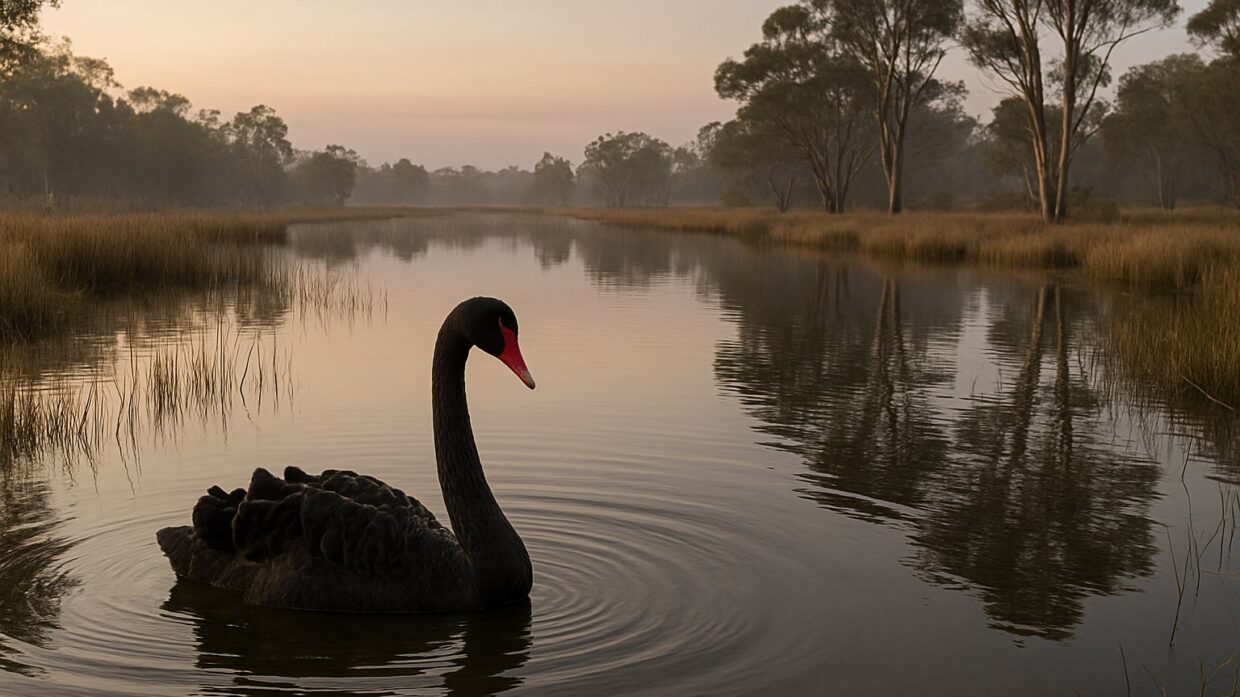
Photo: Well This Is News
Australia's iconic black swans face devastating H5N1 threat as bird flu spreads to mainland
First mainland mammal death from bird flu confirmed in Australia; wildlife monitoring underway
H5N1 bird flu reaches Australian mainland; Western Australia warns of black swan population risk
Key Takeaways
- Australia has no baseline data on what normal swan mortality looks like in any given year, making it impossible to distinguish between an actual outbreak and normal population fluctuations once the virus spreads.
- The virus's arrival in Australia was statistically predictable given H5N1's decades-long circulation in bird populations globally, but the reporting does not explain why it reached the mainland now or whether quarantine infrastructure failed.
- The critical question is not whether the virus arrived, but whether Australia's wildlife monitoring and response capacity can actually manage the mammalian transmission chains that a fur seal death might signal.
The Analysis
A fur seal found dead on mainland Australia has tested positive for H5N1 bird flu, and Western Australia is warning of potential significant mortality among black swan populations. What is being reported and what is being quietly omitted are two different stories about the same outbreak.
The documented facts are these: H5N1 has reached the Australian mainland. A mammal has died from it. Black swans, which are the state emblem of Western Australia, are considered an indicator species for the virus because they are highly visible and have historically low survival rates when exposed to novel pathogens. Experts quoted in The Guardian Environment piece use the phrase "significant mortality" when discussing potential impact on swan populations. The piece frames this as a "black swan moment," using the species name as a metaphor for an unforeseen catastrophic event.
The left framing emphasizes ecological vulnerability and the visibility of the threat. The Guardian Environment report uses language like "devastating" and "black swan moment," placing emphasis on what the virus could do to a flagship species. This framing foregrounds the precautionary principle: unknown risk to a visible population demands urgent attention. What this framing leaves out is any baseline comparison. The reporting does not establish what swan mortality rates look like in normal years, what causes typical die-offs, or whether the current monitoring infrastructure can actually detect and quantify the outbreak the way the language implies it will. The emphasis creates a sense of imminent ecological crisis without establishing a factual baseline against which to measure the actual impact when it arrives.
The right framing, insofar as it appears in the reporting, emphasizes that human transmission risk remains low and that monitoring is underway. This approach treats the event as a disease surveillance success: the system detected the arrival of the virus, documented it, and can now track its spread. What this framing underplays is the uncertainty about mammal-to-mammal transmission chains and what the presence in a fur seal signals about the virus's ability to move through non-avian species. A complete reading requires asking whether a seal death represents an epidemiological anomaly or the beginning of a broader mammalian infection pattern.
What neither side fully addresses is the specific epidemiological history that would make this prediction credible. H5N1 has been circulating in bird populations for decades. The reporting does not establish why this particular wave is reaching the Australian mainland now, what the regional introduction pathway was, or whether Australia's quarantine infrastructure failed or functioned as designed in allowing a virus that was always likely to arrive eventually. The framing treats the event as either a disaster in waiting or a manageable detection, but the underlying question is structural: how prepared is Australia's wildlife monitoring and response capacity, and what does this arrival signal about future zoonotic pathogen risk?
The real headline is that Australia is confirming what was always statistically likely: that H5N1 would eventually reach the mainland, and that when it did, authorities would detect it in wildlife before seeing human cases. Whether that represents failure or success depends on what happens next, not on what the virus's arrival alone establishes.
Australia's H5N1 detection reveals a critical gap in the country's wildlife disease surveillance infrastructure that will determine how future zoonotic outbreaks are contained. A mammal death on the mainland signals the virus has crossed a quarantine boundary previously treated as more secure than it actually was, forcing authorities to justify monitoring systems that may lack the capacity to track spread through non-avian species as quickly as the language of "significant mortality" suggests they can. The real test begins now: whether Australia can establish what baseline swan mortality looks like, confirm whether the fur seal represents an isolated event or the start of mammalian transmission chains, and demonstrate that detection capability translates to containment speed. If the system cannot answer these questions within weeks, Australia enters a scenario where visible wildlife die-offs will drive public panic independent of actual human transmission risk, while hidden mammalian infection pathways go untracked. The next H5N1 wave will arrive somewhere on the continent