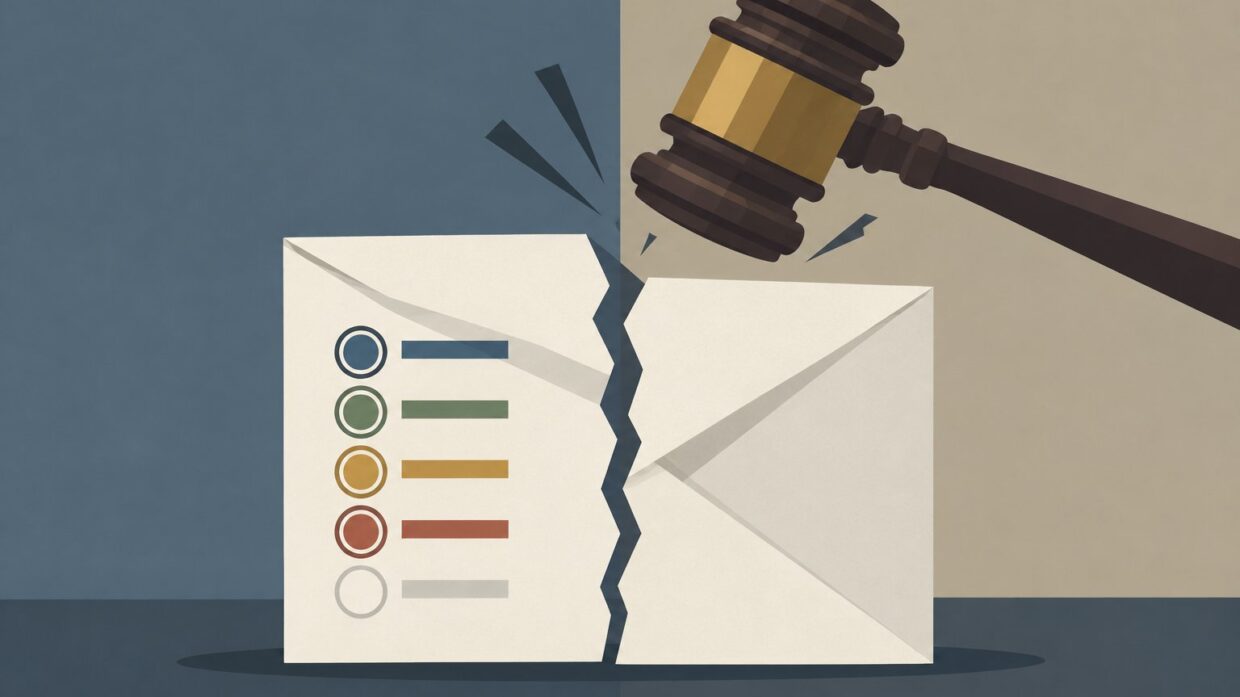
Photo: Well This Is News
Trump Attacks Ranked Choice Voting After Murkowski's Reelection, Orders DOJ Challenge
Trump Rips Alaska's 'Corrupt' Ranked Choice Voting System That Saved Murkowski
We haven't found a neutral take on this story yet.
Breaking stories sometimes publish before every side has covered them. We'd rather show you that than invent a view.
The Analysis
Trump's move to direct the Department of Justice to challenge Alaska's ranked choice voting system raises a specific and unusual question: a sitting president is ordering a federal lawsuit against a state election method that a Republican senator won under, not lost. What neither his supporters nor his critics are emphasizing is that ranked choice voting did not prevent a Republican from winning the seat. Murkowski, though at odds with Trump, is still a registered Republican. The framing hinges on whose Republican candidate should have won, not whether a Republican won the seat itself.
The facts: Murkowski defeated both Trump-endorsed Republican Kelly Tshibaka and Democrat Patricia Chesbro in Alaska's 2022 general election using the state's ranked choice voting system, which eliminated the candidate with the fewest first-choice votes and redistributed them in subsequent rounds. Tshibaka won the most first-choice votes but fell short in the final round when second and third-choice votes were counted. Trump has called the system corrupt and, in his recent statements captured by The Hill and the Washington Examiner, characterized Murkowski as Alaska's worst Republican senator.
The left frame emphasizes Trump's antidemocratic weaponization of federal power. Ranking choice voting, in this reading, is a legitimate electoral reform that expanded voter choice. The framing highlights Trump's use of executive authority to challenge an election outcome unfavorable to his preferred candidate and treats his DOJ directive as authoritarian overreach. What this frame leaves out is any acknowledgment that ranked choice voting is genuinely controversial among political scientists and election administrators, independent of Trump's complaint. The omission is strategic: acknowledging that criticism exists from non-Trump sources would require engaging with the system's actual design trade-offs rather than dismissing opposition as pure partisanship.
The right frame emphasizes Trump's legitimate complaint against an election system that produced a result at odds with Republican primary voters' stated preference. Trump's language, captured in both sources, describes the system as corrupt, not merely ineffective. The Washington Examiner reporting foregrounds his claim that ranked choice voting was the sole reason Murkowski won. What this frame leaves out is the counterfactual it cannot establish: whether Tshibaka would have actually won under Alaska's previous plurality voting system. First-choice votes favor Tshibaka, but plurality voting does not measure second and third preferences, making the comparison inferential. The right frame also does not address why a Republican senator winning the seat would constitute corruption of the electoral process itself.
What neither side fully engages with is the actual legal question Trump's DOJ directive raises: what federal constitutional grounds exist to challenge a state's election method after results are certified and already upheld by state courts? Alaska's ranked choice voting system has survived prior legal challenges. The framing from both sides treats this as a straightforward policy dispute, but Trump's directive to the DOJ appears to assume federal jurisdiction over state election procedures that do not violate the Voting Rights Act or constitutional equal protection standards. That unresolved tension is where the real institutional question lives.
A sitting president ordering the Justice Department to challenge a state election system that produced a Republican winner creates a novel constitutional crisis disguised as a policy complaint. Trump's directive assumes federal power to overturn certified state election results based on methodology objections, not voting rights violations or constitutional defects. If the DOJ proceeds, it will force courts to define the limits of federal authority over state electoral procedures for the first time in this context. The precedent established will determine whether future presidents can weaponize the Justice Department against any state election method their preferred candidates lose under, regardless of which party wins the seat. That institutional boundary, once crossed, does not reset.