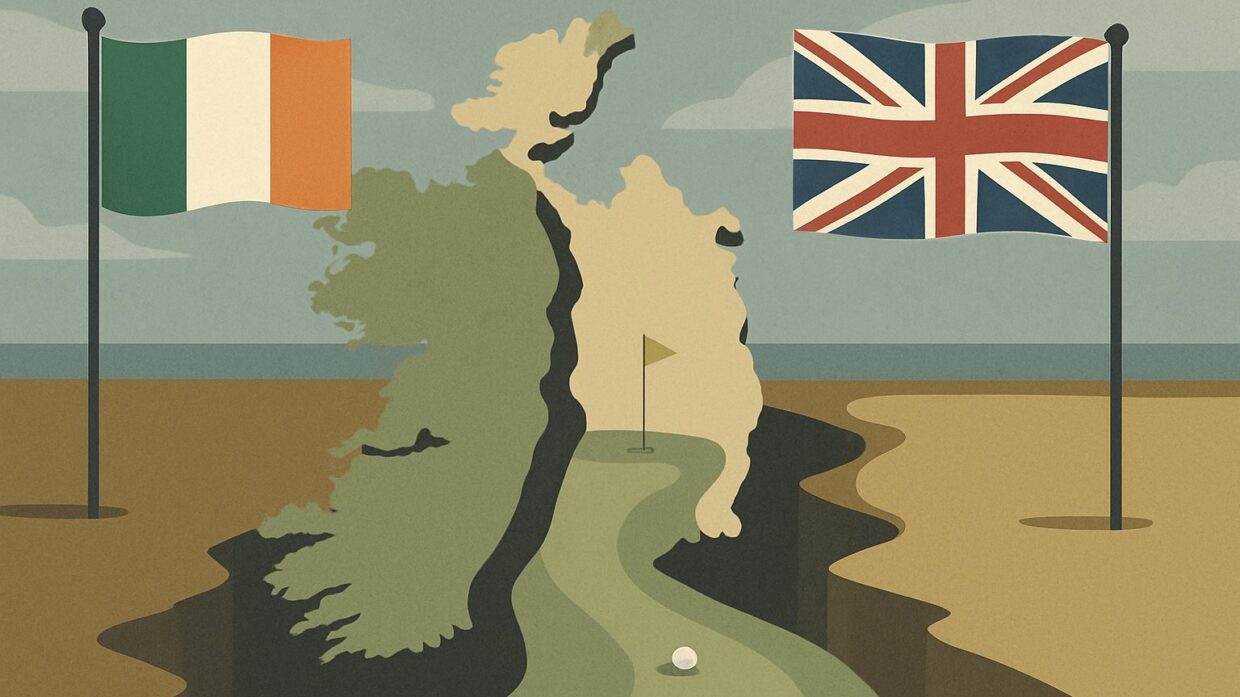
Photo: Well This Is News
Trump embraces Irish unity while meeting skeptical Irish leaders in Dublin
Trump voices support for unified Ireland, reigniting historical sovereignty debate
Trump calls for unified Ireland during Dublin visit, drawing UK pushback
Key Takeaways
- The Belfast Agreement of 1998 established a legal framework requiring concurrent referendums in both Irish jurisdictions before unification is possible, a constitutional reality that neither Trump's preference nor media coverage of it can alter.
- Irish President Connolly and Prime Minister Martin chose to downplay rather than amplify Trump's remarks despite the political opportunity to do so, a decision that raises questions about whether they view his statement as inconsequential rhetoric or as subordinate to managing US relations.
- Trump's diplomatic style prioritizes personal position-taking on international questions without advance coordination with the governments most affected, creating asymmetric outcomes where affected parties must manage the resulting complications rather than the US absorbing coordination costs.
The Analysis
Trump's statement that he would "love" to see Ireland unified arrived without diplomatic preparation or formal alignment with either Irish or UK government positions, creating a factual tension between what he said and how the governments most affected by it chose to respond. The record shows Trump spoke to the Irish political leadership during a scheduled visit centered primarily on attending a golf tournament at his family's resort in Doonbeg.
The documented facts establish the following sequence: Trump told reporters and Irish leaders he would support unification and suggested "it may as well happen now." Bloomberg reports that UK Prime Minister Andy Burnham had recently stated the issue was "off the table." Both Irish President Connolly and Prime Minister Micheál Martin downplayed the remarks rather than amplified them, a choice that itself carries political meaning. The Guardian noted in advance of the visit that Connolly had previously criticized Trump's policies, raising expectations of direct confrontation that did not materialize in the reported accounts of their meeting.
The left framing emphasizes Trump's alignment with Irish nationalist sentiment, using language like "embraces" and framing his comments as potentially supportive of the Irish position. This coverage leaves out the fact that Irish leadership did not embrace the comments themselves. The Guardian's live reporting of the meeting and NPR's coverage both note the downplaying of tensions by the Irish government. The narrative Trump-as-ally-to-Irish-sovereignty requires Irish political actors to have welcomed or amplified his remarks. They did not.
The right framing treats Trump's comment as an expression of his candid personal preference and frames it as reigniting a sovereignty debate. Fox News provides historical context (Irish independence in 1922, Northern Ireland's 1921 establishment as part of the UK) without noting the Belfast Agreement of 1998, which established the legal and constitutional framework currently governing North-South relations. That omission matters because it leaves out the institutional reason this is not simply a matter of what any single leader wants.
What neither framing adequately captures is the diplomatic asymmetry at work. Irish leadership chose not to make Trump's comment a centerpiece of the visit or a point of political leverage, despite the opportunity. They downplayed it. That suggests either that supporting Irish unification is less politically urgent than managing relations with a US president who controls significant economic and security interests, or that they assessed Trump's comment as empty rhetoric unlikely to influence actual policy. The record does not establish which interpretation is correct.
The Belfast Agreement of 1998, which neither left nor right coverage foregrounds, established that Irish unification is theoretically possible but only through a dual referendum in both jurisdictions held concurrently, and only if a majority in each votes to proceed. That framework has held for 26 years and reflects hard negotiation between Dublin, Belfast, and London. Trump's preference, however sincerely expressed, does not change the legal or political architecture. What this signals is that Trump's diplomatic style involves personal position-taking on longstanding international questions without apparent coordination with the parties involved. The question this raises is whether that approach serves US interests in maintaining relationships with both Ireland and the UK, or whether it reflects a calculation that rhetorical alignment costs nothing and generates favorable coverage domestically.
Trump's uncoordinated statement on Irish unification reveals a pattern that will shape US diplomacy across multiple allied relationships: the willingness to stake personal positions on settled international questions without institutional preparation. The Belfast Agreement framework, established in 1998 and affirmed by successive US administrations, structures any unification process through dual referenda requiring majorities in both jurisdictions. Trump's comment bypassed this entirely. Irish leadership's deliberate downplaying of his remarks, despite the domestic political opportunity they represented, signals their calculation that managing a transactional relationship with Washington matters more than leveraging presidential rhetoric. This creates an asymmetry where allied governments must now parse whether Trump's statements represent actual policy position or rhetorical positioning for domestic consumption, forcing them to invest diplomatic capital in clarification rather than substantive negotiation on their own priorities.