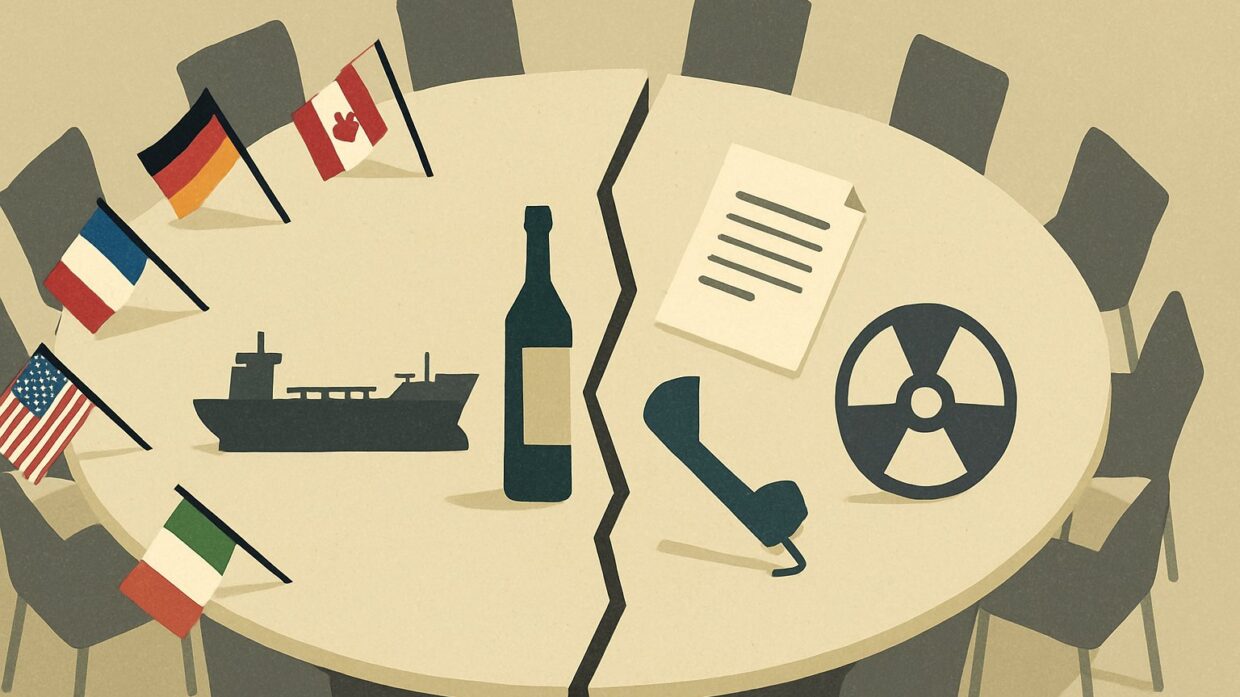
Photo: Well This Is News
Trump Faces Unified European Opposition at G7 Over Two Wars
Trump Confronts Divided West at G7 as New Iran Deal Reshapes Diplomacy
Trump Arrives at G7 Summit Amid Iran Deal, Trade Tensions With Europe
Key Takeaways
- Trump announced a preliminary unsigned Iran deal immediately before arriving at the G7, a sequencing choice that appears designed to limit allied input rather than seek it.
- The G7 is no longer a binding alliance where members follow U.S. leadership based on solidarity, but a loose coalition where each nation calculates support based on narrow national interest.
- Trump has real leverage on trade and Ukraine security commitments but not on Iran, where European nations have already signaled they will not follow if the preliminary agreement collapses.
The Analysis
Trump's arrival at the G7 summit in Evian on Monday represents a moment where three separate diplomatic crises collide, yet the media framing across outlets obscures what each side is actually omitting about his negotiating leverage and the structural vulnerabilities of the Western alliance.
What actually happened: Trump announced a preliminary agreement with Iran on Sunday that the U.S. says will open the Strait of Hormuz on Friday following a signing in Geneva. He then arrived in France on Monday and immediately faced pushback from Emmanuel Macron over tariffs, with Trump threatening 100 percent tariffs on French wine in response to France's digital tax. European G7 leaders have expressed skepticism about the Iran deal, viewing it as a unilateral U.S. action that bypassed allied input. The summit agenda includes discussion of AI regulation in the financial sector, Ukraine policy, and broader defense spending commitments.
The left frame, as presented by MSNBC, emphasizes that Trump's European allies are "at odds with him over two wars." That language choices matters: it positions Trump as isolated from consensus. The reporting foregrounds European opposition to both the Iran deal and Trump's stance on Ukraine, implying that Trump is acting contrary to allied preferences. What this framing does not foreground is that European leaders have spent months divided among themselves on Iran policy, with France and Germany pursuing separate diplomatic channels while Italy and Eastern European nations have taken harder lines. By framing this as allies unified against Trump, MSNBC obscures the pre-existing fractures that Trump's deal may have exploited rather than created.
The right frame, from The Daily Wire, characterizes Trump as confronting "a divided West" and presents the Iran deal as a reset of diplomatic initiative. That framing emphasizes Trump's agency and decisiveness. What the Daily Wire's approach leaves understated is that the Iran deal remains unsigned and its terms remain preliminary, meaning its actual enforceability is unestablished. The reporting also does not adequately address why Trump chose to announce this deal immediately before a G7 summit where allied nations would need to coordinate a response, a sequencing choice that appears designed to constrain allied input.
What neither side fully captures is the structural imbalance underlying this summit. Trump has leverage on trade, as demonstrated by his tariff threat to Macron, which Macron refused to capitulate to. Trump has leverage on Ukraine, where the U.S. remains the dominant security guarantor and European nations have expressed exhaustion with the financial and military commitment. What Trump appears to lack is leverage on the Iran question itself, where European nations have already signaled they will not follow a U.S. withdrawal from a preliminary agreement if it collapses. The real headline is not that Trump faces unified opposition or that he commands a divided coalition, but that the G7 is no longer a binding alliance on major questions. Each member is now calculating whether to follow U.S. leadership on specific issues based on narrowly defined national interest, not on alliance solidarity. The Iran deal announcement before the summit was not a show of strength but a signal of that reality.
Trump's Iran deal announcement immediately before the G7 summit exposes the alliance's fundamental fragmentation and forces European capitals into bilateral rather than collective calculations. The sequencing was deliberately designed to prevent allied input, yet it simultaneously revealed that Trump cannot enforce compliance on Iran policy the way he can on trade or security commitments. Europe's divided Iran positions, which MSNBC obscures and The Daily Wire understate, mean Trump has traded short-term negotiating initiative for confirmation that the G7 no longer functions as a coordinating body on major geopolitical questions. Future crises will proceed through bilateral leverage plays, not collective strategy, fundamentally altering how Western democracies respond to global threats.