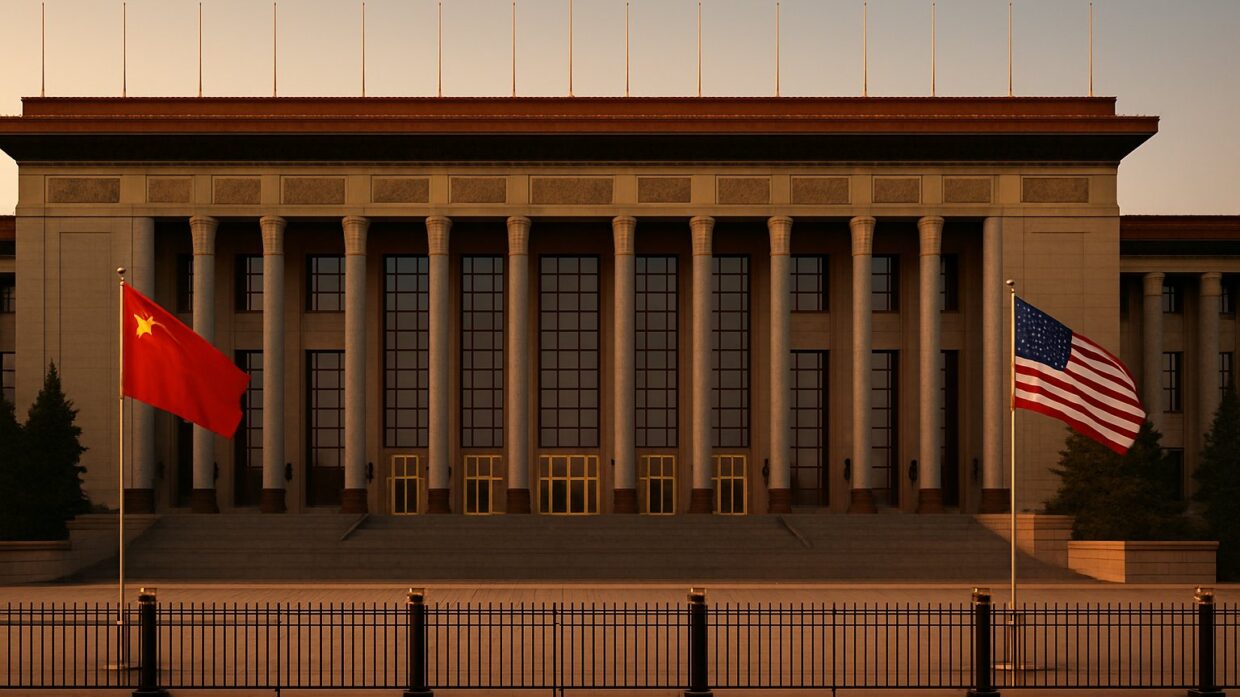
Photo: Well This Is News
Trump heads to China amid trade war while Iran conflict undermines US leverage
Trump brings US tech CEOs to China summit as Iran war tests diplomatic strategy
Trump arrives in Beijing for Xi summit as trade war, Iran conflict shape negotiations
Key Takeaways
- Trump is renegotiating a trade settlement that broke down from his first term, meaning he is returning to resolve issues he previously claimed victory over rather than advancing new gains.
- Historical precedent shows that when US presidents are militarily committed elsewhere, China interprets this as reduced leverage in Asia-Pacific diplomacy, a dynamic neither major news outlet directly acknowledged.
- The presence of tech CEOs at the summit could indicate either confidence in US dominance or an attempt to negotiate company-specific exemptions from chip restrictions, and interpreting which requires examining outcomes rather than rhetoric.
The Analysis
Trump is in Beijing for a summit with Xi Jinping, but what both cable news and right-wing outlets are conspicuously downplaying is that this meeting happens under the exact conditions that historically make Chinese negotiators dig in harder, not fold.
The verified facts first. Trump arrived in Beijing for a two-day summit with President Xi Jinping. He brought Nvidia co-founder Jensen Huang, Apple CEO Tim Cook, Tesla's Elon Musk, and Boeing's Kelly Ortberg as last-minute additions. Pre-summit trade talks occurred in Seoul between US Treasury Secretary Scott Bessent and China's Vice Premier He Lifeng. The ongoing Iran conflict is happening simultaneously. American soybean farmers are planting spring crops without clarity on whether China will resume bulk purchases.
MSNBC framed this as Trump heading to a "high-stakes summit" shadowed by "trade, Taiwan and Iran." Notice the language: shadowed. It suggests external complications to an otherwise normal diplomatic moment. The framing treats the Iran conflict as an unfortunate coincidence rather than a structural constraint on Trump's negotiating position. What MSNBC does not say: when a US president is militarily committed elsewhere, China historically interprets that as weakness in Asia-Pacific diplomacy. This is not speculation. This is how Beijing read the situation in 1973 when Nixon was withdrawing from Vietnam, and how it reads similar dynamics today.
The Daily Wire's version emphasizes Trump's "strategic" arrival with tech CEOs and frames this as Trump "reasserting US economic leverage." The headline is nearly identical to MSNBC's in naming Iran as a shadow factor, but the story's tone suggests Trump is in control, that bringing Jensen Huang sends a message about American technological dominance. What The Daily Wire does not examine: whether bringing Nvidia's CEO to a summit about chip restrictions actually signals confidence or desperation. If the US were winning on semiconductor restrictions, China would not be making exceptions. The presence of tech CEOs could equally suggest Trump is trying to negotiate exemptions for specific companies, which would be a concession.
Bloomberg's reporting is the only outlet that names the actual asymmetry: "Trump Faces Emboldened Xi in China as War Clips US Leverage." This is the headline both sides avoided. Emboldened is not the same as threatening. It means Xi has less reason to compromise because Trump's hand is demonstrably weaker. When you are managing a military conflict in Iran, you cannot credibly threaten economic decoupling from China. You need China's cooperation on sanctions enforcement, regional stability, and oil markets. Xi knows this. Trump arrived knowing this. Neither side is saying it directly.
The history being omitted: the 2018-2020 trade war tariffs remain in place. The original negotiated "Phase One" deal promised Chinese agricultural purchases that never fully materialized. Soybean farmers are now planting without knowing if those commitments will be honored. Trump is returning to negotiate what he claims he already won four years ago, which is itself an admission that the previous settlement broke down. The Iran conflict was not on anyone's calendar when pre-summit negotiations began. It materialized as a constraint on Trump's ability to make threats about additional economic pressure.
The real headline: Trump arrives in Beijing to re-negotiate a trade deal that already failed, while managing a simultaneous military commitment in the Middle East that weakens his leverage in Asia. That is not drama. That is arithmetic.
Trump's return to Beijing to renegotiate a trade agreement that collapsed under his previous administration signals that four years of tariffs failed to achieve their stated objective of forcing Chinese concessions. The simultaneous Iran conflict creates a structural negotiating disadvantage: a president cannot credibly threaten economic decoupling from China while depending on Beijing's cooperation on Middle East sanctions and regional stability. Soybean farmers planting spring crops without clarity on Chinese agricultural purchases face potential losses that expose the original deal's emptiness. Beijing historically exploits such divided US attention to extract maximum concessions rather than offer them. This meeting will establish whether Trump secured genuine gains in 2020 or merely postponed a reckoning that now returns under worse conditions. The presence of tech executives requesting exemptions from chip restrictions, not celebrating American dominance, tells the actual story about who holds leverage.