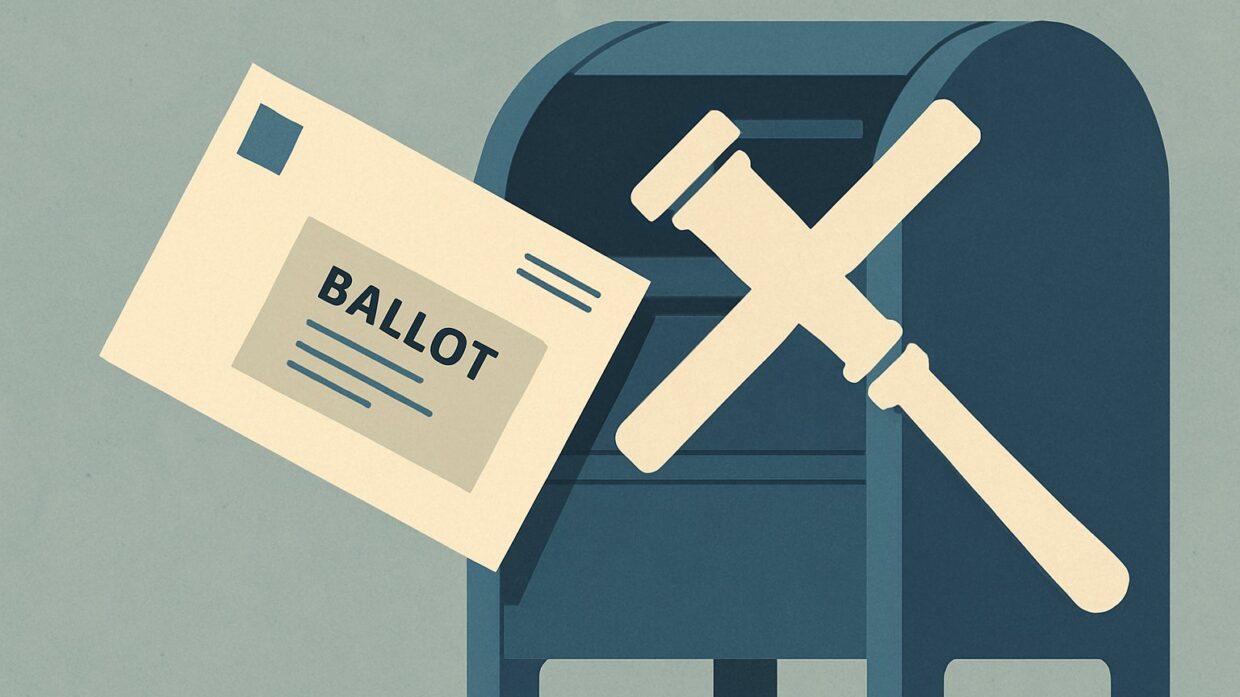
Photo: Well This Is News
Supreme Court rejects Trump's scheme to restrict mail-in voting
Supreme Court denies Trump's emergency request to enforce mail-ballot restrictions
Supreme Court blocks Trump mail-ballot rules from taking effect before midterms
Key Takeaways
- The Supreme Court made no ruling on whether Trump's mail-ballot rules are actually good policy or constitutional, only that emergency relief to bypass a lower court injunction weeks before an election was inappropriate.
- Courts across the ideological spectrum historically avoid overturning voting procedures close to Election Day, a principle that may have influenced all nine justices' decision to deny emergency relief regardless of their views on mail voting itself.
- The case remains alive in lower courts and could eventually reach the Supreme Court on the merits, where the conservative majority might reach a different conclusion than it did on this narrow emergency question.
The Analysis
The Supreme Court rejected the Trump administration's emergency bid to enforce new mail-ballot rules weeks before a national election, but what actually happened is more legally narrow than either side's framing suggests. The Court did not decide whether the rules themselves are legal or wise. It simply denied an emergency request to suspend a lower court injunction while the case continues through the courts.
The Trump administration issued new U.S. Postal Service regulations in late August that would have required all ballot envelope designs to receive pre-approval from postal officials and mandated that states upload voter identity information to a federal portal still under construction. A federal district court blocked the rules nationwide before they took effect. The Trump administration then asked the Supreme Court to overturn that block immediately, citing what it called ballot security and operational efficiency concerns. The Supreme Court's five conservative justices, three liberal justices, and Chief Justice Roberts (who sometimes breaks with the conservative bloc) all declined to grant emergency relief.
The left frames this as Trump attempting to suppress mail-in voting through a "scheme" designed to "disenfranchise" voters. Mother Jones used the phrase "steal the midterms," language that assumes intent and outcome rather than establishing them. NPR's reporting stayed closer to documented fact: Trump requested restrictions, the Court rejected the request. MSNBC and HuffPost focused on the specific mechanics of what the rules required, noting that pre-approval requirements and untested portal uploads would create implementation chaos close to Election Day. This framing is accurate about the likely operational consequence, even if it does not establish that chaos was the intended goal rather than an accepted side effect.
The right describes the decision as the Court denying an "emergency request" or keeping "brakes" on the plan. Fox News reported the outcome straightforwardly. The Washington Examiner added context that the Court "decided in the Trump administration's favor regarding mail-in ballot restrictions" according to some legal analysis, though this misrepresents what actually happened: the Court made no ruling on the merits. It simply refused to override a lower court's block while litigation proceeds. The Daily Wire's phrasing, "slams brakes," implies judicial skepticism, though the emergency denial itself does not signal how the justices view the underlying rules.
What neither side emphasizes is what the legal record actually shows: the Supreme Court declined to use emergency powers to overturn a lower court decision weeks before an election. This is procedurally conservative, regardless of the justices' private views on mail voting. Courts historically avoid disrupting voting procedures close to Election Day, a principle invoked by courts across the ideological spectrum in past cases. Whether that principle applied here remains unsettled because the Court made no substantive ruling.
The Trump administration's rules remain blocked through at least the midterms. The case continues in lower courts and may eventually reach the Supreme Court on the merits, where the ideological alignment might produce a different outcome. What the current decision actually establishes is narrow: emergency relief was not appropriate at this stage of litigation, in this timeline.
The Supreme Court's refusal to overturn the lower court injunction before the midterms does not resolve whether these mail-ballot rules are constitutional. The case will proceed through litigation, and when it reaches the Supreme Court on the merits with a 6-3 conservative majority, the outcome could reverse this emergency denial entirely. The practical consequence is that mail-voting procedures remain unchanged for this election cycle, but the underlying legal question about federal authority over ballot design and voter data collection remains open for future judicial resolution. This leaves the institutional stakes unclear: if the Court eventually upholds these rules in a full hearing, it could establish precedent that federal election officials can impose significant new requirements on state voting systems with minimal notice before Election Day.