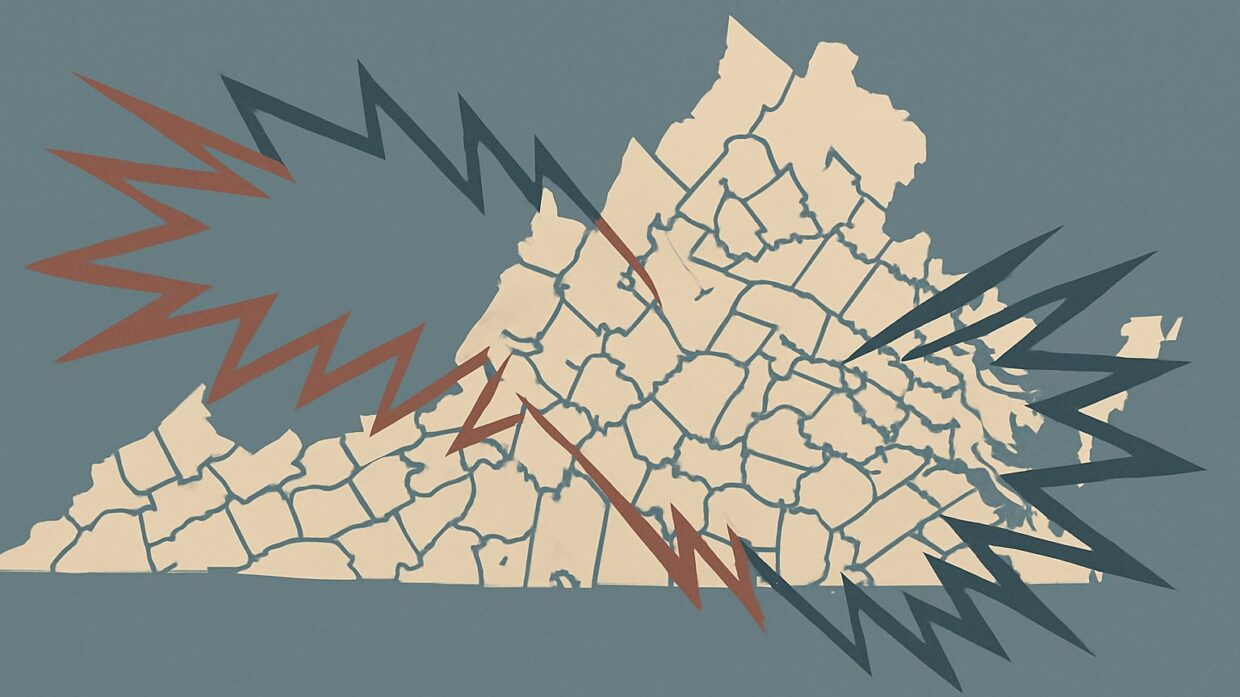
Photo: Well This Is News
Republicans Weaponize Gerrymandering Against Democratic Voters in Virginia
Virginia Democrats Cry Foul Over Fair Redistricting That Threatens Their Majority
Virginia Gerrymandering Fight Exposes Both Parties' Competing Claims About District Manipulation
Key Takeaways
- Both parties have completely reversed their positions on the Voting Rights Act and redistricting between 2011 and 2021, now demanding the opposite remedies depending on who holds power.
- Virginia's maps sometimes pack Black voters so densely into specific districts that it actually reduces overall Democratic representation, yet Democrats defend them as civil rights protections.
- Federal courts have already found violations of the Voting Rights Act in both Democratic and Republican-backed versions of Virginia's maps, suggesting neither side has clean hands.
- The core dispute is whether maps should reflect current voter preferences or protect incumbent parties, but both sides avoid this question by simply calling their opponent's approach gerrymandering.
The Analysis
Virginia's gerrymandering war is being fought with a crucial omission on both sides: neither party is willing to say aloud that they have already won and lost the exact same fight, simply with reversed roles. The National Review article titled "Virginia's Gerrymandering War" frames current redistricting efforts as Democrats protecting maps that they previously gerrymandered in their favor. That framing is accurate about one thing: the current maps were drawn by a Democratic-controlled legislature in 2011 and were designed to maximize Democratic seats. What National Review omits is that Virginia's maps were then redrawn by a Democratic-controlled commission in 2021 after the previous iteration was challenged, and those new maps still favored Democrats significantly. The word choice "fair redistricting" in the right's framing assumes the conclusion—that Republican-backed changes are inherently corrective rather than merely differently partisan.
The Atlantic's coverage, represented by its broader editorial stance on redistricting issues, leans heavily on the language of "suppression" and "dilution of representation." This language presumes that Democratic voters have a pre-political right to the representation they currently hold, and that any change reducing that representation is therefore illegitimate. But this framing obscures a basic fact: Virginia's population has shifted. Northern Virginia has grown more diverse and Democratic-leaning; rural Virginia has become more reliably Republican. The question of whether maps should reflect current voting preferences or protect incumbent parties is precisely the question both sides are avoiding by using the word "gerrymandering" for both their position and their opponent's.
Here is what neither side is saying directly: The Voting Rights Act of 1965 required states to maintain majority-minority districts in certain cases, which itself required drawing maps with explicit racial and partisan intent—a form of gerrymandering in service of civil rights remedies. Virginia's 2011 maps were designed partly to satisfy those requirements. By 2020, demographics had shifted enough that some of those districts no longer needed the explicit protections originally mandated. This created a genuine policy puzzle: should states redraw districts to match current demographics even if that reduces representation for historically marginalized groups? Both parties have inverted their positions depending on whether they benefit. Republicans demanded stricter compliance with the VRA in 2011 to block Democratic maps; Democrats demanded exactly that same compliance in 2021 to block Republican maps.
The National Review omits that Virginia's Republican-backed redistricting efforts have also been challenged in court and that federal judges have already found some current maps to violate the VRA. The Atlantic omits that the current Democratic-drawn maps sometimes pack Black voters into districts so heavily that it effectively wastes Democratic votes in surrounding districts—a technique that can reduce overall Democratic representation even as it guarantees specific seats. Both sides use identical language—gerrymandering—to describe opposite actions, which makes it functionally impossible for readers to understand what is actually being disputed.
The real headline: Virginia's redistricting is a genuine test case for whether democracy should mean majority rule by current voters or incumbent protection by previous majorities, and both parties have switched which answer they prefer depending on whether they hold power.
Gerrymandering debates that ignore how both parties have switched positions based on power reveal that the real dispute is over whether democracy should serve current voters or protect previous electoral majorities—a question neither side will answer honestly.