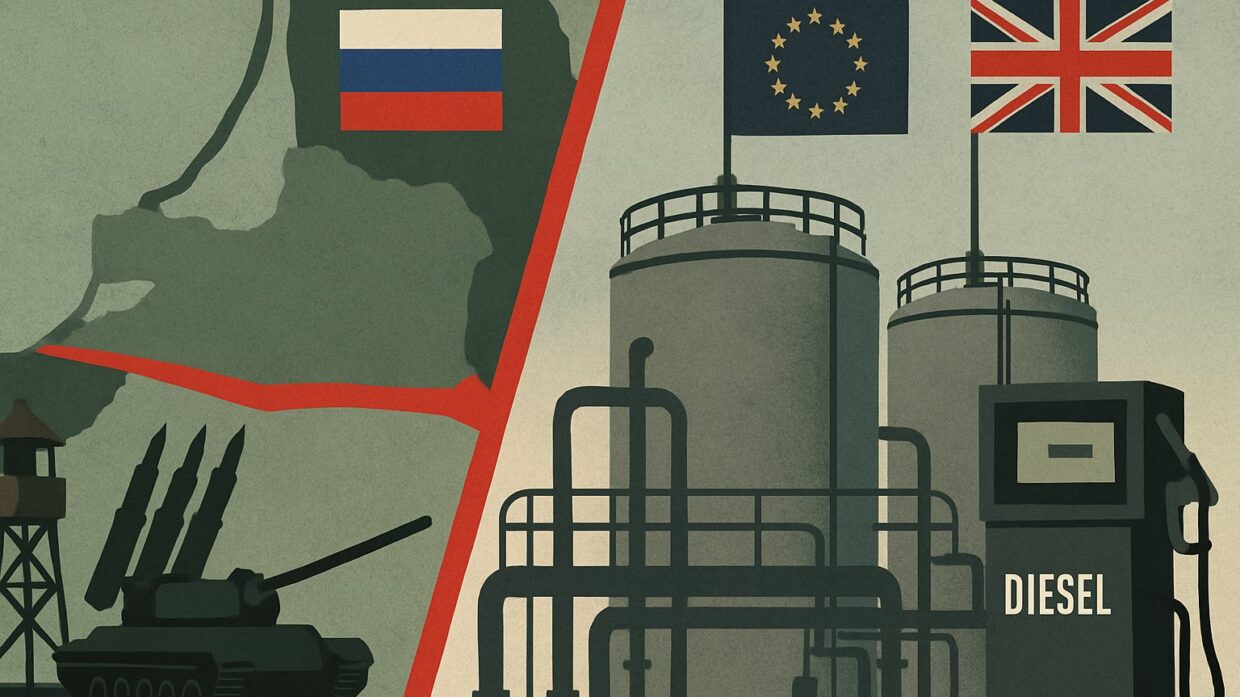
Photo: Well This Is News
Putin escalates nuclear threats as Britain scrambles to secure fuel supplies away from Trump
Putin threatens all-out response to Kaliningrad attack; Western allies move to shield energy independence
Putin warns of full arsenal use if Russia attacked; Britain seeks EU diesel reserves amid Trump supply concerns
Key Takeaways
- Putin's Kaliningrad warning and Britain's emergency diesel talks occurred on the same timeline but respond to entirely different triggering events, with Putin responding to NATO military concerns and Britain reacting to Trump's threatened fuel export restrictions.
- The underlying driver of both developments is doubt about American commitment to its allies rather than a unified Western response to Russian aggression, as Britain now seeks EU alternatives for energy security that the US previously guaranteed.
- Putin appears to be deliberately raising the perceived cost of NATO involvement in Ukraine or the Baltics at the precise moment when European nations are discovering they cannot rely on US economic support, potentially allowing him to exploit divisions within the alliance.
The Analysis
Putin's statement that Russia would deploy its full military arsenal in response to an attack on Russian territory, including Kaliningrad, coincided with Britain's emergency coordination with EU partners to access diesel stockpiles. The timing creates a surface narrative of crisis on two fronts, but the stories operate on entirely different timelines and causation chains that the available reporting does not connect.
Putin's statement was framed as a warning to any nation considering a direct military attack on Russia proper. Bloomberg reports the warning was "reiterating" messages from Russia's Foreign Ministry and embassies earlier in the week, meaning the escalatory language was deliberate and repeated. The specific mention of Kaliningrad, a Russian enclave surrounded by NATO territory in the Baltic, signals a strategic vulnerability Moscow perceives. Putin used the phrase "all weapons at our country's disposal," which the left interprets as nuclear threat signaling and the right reads as a legitimate deterrent declaration. Neither framing engages what remains publicly unclear: whether this represents a tactical shift in Russian military doctrine or rhetorical amplification of existing policy.
Britain's diesel negotiations are a separate calculation. According to The Guardian, ministers held calls with EU counterparts after Trump threatened to cut off US fuel supplies. The EU Commission, France, Italy, Ireland, and Britain were coordinating on whether to release emergency strategic reserves. This is not a response to Putin's statement. It is a response to Trump's stated energy policy. The Guardian's framing emphasizes Britain's vulnerability to US supply disruption and the desperation implied by tapping emergency reserves. Bloomberg's parallel coverage foregrounds Russian military threats without connecting the fuel story, leaving readers with two disconnected crises rather than an integrated picture.
What neither outlet foregrounds is that these events reveal a structural shift in Western energy dependency calculations that predates this week's statements. Britain and EU allies have strategic diesel reserves precisely because energy security has been politically contested since Russia's 2022 invasion of Ukraine. Trump's threat to restrict US energy supplies to NATO allies represents a fracture within the Western alliance itself, not a unified response to Russian aggression. The fact that Britain must now coordinate emergency measures with European partners over a fuel supply that was previously assured by the US suggests a fundamental realignment of assumptions about allied commitment.
Putin's escalatory language serves a defensive signaling function in this context. By amplifying warnings about Kaliningrad, he may be attempting to raise the perceived cost of NATO military involvement in Ukraine or the Baltics, knowing that the US alliance is now in question. Britain's diesel talks reflect the inverse calculation: that European allies can no longer assume US supply reliability and must build independent capacity. These are not two separate crises. They are two manifestations of the same underlying condition: the assumption that the US-led security and energy architecture would hold has collapsed.
The public record does not establish whether Trump's energy threats and Putin's military warnings were coordinated or coincidental. What the sequence does establish is that both moves exploit the same fracture: the doubt now embedded in European calculations about American commitment. Britain seeking EU alternatives to US diesel supplies, and Putin testing NATO's cohesion with Kaliningrad threats, are rational responses to the same destabilizing variable. Neither the left nor the right framing captures that this is not about what Putin did or what Trump said in isolation. It is about what happens when alliance assumptions reverse simultaneously.
Britain's emergency coordination with EU partners on diesel reserves signals that Western Europe is now operationalizing contingency plans for American energy unreliability, a shift that reshapes NATO's logistics and industrial capacity planning for decades. When allies must construct independent fuel supply chains because the hegemon's commitment has become uncertain, procurement timelines lengthen, costs rise, and European defense manufacturing becomes less dependent on just-in-time US supply assumptions. This is not temporary crisis management. The diesel talks represent institutional acceptance that the post-Cold War security architecture, which relied on assured American energy partnership, has fractured. Putin's simultaneous escalation over Kaliningrad exploits precisely this fracture by testing whether European nations now lack unified backing. The consequence is not this week's negotiations but the permanent recalibration of European strategic autonomy,forced not by Russian pressure but by the collapse of assumptions about allied commitment that have organized Western defense economics since 1990.