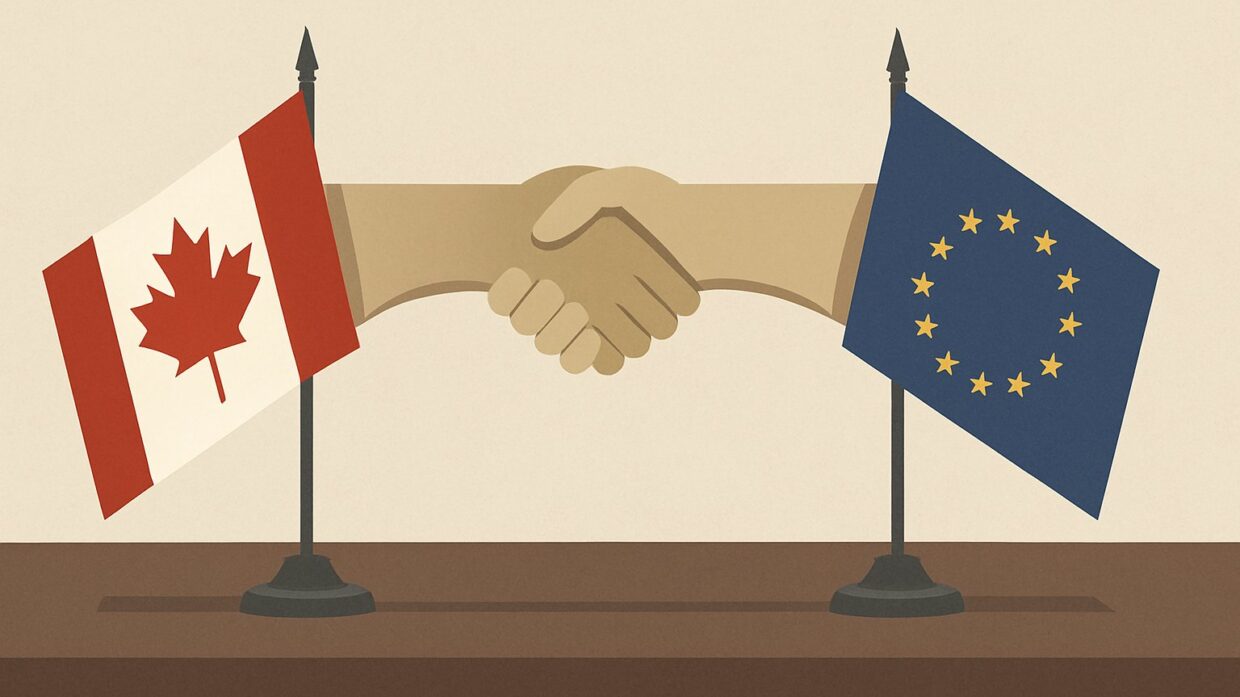
Photo: Well This Is News
EU extends hand to Canada as Trump's tariffs fracture Western alliance
EU seeks closer ties with Canada in bid to counter U.S. influence
EU proposes Canada as first associate member amid U.S. trade tensions
Key Takeaways
- Associate member status does not yet exist in EU law, meaning Von der Leyen's proposal signals political intent but offers no concrete institutional mechanism or timeline for implementation.
- No Canadian officials have been quoted accepting, negotiating, or even responding to the proposal, suggesting either private pre-negotiation or a public announcement made without prior consultation with Ottawa.
- The proposal sits between two possible interpretations: either the EU intends serious structural reform to create new membership categories, or it is primarily a political gesture meant to reassure an ally without committing to institutional change.
The Analysis
Von der Leyen proposed Canada become the EU's first associate member on Wednesday, a status that does not yet exist within EU institutional architecture. What neither the left nor the right reporting adequately explains is that this proposal represents not a response to Trump's tariffs alone, but a structural reorientation of how Europe intends to manage relationships beyond its current 27-member structure.
The documented facts establish that Trump's tariff policies, announced separately and targeting both Canada and EU members, created the immediate political context for the proposal. NPR reported that the proposal came as "U.S. President Donald Trump's tariffs drive Ottawa closer to Europe." Washington Examiner framed it as Europe's effort to "strengthen ties between the two as relations with the United States sour." Both are accurate in attributing timing to trade tensions. Bloomberg reported the proposal more clinically: "forging a novel transatlantic alliance as President Donald Trump tears apart the old one."
The left frame emphasizes rupture and Europe's principled response. NPR's language about "striking overture" and "alliance" implies Europe is rescuing a relationship Trump has damaged. The Guardian's coverage, embedded in live updates about Kosovo war crimes sentencing, positions the Canada proposal within a broader narrative of Europe asserting independent authority against external pressure. This framing leaves out the fact that associate member status remains undefined. No existing treaties govern it. No formal process for implementation has been detailed. The left reporting treats it as a tangible alliance move when the institutional mechanism does not yet exist.
The right frame treats the proposal as strategic competition. Washington Examiner emphasizes Europe's effort to "strengthen ties" and reduce dependence on U.S. leadership, positioning this as Europe's counter-move in a geopolitical contest. This framing is accurate about Europe's incentive structure but underplays that the proposal may also reflect genuine uncertainty about Trump's transatlantic commitments. The right reporting suggests Europe is making a calculated power play, which may be true, but does not establish whether this reflects confidence in a European-Canadian alternative or anxiety about the stability of existing arrangements.
What neither side foregrounds is that associate member status would require rewriting EU law. The EU operates through treaties that establish specific categories of membership. Associate membership exists in some regional structures, but not within the EU framework. Von der Leyen's proposal thus signals intent without specifying mechanism. Bloomberg's video summarized the concept but not the legal obstacles. This gap between proposal and implementation matters because it indicates either that the EU intends to move quickly through structural reform or that this is primarily a political gesture designed to signal alignment without committing to institutional change.
Canada's specific position in this arrangement remains unaddressed in the available reporting. No source quotes Canadian officials accepting, questioning, or negotiating the proposal. This suggests either that negotiations occurred privately before the public announcement or that the proposal was unveiled without prior consultation. Either possibility carries different implications for how serious the commitment is.
The underlying question is whether the EU is building permanent alternative structures or making a temporary political statement to reassure an ally facing U.S. pressure.
Associate member status would require the EU to fundamentally restructure its treaty architecture, yet neither the proposal nor reporting specifies the legal mechanism for implementation. This gap reveals whether Von der Leyen intends a genuine institutional overhaul or a political gesture to signal alignment without binding commitment. If pursued seriously, rewriting EU membership categories could establish precedent for other non-member states seeking formal integration, fundamentally altering how Europe manages its external relationships. If abandoned or delayed, it signals the EU cannot move decisively on structural reform under pressure, weakening its credibility in future negotiations with both Canada and other potential partners questioning Europe's ability to deliver on commitments.