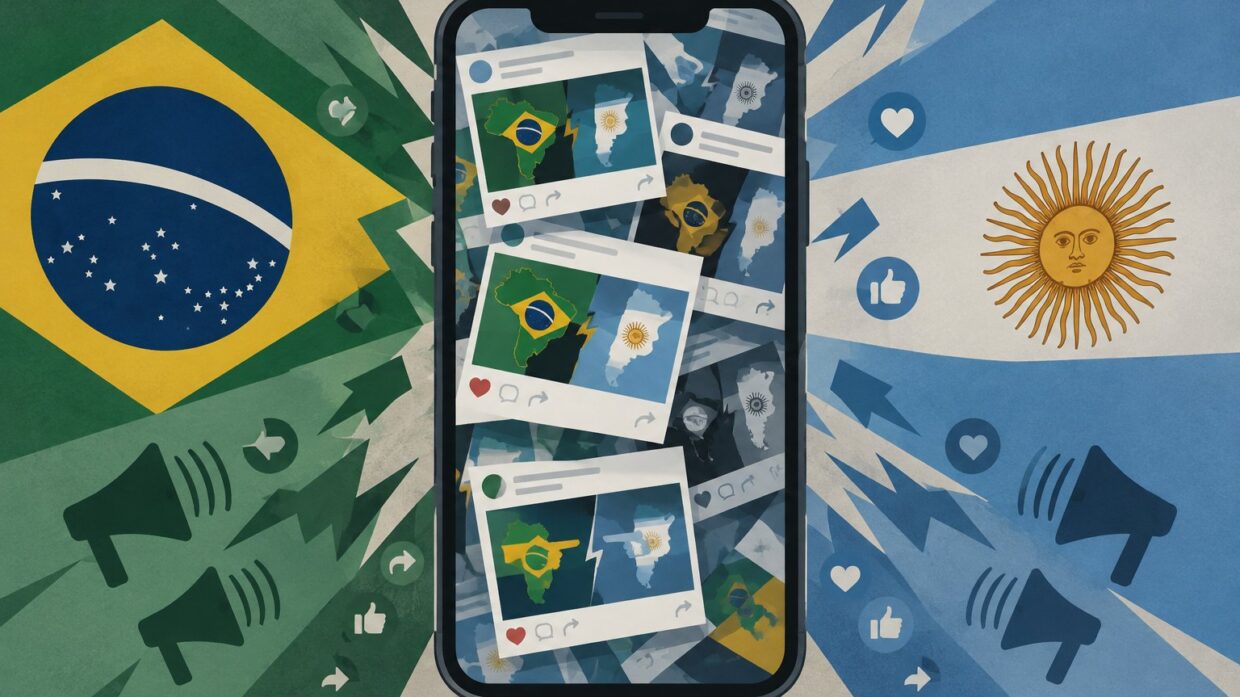
Photo: Well This Is News
Flavio Bolsonaro's Debate 'Corrupto' Jab Becomes Viral Mockery Ahead of Brazil Runoff
We haven't found a right-leaning take on this story yet.
Breaking stories sometimes publish before every side has covered them. We'd rather show you that than invent a view.
Brazil Election: Bolsonaro Ally's Attack Ad Backfires as Meme; Argentine Leader Accused of Interference
Key Takeaways
- No polling data was published showing whether the viral meme moment actually changed any voters' minds or merely entertained social media users who were already opposed to Bolsonaro.
- Brazil's government formally accused Milei of interference without disclosing whether he was solicited to comment, had prior positions on Brazilian elections, or violated any established diplomatic agreements.
- The two episodes received asymmetrical treatment: Bolsonaro's gaffe was analyzed as campaign incompetence while Milei's statement was elevated to state-level interference, despite neither outcome being measured against actual electoral impact.
The Analysis
Brazil's presidential runoff has collided with two distinct episodes of message discipline failure, one domestic and one international, that reveal different fractures in how political actors attempt to control narrative in a heavily mediated environment.
On October 20, 2026, Flavio Bolsonaro, the far-right candidate, deployed a single word during a televised debate: 'corrupto,' directed at his opponent. The Guardian's reporting documents that the phrase became the subject of widespread social media parody rather than functioning as a political weapon. What the available coverage does not establish is whether this was an isolated debate moment or part of a sustained messaging strategy. The reportage frames the outcome as backfire but does not disclose the pre-debate polling or post-debate polling to establish what actual impact, if any, the moment had on voter behavior.
Simultaneously, Argentine President Javier Milei commented publicly that Brazil's election opponent Luiz Inácio Lula da Silva 'may try to steal the election.' Bloomberg reports that Brazil's government formally accused Milei of attempting to interfere in Brazilian electoral sovereignty as a result. This framing raises an unaddressed question: whether Milei's statement constitutes election interference under any international standard or whether it constitutes a foreign leader's public commentary on political risk. Bloomberg does not report whether Milei was invited to comment, whether he held any stated position on Brazil's electoral integrity before this moment, or what diplomatic channels Brazil used to lodge its complaint.
The left-leaning framing emphasizes the Bolsonaro meme as evidence of campaign incompetence or the public's rejection of far-right messaging. The Guardian's reporting does not contextualize what audience the 'corrupto' attack was aimed at or whether viral mockery among social media users reflects broader electoral sentiment. The right-wing frame is not substantially represented in the available source material.
What neither side foregrounds is the asymmetry in what each episode suggests about electoral communication in 2026 Brazil. Bolsonaro's phrase became a meme because social media users could weaponize it against him, suggesting his message lacked control in a distributed information environment. Milei's statement, by contrast, was reported as a discrete claim and treated as state-level interference, suggesting his words carried weight precisely because they could be attributed to a foreign government. One was treated as a gaffe; the other as diplomacy. The available reporting does not establish why the two episodes warrant different analytical weight or whether Brazil's government complaint had any documented basis in prior agreements about cross-border campaign conduct.
The underlying question is whether these moments indicate genuine vulnerabilities in the campaigns involved or whether they reflect normal noise in a closely contested election where both sides are searching for advantage in the final days. The reporting establishes what happened but does not establish what changed.
Brazil's election runoff has exposed a critical vulnerability in modern campaign infrastructure: the inability to maintain message discipline across simultaneously operating communication channels. Bolsonaro's "corrupto" attack became a meme precisely because social media users can now weaponize political speech faster than campaigns can control it, while Milei's foreign commentary triggered a formal diplomatic complaint that elevated his words to state-level interference. The asymmetry matters because it reveals that Brazilian electoral actors face different costs for the same type of speech depending on their institutional position. If Milei's statement genuinely constitutes election interference under Brazilian or international law, the country has established a precedent for treating foreign political commentary as a diplomacy violation rather than protected speech. If it does not, Brazil's government complaint signals that election officials will use diplomatic channels to punish unfavorable foreign commentary, potentially chilling legitimate cross-border political discourse. Either interpretation restructures what Brazilian campaigns can expect from neighboring governments in future elections