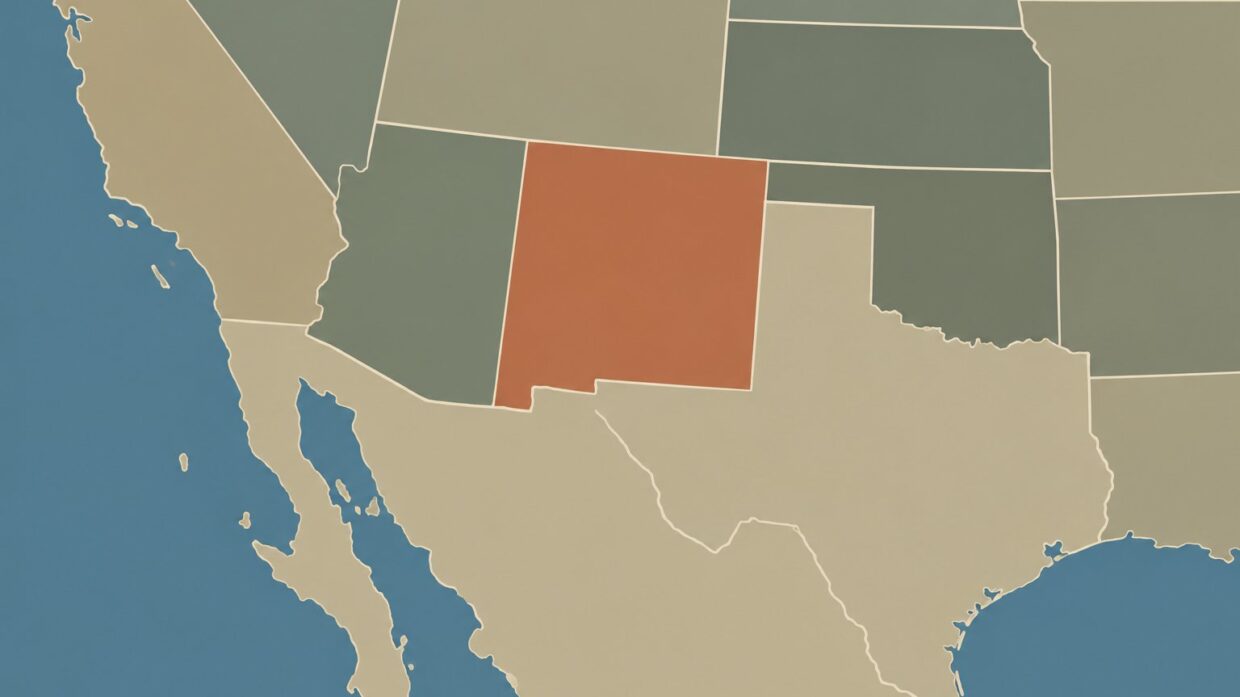
Photo: Well This Is News
Trump Again Demands New Mexico Change Name to New America
Trump Renews Push to Rename New Mexico 'New America,' Touts Economic Benefits
Trump Renews Call for New Mexico to Rename Itself 'New America'
Key Takeaways
- Renaming a U.S. state requires that state's legislative approval and likely voter consent, meaning Trump lacks the executive authority to implement this change unilaterally.
- No New Mexico state official from either party has expressed support for renaming the state, and no legislative action has been initiated to pursue the proposal.
- Trump's proposal functions as presidential rhetoric rather than actionable policy, with neither major news outlet examining the actual constitutional or procedural barriers to implementation.
The Analysis
Trump posted on Truth Social calling for New Mexico to change its official name to 'New America,' marking the latest instance of what appears to be a sustained focus on removing 'Mexico' from U.S. geographic nomenclature. The Hill reports that Trump framed this demand explicitly: 'New Mexico should immediately change its name to New America. We are not Mexico, we are the United States of America.' This follows Trump's prior decisions to rename the Gulf of Mexico and Lake Ontario, establishing a pattern across multiple geographic features.
The factual record is straightforward. Trump made the statement on Truth Social. New Mexico's official name has been 'State of New Mexico' since 1912, when it was admitted to the Union. The state's name derives from the colonial Spanish designation 'Nuevo México,' applied to the territory in the 16th century to distinguish it from Mexico proper. No legislative action has been initiated in New Mexico to alter the state's name, and no state official has indicated receptiveness to the proposal. The federal government lacks direct authority to rename a state without that state's consent.
The left frame, represented by Mother Jones, emphasizes Trump's 'fixation' and 'burning desire' to accomplish this rebranding. The language choices are interpretive: 'fixation' and 'burning desire' characterize the proposal as obsessive rather than policy-driven. Mother Jones leaves out any explanation for Trump's rationale or any acknowledgment that Trump provided one. The coverage focuses on the repetition of the demand as evidence of its oddness rather than engaging with the stated reasoning.
The right frame, represented by Fox News, emphasizes Trump's economic argument. Fox News reports that Trump claimed the change 'would boost home values and incomes' and notes that Trump 'took a swipe at state elections.' This framing presents the renaming as a policy proposal with asserted benefits rather than as a symbolic gesture. Fox News does not examine whether the economic claims are supported by evidence or precedent, and does not engage with the practical obstacles to implementation.
What neither side foregrounds is the constitutional and practical reality: a U.S. state cannot be renamed without that state's legislative consent. New Mexico's state government would need to pass legislation and likely hold a referendum to effect such a change. No New Mexico official, Republican or Democrat, has signaled support for the proposal. The coverage treats Trump's demand as newsworthy speech rather than examining the actual mechanism by which it could occur, which suggests it cannot.
The naming itself carries historical weight. 'New Mexico' was applied by Spanish colonizers in the 1590s and has persisted through Mexican independence, the Mexican-American War, U.S. territorial acquisition, and statehood. The name is embedded in state law, federal law, interstate commerce, and decades of institutional practice. Changing it would require not only state legislative action but amendments to federal law and regulation across multiple agencies.
What the reporting does not establish is whether Trump made this proposal as a policy objective, as a rhetorical flourish, or as part of a broader messaging strategy about American identity. The absence of follow-up reporting from either source on state officials' responses or legislative feasibility suggests the proposal operates in the realm of presidential rhetoric rather than policy development. A reader exposed only to these headlines might not understand that renaming a state falls outside executive power.
Trump's demand to rename New Mexico exposes the gap between presidential rhetoric and constitutional authority. A state cannot be renamed without its own legislative consent, yet neither left nor right coverage foregrounded this elementary constraint. New Mexico's government, bipartisan in composition, has shown zero receptiveness to the proposal. The naming itself is embedded across federal law, interstate commerce systems, and institutional infrastructure spanning four centuries. What matters is not the proposal's odds of success (effectively zero) but the press's failure to clarify what power actually exists here. When media treats an impossible demand as equivalent news regardless of feasibility, it normalizes the conflation of speech with policy, leaving voters uncertain about what a president can actually do versus what he can only say.