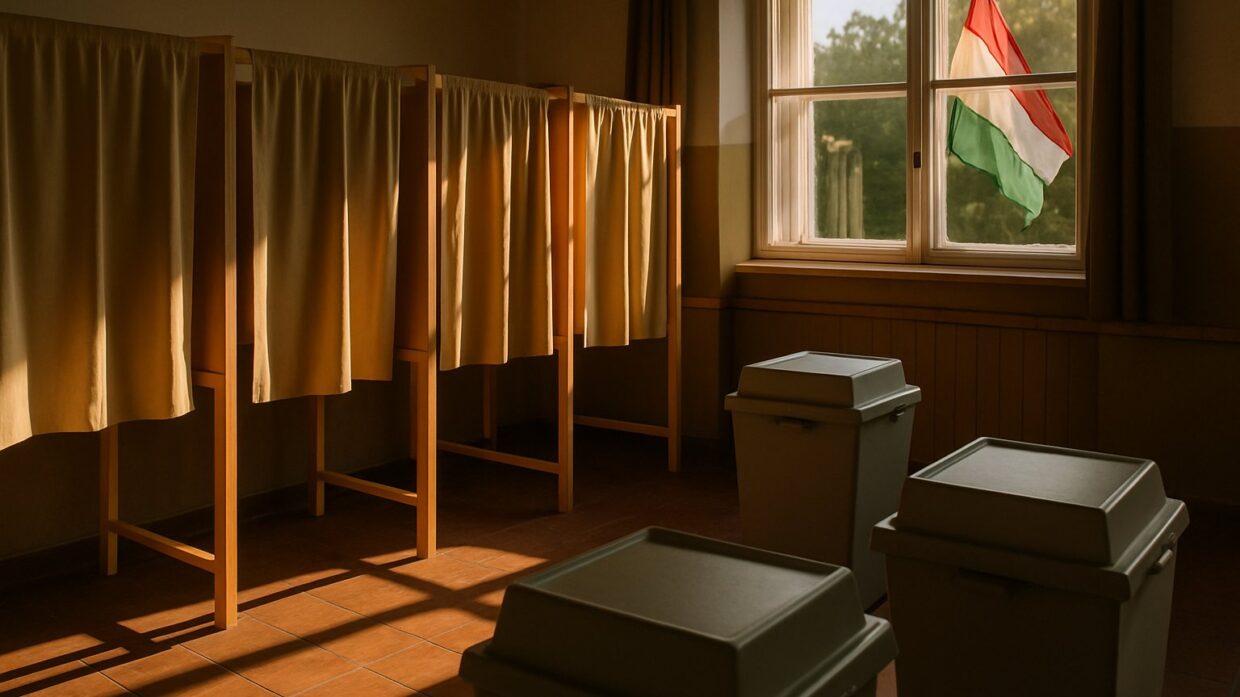
Photo: AI-generated
Hungarian voters reject Orbán's authoritarian rule in historic election
Hungary's election tests populist governance as voters weigh economic security
Hungary votes in record turnout election that could unseat Orbán after 16 years
The Analysis
Hungary's Sunday election is being framed across the political spectrum as either a democratic reckoning or a test of nationalist governance, but both versions omit the specific structural advantages Orbán has built into the system that make a genuine power transfer far more complicated than headlines suggest.
The verified facts: Hungarians voted Sunday in record numbers in what the Central Electoral Commission confirmed as the highest turnout for a Hungarian parliamentary election since the 1998 transition. Péter Magyar's Tisza Party led pre-election polling for the first time, with independent surveys showing Orbán's Fidesz Party trailing by margins between 3 and 8 percentage points. Orbán has served as Prime Minister for 16 consecutive years since 2010, after an earlier term from 1998-2002. The election occurred amid ongoing tension between Budapest and Brussels over judicial independence, media ownership concentration, and EU fund withholding.
The Guardian and NPR frame this as a potential "end to Orbán's rule" and describe his governance as "authoritarian," using language that positions the election as a democratic correction. This framing emphasizes Orbán's attacks on press freedom—citing specific restrictions on media licensing and the concentration of outlets under pro-government owners—and his conflicts with the European Court of Justice. But this narrative elides Orbán's consistent electoral victories under these same rules: he has won four consecutive general elections by substantial margins, not through fraud but through legal systems he rewrote. The left's framing treats institutions as static; it doesn't explain why Hungarian voters have repeatedly chosen him despite—or perhaps because of—his governance model.
The Washington Examiner and right-aligned outlets describe the election as testing "populist governance" and emphasize Orbán's economic performance and his alignment with Trump and Putin. This framing avoids specificity about what that alignment means: Hungary is a NATO member that has blocked weapons shipments to Ukraine and a EU member that has obstructed sanctions against Russia. The right's framing also sidesteps the institutional question entirely—if Orbán's policies are so popular, why have polling leads shifted so dramatically in Magyar's direction?
What both sides omit: Hungary's electoral system is not neutral territory. Orbán's government redrew district boundaries in 2011 and again in 2022 in ways that benefit Fidesz mathematically even when Fidesz wins fewer votes. The system mixes proportional and single-mandate districts in a configuration that, according to the OSCE's 2022 election analysis, "favours larger, more established parties." Even if Magyar's Tisza Party wins the popular vote by the margins shown in recent polls, the actual seat count may not reflect that. Additionally, Orbán controls public media, which accounts for roughly 40% of Hungarian television viewing; independent analysis from Reporters Without Borders documented heavy anti-Magyar coverage in the weeks before the vote.
The real headline neither side articulates clearly: Hungarians are voting for change within a system structurally designed to resist it. A Magyar victory would require not just defeating Orbán at the ballot but immediately confronting whether coalition arithmetic and electoral geometry will allow it. The deeper question—whether democratic institutions can be meaningfully restored after 16 years of systematic rewriting—remains unanswered by either political side.