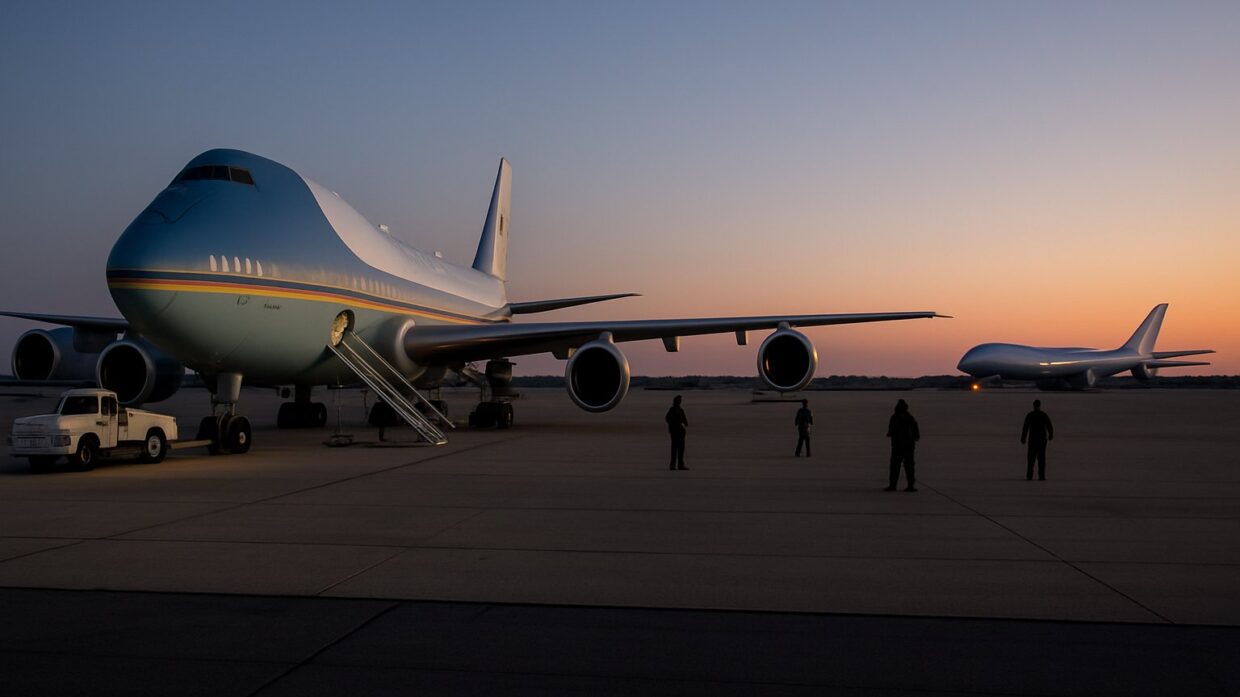
Photo: Well This Is News
Trump abandons Qatari-gifted jet for older Air Force One, raising questions about aircraft security
Trump flies older Air Force One to allow troops to tour new aircraft at UK base
Trump switches aircraft mid-trip, cites security concerns over Iran threat to new Air Force One
Key Takeaways
- Trump made no public statement about Iran security threats to the aircraft and supplied no advance notice that he would switch planes, leaving both the threat claim and the troop morale explanation unverified.
- Trump's declaration that the Iran ceasefire was 'over' during the NATO summit drove oil prices upward and marked a material policy reversal that neither side adequately connected to the aircraft switch.
- The aircraft switch became a distraction from Trump's more significant announcement about Iran hostilities, which has direct consequences for regional stability and energy markets regardless of why he changed planes.
The Analysis
Trump switched aircraft during his return from the NATO summit in Turkey, boarding the older Air Force One to England rather than continuing on the new aircraft he had used to reach the summit. The Guardian reported the switch as unexpected; Fox News attributed it to Trump's decision to position the new plane at Mildenhall Air Force Base for troops to tour; PBS NewsHour documented that Trump did not refute suggestions Iran posed a security threat to the new aircraft. The sequence reveals a gap between the stated rationale and the available evidence.
The left frame emphasizes the unexpectedness of the pivot and the security vulnerability it implies about the new aircraft. The Guardian's language, "unexpectedly changed plans," casts the decision as reactive rather than planned. This framing invites readers to question whether Trump had discovered a problem with the new plane or was responding to a credible threat. The narrative leaves out whether switching aircraft mid-journey is operationally standard, whether security threats to presidential aircraft are routinely managed by aircraft changes, or whether the Qatari jet's origin created any documented security concerns prior to Trump's use of it.
The right frame, via Fox News, presents the aircraft repositioning as purposeful and operationally sound. Trump's statement that the new plane would be sent to Mildenhall "so troops can tour the aircraft" supplies a concrete reason for the logistical choice. This framing treats the decision as forward-thinking rather than reactive. What this narrative underplays is whether a newly delivered presidential aircraft would normally be deployed for troop morale purposes before returning to regular service, or whether this was an unusual application of a plane still in operational evaluation.
What neither frame adequately addresses is the substance of Trump's Iran statements. Axios reported that Trump declared the ceasefire "over" during the NATO summit, a statement that shifted markets and represented a material change in stated policy from his earlier description of the arrangement as "unconditional surrender" by Iran. The aircraft switch itself became a secondary question relative to Trump's simultaneous declaration of renewed Iran hostilities, which Axios documented as driving oil prices upward. The public record does not establish whether Trump's security concerns about the aircraft were independent of his broader decision to escalate Iran rhetoric, or whether the sequence of announcements reflected a coordinated strategic pivot.
The PBS reporting notably captured Trump not refuting the Iran security concern, which is distinct from Trump confirming it. His silence on that specific question left both framings available. Trump did supply a positive reason for the aircraft move, but the timing and the lack of advance notice to the media distinguish this from a routine operational decision.
What the story actually signals is a tactical shift in Trump's negotiating posture toward Iran, announced at a NATO summit where he faced allied pressure on multiple fronts. The aircraft switch may have been operational, symbolic, or both. The absence of prior public discussion of security vulnerabilities in the new plane, combined with Trump's simultaneous Iran escalation, suggests the explanations may be incomplete. The significant event is not the aircraft change but what Trump announced about Iran policy at the same moment, and what that means for oil markets and regional stability.
Trump's simultaneous declaration that the Iran ceasefire was "over" and his unexplained mid-journey aircraft switch signals a deliberate escalation of Iran policy that will ripple through energy markets and NATO alliance management. The aircraft change, whether operationally justified or strategically timed, has become cover for a material shift in stated U.S. posture that Axios documented as immediately pushing oil prices upward. Trump announced this pivot at a NATO summit where allied governments were already pressing him on multiple security commitments, meaning his Iran escalation forces European leaders to recalibrate their own Iran engagement strategies and energy hedging. The incomplete public record on why a newly delivered presidential aircraft suddenly required replacement mid-trip, combined with Trump's refusal to address the Iran security concern directly, leaves open whether the logistics served the diplomacy or masked it. Either way, markets and adversaries are now operating on Trump's new Iran baseline, not his prior characterization of