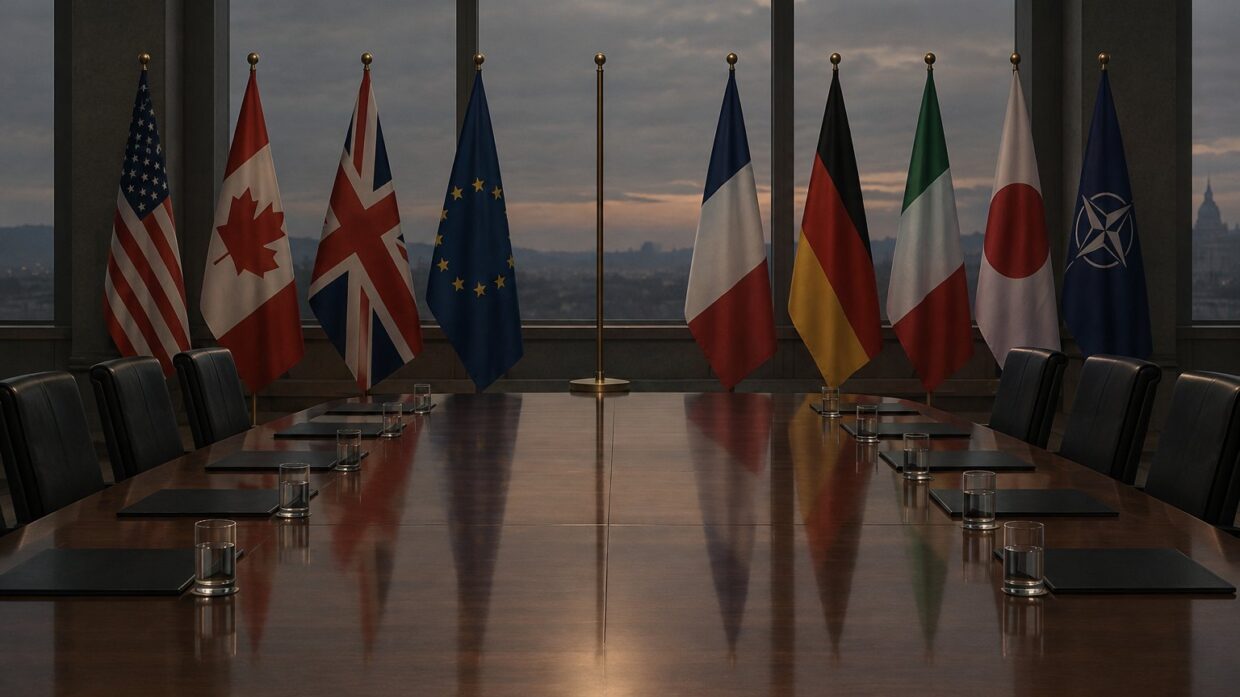
Photo: Well This Is News
Rubio forced to scrap G20 photo op as democracies refuse to pose with Russia over Ukraine
We haven't found a right-leaning take on this story yet.
Breaking stories sometimes publish before every side has covered them. We'd rather show you that than invent a view.
US cancels G20 family photo after multiple nations refuse to appear with Russian minister
Key Takeaways
- Russia has been a G20 member since 1998, and the cancellation of one photograph does not resolve the fundamental question of whether Russia should remain in the organization or be expelled following the Ukraine invasion.
- Approximately one-third of G20 nations threatened a boycott of the photo, indicating meaningful but not overwhelming opposition to Russia's participation, leaving two-thirds of members either absent from reporting or unbothered by Russia's presence.
- Rubio's decision to cancel the photo kept Russia in the actual meeting and substantive negotiations rather than forcing an institutional break, suggesting the US prioritized avoiding a visible walkout over taking a definitive stance on Russia's G20 membership.
The Analysis
The cancellation of a symbolic photo reveals a specific diplomatic fracture, not an unprecedented collapse of international institutions. Secretary of State Marco Rubio cancelled the traditional opening photograph at the G20 foreign ministers' meeting in Atlanta after approximately one-third of participating nations explicitly threatened to boycott the image. The nations involved included Australia and the UK. The reported reason was the presence of Russian Foreign Minister Sergey Lavrov, whom UK Foreign Secretary Ed Miliband confronted at the meeting with accusations that Russia was killing innocent civilians in Ukraine.
The left frames this as a democratic stand against Russian participation in any normalizing gesture. The Guardian's headline emphasizes that democracies "refuse to appear with Russia," treating the boycott as a principled moral stance and portraying Rubio's decision to cancel as a forced concession to Western pressure. This framing spotlights the Ukraine conflict and positions the G20 as a body where the presence of an accused aggressor state becomes diplomatically untenable. The left emphasizes Miliband's direct confrontation with Lavrov, elevating the personal rebuke as evidence of the severity of Western opposition. What this frame does not foreground is how the cancellation itself may have served Rubio's purposes, or whether removing the photo altogether might have been strategically preferable to forcing countries to choose between attendance and protest.
The right perspective is largely absent from the available reporting, suggesting either limited conservative coverage of this specific event or alignment with the decision to exclude Russia from the visual record. One possible interpretation is that conservative outlets may view the cancellation as appropriate given the Ukraine conflict, or that they are not contesting the underlying diplomatic isolation of Russia at this moment.
What neither side fully addresses is the prior status of Russia within G20 institutions. Russia has been a G20 member since 1998. The question of Russian participation at G20 meetings has been contested since 2022 following the invasion of Ukraine, with some members calling for expulsion and others arguing that G20 unity depends on inclusion of major economies. The cancellation of the family photo does not resolve this underlying structural tension. It papers over it temporarily. The decision to cancel rather than proceed with a partial photograph or exclude Russia entirely from the meeting suggests that Rubio and other organizers opted to avoid a direct institutional break while honoring the boycott threat. The reported involvement of about one-third of nations in the threatened boycott indicates meaningful but not overwhelming opposition within the G20 membership.
The sequence of events also leaves unclear whether this reflects a shift in US diplomatic strategy under Rubio toward stronger visual alignment with Western opposition to Russia, or whether it was a procedural accommodation to prevent a walking-out during the actual meeting. The cancellation removes optics but does not alter participation or substantive negotiation. Russia's Foreign Minister remained present at the meeting itself. What the reporting does not establish is what other nations, including those not threatening a boycott, preferred or whether the decision faced internal discussion within the US State Department.
The real headline is that institutional unity among G20 members on Russia's status remains unsolved, and this particular dispute over a photograph highlights how that tension now disrupts even ceremonial proceedings.
Russia's presence at G20 meetings has created a structural fracture that now extends into symbolic protocol. By canceling the family photo rather than expelling Russia entirely or proceeding without it, the US State Department acknowledged that roughly one-third of G20 members will not legitimize Russia's participation through imagery, yet a supermajority still wants the country at the table for substantive negotiations. This compromise avoids institutional rupture today but leaves the core question unresolved: whether Russia belongs in a forum designed for major economies or whether its invasion of Ukraine has fundamentally altered G20 legitimacy. Future meetings will face identical dilemmas whenever ceremonial moments arrive, forcing repeated tactical retreats rather than confronting the membership question directly. The G20's functional paralysis on this issue signals that major institutional bodies can no longer absorb deep geopolitical splits through symbolic compromise.