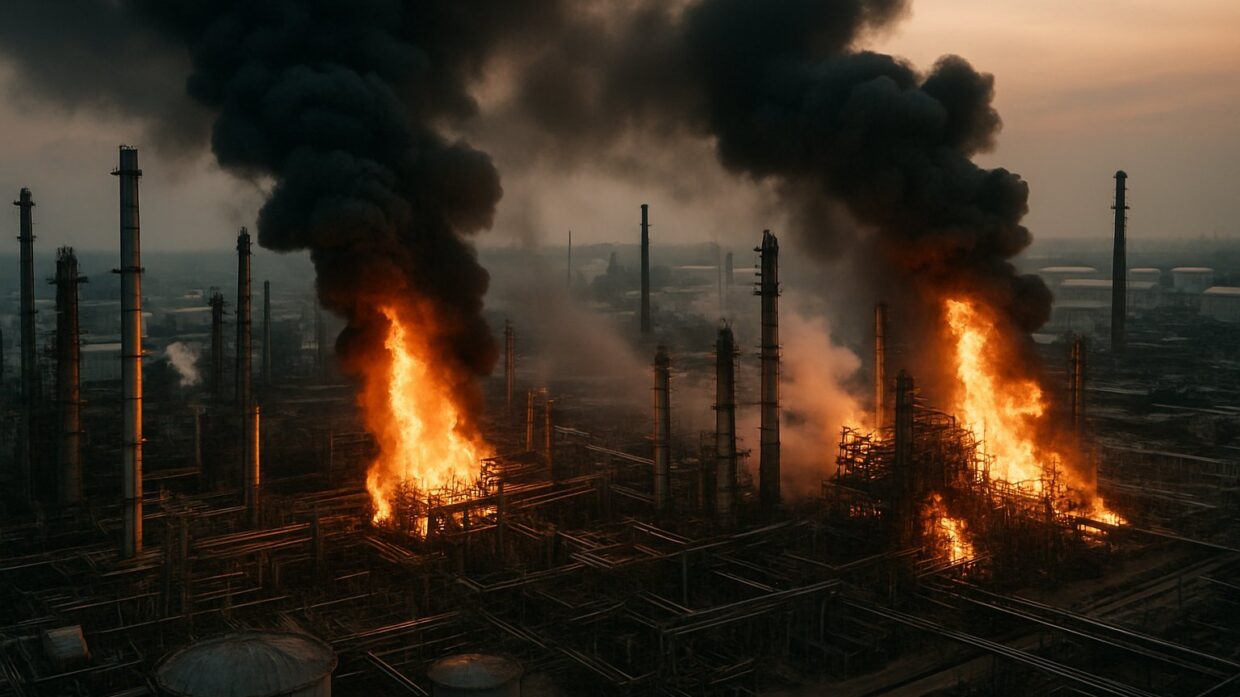
Photo: Well This Is News
Ukraine's Long-Range Campaign Targets Russian Energy Infrastructure Far From Border
Ukraine Claims Deadly Strike on Oil Refinery Deep Inside Russian Territory
Ukraine Strikes Russian Oil Refinery Deep Inside Tatarstan; 13 Reported Dead
Key Takeaways
- Neither Ukraine nor Russia has publicly disclosed the actual damage to refinery capacity, repair timelines, or whether production has resumed, making it impossible to independently assess the strike's strategic impact.
- Both sides have normalized long-range strikes on energy infrastructure without establishing any agreed restraints or addressing what happens when targeting logic extends beyond industrial facilities to broader civilian economic targets.
- Ukraine has conducted months of similar operations against Russian energy infrastructure while Russia has conducted extensive parallel drone strikes against Ukrainian civilian infrastructure, but neither side is discussing the precedent this reciprocal escalation creates for future conflicts.
The Analysis
Ukraine's drone strike on the Taneco refinery in Tatarstan killed at least 13 people and injured 75 others, according to Russian local authorities, and the operation reveals both how the conflict's geography has expanded and how little either side is disclosing about the actual strategic stakes.
The documented facts are sparse but concrete. The strike hit two facilities: the Taneco oil refinery and the ZapSibNeftekhim petrochemical plant, both located in Tatarstan, a region roughly 500 miles from the Ukrainian border. Russian authorities confirmed the casualty count. Ukraine did not immediately claim the operation publicly, though the Guardian and Bloomberg reporting attributes the strike to Kyiv "according to Ukrainian officials." This matters: neither side has yet provided full damage assessments to the facilities themselves, only casualty figures. The public record does not disclose how much refinery capacity was destroyed, how long repairs might take, or whether production has resumed.
The Guardian frames this as Kyiv "stepping up its campaign of long-range strikes" and "aiming to strangle Russian economy," language that centers strategic intent and economic damage as the central narrative. That framing emphasizes Ukraine's expanding drone capability, the shift from border-area attacks to deep-strike operations, and the deliberate targeting of energy infrastructure as a means of economic attrition. The Guardian does not foreground the escalatory implications of striking civilian-adjacent industrial targets hundreds of miles from active combat zones, nor does it address the precedent this sets for long-range strikes on non-military facilities.
Breitbart's framing uses the word "claims" in its headline and attributes the strike to "Ukraine" without the grammatical subject initially clear, a structure that creates subtle distance from the attribution. The article emphasizes the death toll and injury figures, quoting local authorities, and places the strike in the context of "the country's downstream industry" under pressure. Breitbart does not amplify the strategic narrative or the significance of the strike's range. It does not question whether the target selection or the casualty count was proportional to the military objective, nor does it provide analysis of what the strike signals about the conflict's trajectory.
What neither framing addresses is the documented history that precedes this strike. Ukraine has conducted similar operations against Russian energy infrastructure for months. Russia has, in parallel, conducted extensive drone strikes against Ukrainian civilian infrastructure, including power plants and grain facilities. The precedent matters: once long-range strikes on energy infrastructure become normalized practice, the distinction between military and civilian-supporting industrial targets erodes. Neither side is addressing what restraints, if any, govern such operations, or what happens when the targeting logic extends further.
The underlying question is whether this strike represents tactical escalation within the existing conflict or strategic expansion of the conflict's permitted geography. The casualty count alone does not answer that. What matters is whether production capacity was destroyed and whether Russia's refining capability overall has been materially degraded. The public reporting does not establish this, and neither side appears interested in disclosing it clearly. That omission is itself the story: both sides are calibrating information release to sustain their preferred narrative about momentum and capacity without providing the data that would allow independent assessment of actual war costs.
The real headline is this: Ukraine has demonstrated the capacity to strike major Russian industrial targets at extreme range, and Russia has confirmed the operation succeeded in killing people. Everything beyond that remains classified or strategically obscured by both sides.
Ukraine's strike on the Taneco refinery establishes a new operational radius for drone warfare that fundamentally alters how both sides calculate acceptable targets. By successfully hitting civilian-adjacent industrial infrastructure 500 miles from the front, Kyiv has normalized deep-strike operations against energy production, eroding the historical distinction between military and economic targets. Russia faces a cascading problem: each refinery damaged reduces its export revenue and domestic fuel availability, but acknowledging the damage validates Ukraine's capability and invites further attacks. More critically, neither side has articulated what restraints govern these operations, meaning the targeting logic will inevitably extend to power grids, food processing plants, and transportation hubs serving civilian populations. Once normalized, this precedent becomes the baseline for future conflicts. The absence of damage assessments from both governments reveals they are more invested in information control than transparency, suggesting the true cost to Russian refining capacity is substantial enough to warrant secrecy.