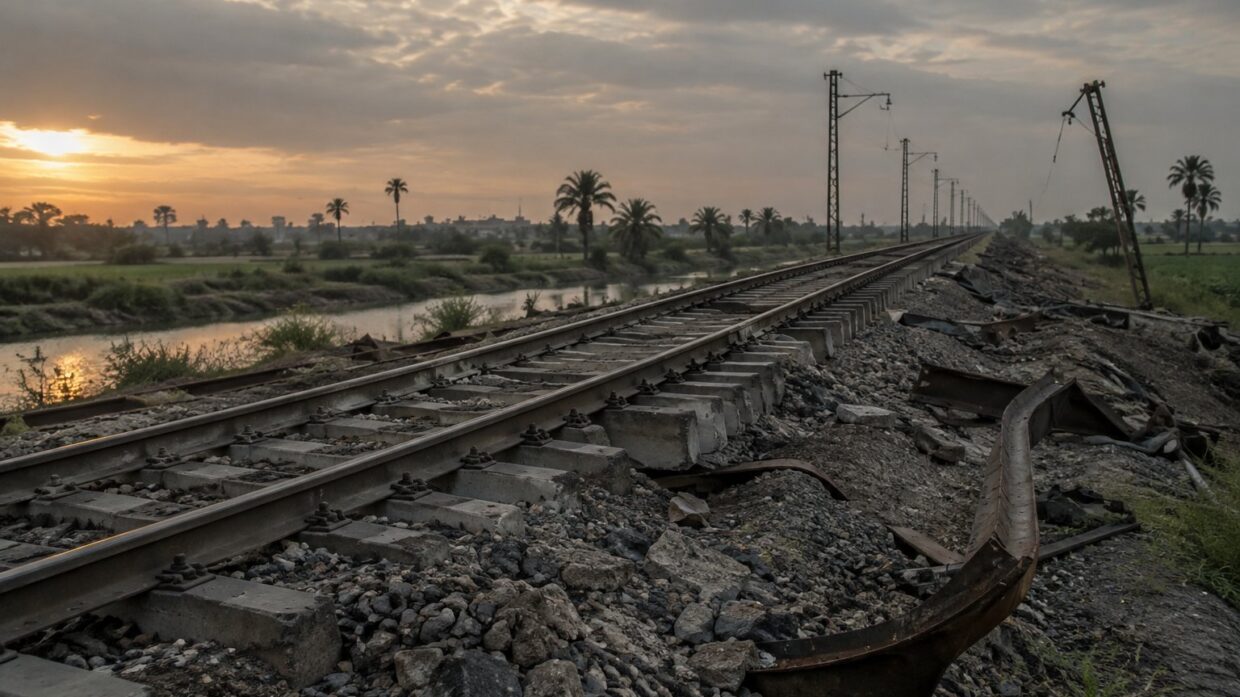
Photo: Well This Is News
President orders investigation after deadly train derailment collision kills at least seven
Train conductor among seven dead in collision between two trains in Egypt
We haven't found a neutral take on this story yet.
Breaking stories sometimes publish before every side has covered them. We'd rather show you that than invent a view.
The Analysis
Two trains collided in Egypt's Giza province Sunday, killing seven people and injuring more than 100, but the two major Western news accounts that reported this incident framed the same basic facts through distinctly different editorial choices about what mattered most.
The verified details establish a straightforward incident: the collision occurred in al-Ayyat district, approximately 30 miles south of Cairo, on Sunday. Seven fatalities were confirmed by Egypt's Chief Prosecutor's office. More than 100 people were injured. The train conductor was identified as one of the deceased. These facts appear consistently across both source accounts.
The Guardian's framing centers on presidential action and accountability. The opening sentence pairs the death toll with immediate mention that "President orders prompt investigation." This editorial choice elevates the governmental response as a lead element, signaling to readers that the story is partly about whether Egyptian authority will act decisively. The word "derail" appears in The Guardian's headline but not in the Washington Examiner account, a distinction worth noting. A derailment describes a specific mechanical failure; the collision itself is the primary event. By foregrounding "derailment," The Guardian's framing suggests the question of mechanical failure or system breakdown may be central to understanding what happened.
The Washington Examiner's framing emphasizes the official status of the information and a specific operational detail: the inclusion of the conductor's death in the opening paragraph. This choice foregrounds the professional railroad operator as among the casualties, which carries an implicit acknowledgment that the person responsible for train operation was also a victim. The structure mirrors a wire service account, prioritizing verified data points from official sources without editorial layering about government response or investigation.
What both framings leave undisclosed is the underlying question of causation. Neither account, based on the available reporting, establishes whether the collision resulted from signaling failure, conductor error, mechanical malfunction, track conditions, or operational protocol breakdown. The Guardian's emphasis on investigation suggests investigation is necessary because cause is not yet known. The Washington Examiner's recitation of facts without framing the accountability question leaves that investigative imperative implicit rather than explicit.
Neither source addresses Egypt's documented history with train safety. Egypt's railway system has experienced multiple significant incidents in recent years. In 2020, a Cairo train station fire killed 25 people. In 2018, a train derailment in the same province killed 12 people. The question of whether this collision reflects systemic infrastructure problems, chronic maintenance deficits, or inadequate operator training remains outside the scope of both accounts. That omission is significant not because it is hidden, but because it is structurally routine in immediate incident reporting.
The real analytical question this incident raises is whether the collision represents a discrete, contained accident or a symptom of ongoing infrastructure vulnerability in a transportation system serving Cairo's metropolitan area of over 20 million people. The available reporting does not yet establish that distinction.
Egypt's railway system will face renewed scrutiny of safety protocols and maintenance standards that have produced five major incidents killing over 50 people since 2018, yet Sunday's collision already shows how immediate political response can obscure the underlying question of systemic failure versus individual accident. The Egyptian government's swift call for investigation signals accountability theater rather than structural reform, a pattern that has repeated after previous disasters without producing documented improvements to signaling systems, conductor training, or track maintenance across a network carrying millions daily through Africa's most densely populated region. If this collision results only in personnel changes or temporary operational reviews without addressing documented chronic infrastructure deficits, Egypt's transportation system will remain vulnerable to predictable future incidents with preventable casualties.