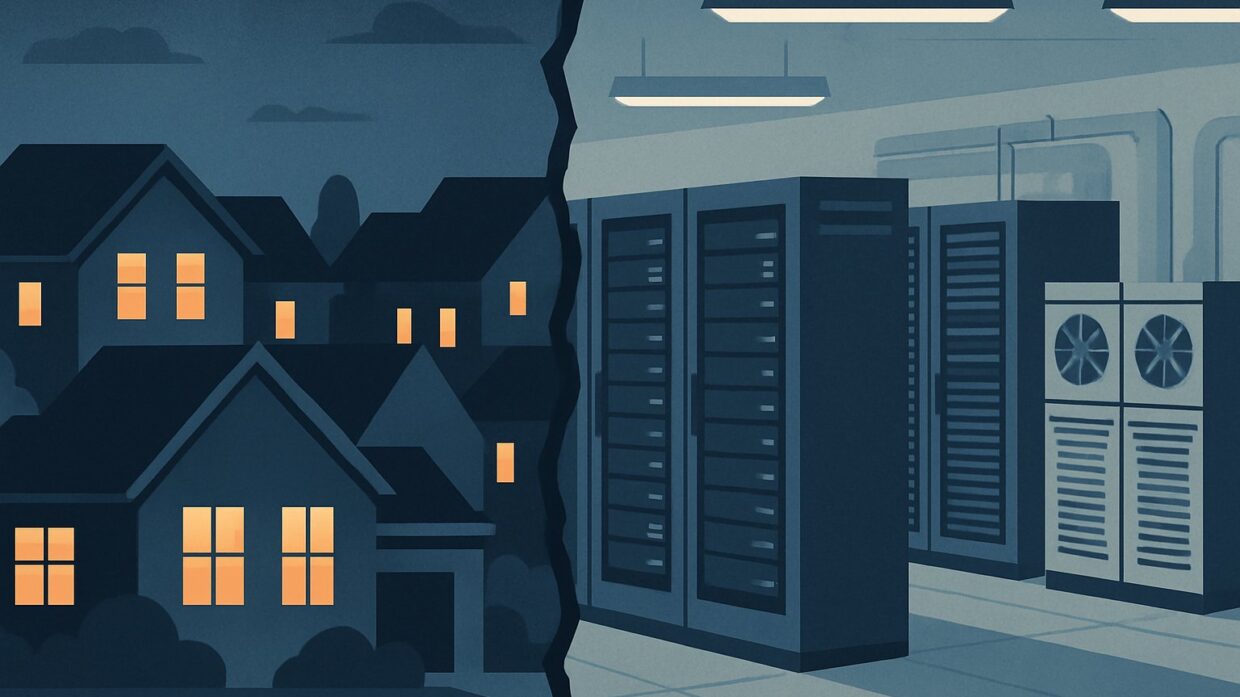
Photo: Well This Is News
Grassroots movement challenges corporate data center expansion that threatens local power grids
Democratic obstruction of data center compromise reveals party fracture on critical infrastructure
Senate Democrats block bipartisan data center bill amid split over energy and ratepayer costs
Key Takeaways
- The bill contained a specific technical mechanism requiring load reductions only for facilities exceeding 50 megawatts during peak hours when grid demand surpassed 85 percent capacity, and only for facilities built after January 2026.
- Democratic leadership did not publicly explain whether they opposed the bill's restrictions as insufficient, feared electoral backlash from voting yes, or genuinely lacked internal consensus on its merits.
- Both grassroots complaints about residential electricity costs and Republican arguments for competitiveness assume the bill would meaningfully improve grid resilience, but neither side engaged with whether peak-load restrictions actually achieve that outcome or simply shift data center investment elsewhere.
The Analysis
Senate Democrats blocked the Ratepayer Protection Act this week, a bipartisan proposal that would have limited data center power consumption during peak residential demand hours. The vote fracture reveals competing priorities within the Democratic caucus that neither side's framing fully acknowledges.
The bill itself operated on a specific mechanism: data centers consuming more than 50 megawatts during peak hours would face temporary load reductions when grid demand exceeded 85 percent of capacity. The measure applied exclusively to new facilities built after January 2026. Republican sponsors framed it as balancing growth with grid stability. The procedural vote required 60 senators to proceed; only 52 voted yes, all Republicans and seven Democrats. Forty-eight Democrats voted no, effectively killing the measure.
The Atlantic's framing emphasizes grassroots opposition to data center expansion itself. The piece describes a populist movement across communities like Virginia and Arizona where residents filed utility commission complaints, citing concerns that massive computing facilities would increase residential electricity costs and destabilize aging grid infrastructure. This framing presents the data center issue as fundamentally a problem of scale and corporate priorities overriding local democratic input. What this narrative leaves out is any engagement with why data centers concentrate where they do: proximity to existing fiber networks, cooling water sources, and established power infrastructure. The Atlantic does not address whether blocking new facilities relocates the computing load to other regions or changes the economic calculus for AI companies.
The Washington Examiner's framing emphasizes Democratic internal dysfunction and political miscalculation. The reporting notes that seven Senate Democrats who voted yes appeared to split from party leadership, suggesting the caucus had not aligned on a unified position before the procedural vote. The piece quotes an unnamed Democratic aide saying the bill would have "handed Republicans a win on infrastructure competitiveness" immediately before elections, framing the blockade as a deliberate choice to avoid appearing weak on regulation. This framing implies internal party discipline overcame substantive policy judgment. What this reading does not establish is whether party leadership explicitly instructed Democrats to vote no or whether the vote reflected genuine disagreement about the bill's merits.
Neither framing addresses the underlying technical question that structures the actual policy debate: whether peak-load restrictions meaningfully improve grid resilience or simply shift investment timelines and locations. The Examiner does not clarify what the seven Democratic defectors believed about grid safety. The Atlantic does not examine whether the grassroots opposition reflects engineering analysis or aesthetic and economic anxiety about change. Both sides treat the vote as primarily meaningful for what it reveals about their opponents' character or competence rather than what it establishes about data center economics.
The public record shows Democrats blocked a bipartisan compromise without a unified explanation. What remains undisclosed is whether Democratic leadership believes the bill's restrictions were insufficient, whether they feared electoral vulnerability if voting for it, or whether they lacked consensus and defaulted to obstruction. The vote itself was real. The competing interpretations of why it occurred both rest partly on inferences about internal caucus dynamics that the sources do not fully disclose.
Blocking this bill without articulating a unified Democratic alternative leaves the actual regulatory question unresolved, guaranteeing that data center expansion will proceed through state-by-state utility commission battles instead of federal framework. The absence of a coherent Democratic position transforms a technical infrastructure debate into pure political obstruction, ceding the framing of grid management entirely to Republican advocates and forcing local communities into protracted regulatory fights where they lack the technical expertise that federal legislation would have required companies to demonstrate. The next Congress will either pass a similar restriction with Democratic names removed or abandon federal oversight altogether, making this week's blockade a procedural setback masquerading as principled opposition. Democratic senators divided without explanation, and no alternative mechanism for managing peak-load demand has been proposed, ensuring the underlying conflict between residential power costs and data center expansion will metastasize across utility commissions for years.