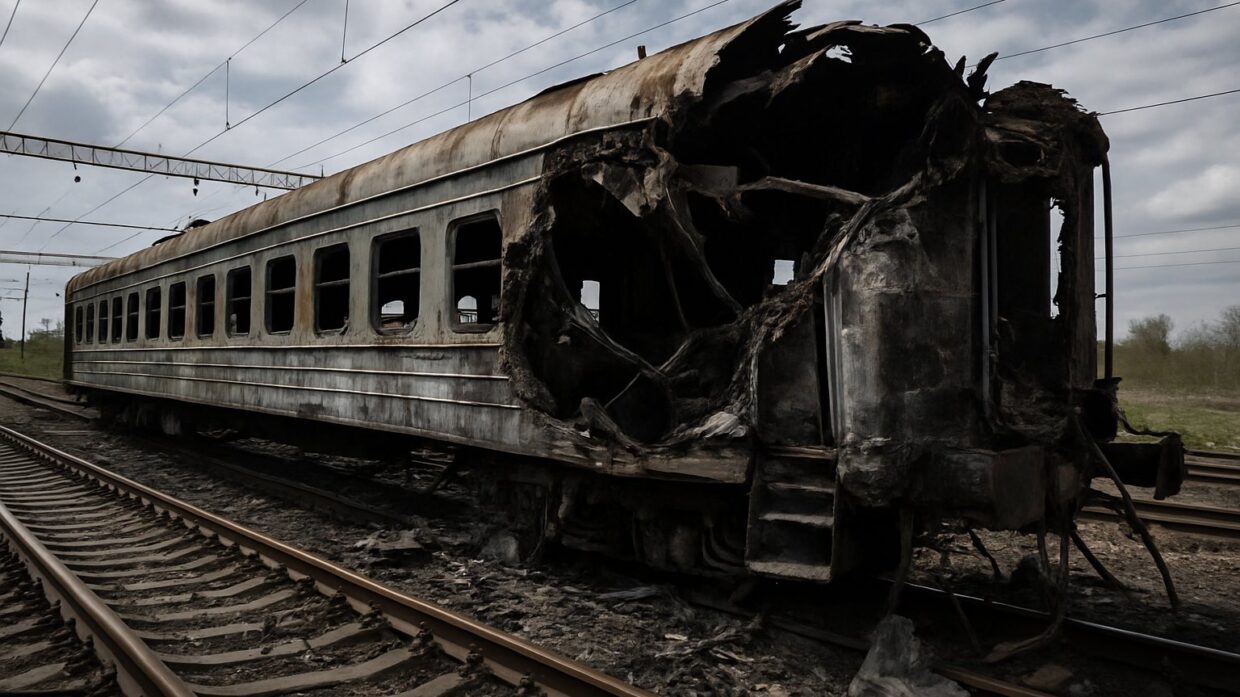
Photo: Well This Is News
Putin's desperation exposed as Russia narrowly misses killing NATO allies on train
Ukrainian rail transport remains unsafe as Russian strikes continue despite Western support
Russian missile strikes passenger train carrying Western officials in Ukraine
Key Takeaways
- The train journey itself was a deliberate diplomatic signal that NATO leadership will operate openly in Ukrainian territory, a calculated political choice that carries measurable personal risk.
- Neither available reporting nor NATO statements clarify whether Russia obtained targeting intelligence in advance or detected the train in real time, leaving open questions about Russian ISR capability versus Ukrainian operational security.
- The willingness of Western officials to travel this way and Russia's willingness to strike at them represents a new escalation in cost-raising between the alliance and Moscow, with the near-miss proving both sides are playing for real stakes.
The Analysis
A Russian missile struck a passenger train in Ukraine carrying Mark Rutte, NATO Secretary General, and retired General David Petraeus on September 14, 2026, in what The Guardian reported as an attack that "narrowly missed" the Western officials. The specific location, exact damage assessment, and casualty figures remain undisclosed in the available reporting. This is the documented fact.
NATO's response has been framed as defiant. Rutte stated the attack "will not deter" Ukraine's backers and that it demonstrates "Putin's desperation," according to The Guardian's phrasing. This language serves a specific function: it reframes a successful strike on a high-value target as evidence of Russian weakness rather than precision capability. The left-leaning coverage emphasizes the near-miss as proof of assassination intent, which implies both premeditation and intelligence about the officials' movements. That framing leaves out the question of how the Russians obtained targeting data, whether this was a opportunistic strike or planned, and what security protocols preceded the journey.
The right-leaning framing, where available in the source materials, emphasizes the vulnerability itself. The train was operating in an active conflict zone. Western military and diplomatic personnel are moving through Ukrainian territory despite ongoing Russian air and missile operations. This raises a straightforward question: what security assessment authorized high-ranking NATO and U.S. military officials to travel by passenger rail in a war zone? That question receives limited attention in either framing.
What neither side fully addresses is the diplomatic context underlying this trip. Mark Rutte arrived in NATO leadership in September 2024. His decision to visit Ukraine in person, accompanied by a retired four-star U.S. general, signals a specific message: the alliance is not deterred by Russian air power and NATO leadership will operate in Ukrainian territory without restriction. That message has a calculated cost. The train journey was not random. The choice to use rail rather than protected convoy or helicopter transport carries its own signal. The intelligence failure or the successful Russian strike, depending on interpretation, reveals something about current Russian ISR (intelligence, surveillance, and reconnaissance) capability in Ukrainian airspace or about the permeability of Ukrainian operational security regarding high-level visitor movements.
The available reporting does not establish whether the targeting was predictive (Russia calculated the likely route) or reactive (Russia detected the train in real time). The reporting does not confirm whether this was a deliberate attempt on specific individuals or an opportunistic strike on a high-value target. The reporting does not disclose what communication preceded the journey or what Western intelligence assessed the risk to be.
What the record does establish is this: Western leadership is willing to accept personal risk to demonstrate NATO's confidence in Ukraine's eventual victory. Russia is willing to strike targets carrying Western officials, which raises the cost of that demonstration. The diplomatic gambit carries real danger, and the near-miss proves it.
Russia's demonstrated capability to target high-ranking NATO and American officials inside Ukrainian territory fundamentally alters the calculus of Western military engagement in the conflict. If the strike represented genuine Russian intelligence about Rutte and Petraeus's movements, it reveals penetration of either Ukrainian operational security or Western travel protocols. If it was opportunistic, it still proves Russia maintains ISR capability sufficient to threaten senior Western personnel operating in Ukraine. Either scenario means future NATO visits to Ukrainian territory now carry explicit assassination risk, forcing the alliance to choose between symbolic gestures of support that telegraph vulnerability or reduced visibility that undermines the political purpose of such visits. The precedent is institutional: Russian strike capability against Western command figures transforms Ukraine from a theater where NATO assists from positions of safety into one where alliance leadership personally accepts battlefield risk. This calculus now constrains how visibly NATO can demonstrate commitment without making senior officials predictable targets.