Photo: Well This Is News
We haven't found a left-leaning take on this story yet.
Breaking stories sometimes publish before every side has covered them. We'd rather show you that than invent a view.
Anti-Trump Republican Massie courts defectors to challenge Iran war policy
Republicans divided on Iran military commitment as Trump signals conflict resolution
Key Takeaways
- Trump has created a strategic contradiction by declaring the Iran conflict militarily won while explicitly rejecting any negotiated settlement, allowing him to claim victory without resolving the actual military commitment.
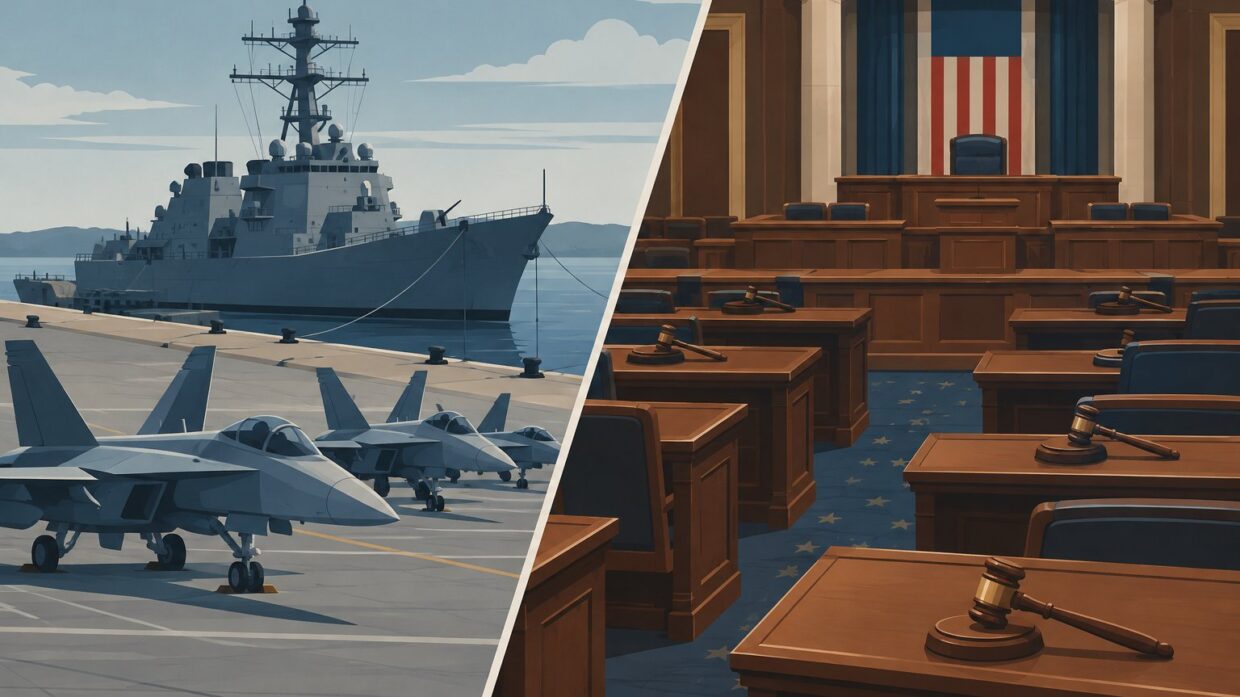
- The Trump administration appears to have maintained ongoing Iran military operations through executive discretion without seeking explicit Congressional authorization, which is what a War Powers resolution would require.
- The U.S. is spending billions annually to sustain military readiness in Iran despite Trump's public statements about conflict resolution, meaning the operational reality diverges significantly from the administration's rhetorical framing.
The Analysis
The public dispute over Iran policy has fractured the Republican Party along a fault line that does not align with traditional Trump support. President Trump declared the Iran conflict 'effectively over' militarily and said the U.S. 'won,' yet simultaneously rejected negotiated settlement, stating on Truth Social that 'we no longer need a deal with Iran.' This framing allows Trump to claim victory while avoiding the diplomatic work that might end actual military operations. Representative Thomas Massie is using this contradiction as an opening, explicitly recruiting GOP defectors to vote on a War Powers resolution that would force Congress to authorize ongoing military operations. Massie's language is revealing: he is offering Republicans a 'life boat from MAGA,' framing opposition to the Iran commitment not as policy disagreement but as political separation from Trump's coalition.
The right-leaning coverage emphasizes Massie's defection narrative and his personal ambition. Fox News highlights that constituents in his Northern Kentucky district view his push to impeach Defense Secretary Pete Hegseth as 'pure spite' and question whether his motives are principled or tactical. This framing marginalizes Massie's substantive argument about war powers by redirecting attention to his political positioning and perceived disloyalty to the Republican base. The reporting does not foreground what a War Powers vote would actually require: explicit Congressional authorization for continued military deployment, a procedural mechanism the Trump administration has apparently avoided invoking.
The neutral coverage establishes a material fact both other framings downplay: the U.S. is spending billions annually to maintain military readiness in and around Iran, regardless of Trump's declarative statements about conflict resolution. The Hill reports this cost structure persists even as the war 'no longer makes top headlines,' suggesting the operational reality and the rhetorical reality have diverged. Trump's victory claims do not address whether continued deployment represents successful deterrence or indefinite commitment without resolution.
What neither framing directly addresses is the strategic ambiguity Trump appears to be maintaining. By declaring military victory while refusing negotiation, he positions himself as tough on Iran without the political cost of a formal peace process or treaty. Massie's War Powers challenge exposes this gap, but the right-side coverage responds by questioning Massie's motives rather than engaging the procedural question: has the Trump administration sought explicit Congressional authorization for the ongoing military presence, or has it proceeded through executive discretion? The absence of that authorization is what a Massie resolution would force. The underlying issue is not whether the Iran war should end, but whether military commitment requires Congressional consent and whether Trump's rhetorical claims of resolution match the actual policy his administration is implementing.
Congress has avoided a direct vote on the Iran military commitment for months, allowing the Trump administration to maintain a costly deployment without explicit legislative authorization. Massie's War Powers resolution forces a choice Republicans cannot dodge: either formally authorize continued military operations or withdraw them. This procedural mechanism matters because it closes the gap between Trump's victory declarations and the billions spent annually sustaining force readiness around Iran. If the conflict is truly over, Congress must vote to end it. If it continues, Congress must vote to fund it. Either way, the ambiguity ends, and members must answer to constituents whether they support indefinite military commitment to a region where the stated mission is complete. This transforms a rhetorical dispute into a binding legislative act.