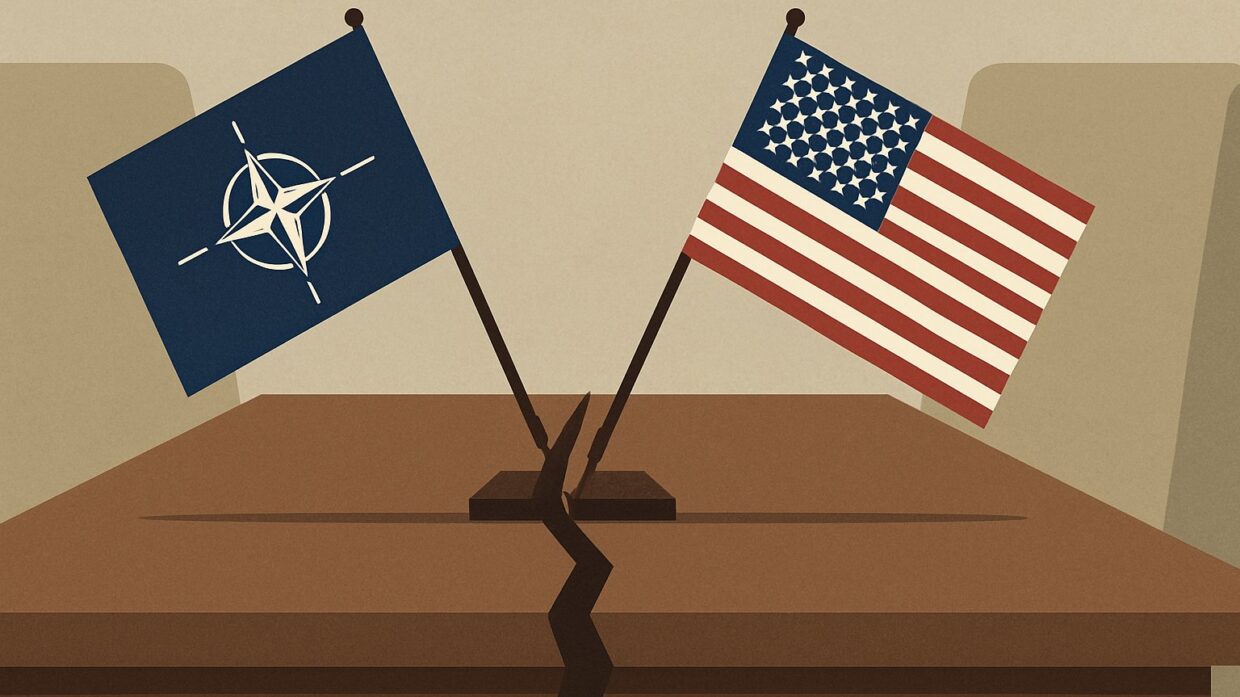
Photo: Well This Is News
Reporter Confronts NATO Chief Over Accepting Trump's Demands
Trump's Hardball Tactics Deliver NATO Commitments in Ankara
NATO Chief Questioned on Trump Relationship as Alliance Navigates Renewed Pressure
Key Takeaways
- No news outlet reporting on the Ankara summit specified what new or accelerated defense spending commitments NATO members actually made, making it impossible to verify whether Trump's approach produced different results than traditional diplomacy would have.
- Neither left nor right coverage explained whether the spending increases announced represent entirely new obligations, restatements of the 2 percent target NATO members committed to years earlier, or timelines that were already planned.
- The core question about whether Trump's personal confrontational style achieves better outcomes at acceptable costs to alliance relationships remains unanswered because neither side provided the spending numbers, timelines, and historical comparison needed to assess it.
The Analysis
A Danish reporter's direct question to NATO Secretary-General Mark Rutte about his "self-respect" in dealing with Donald Trump captured the core tension of the June summit in Ankara: whether Trump's confrontational approach to NATO spending demands strengthens the alliance or destabilizes it through personal conflict.
What actually happened: At the Ankara summit, an unidentified reporter asked Rutte a question framed around personal dignity in response to Trump's demands. The Daily Wire reported that Trump's negotiating position yielded "results" and commitments from NATO members. National Review framed the summit as NATO having "survived" the encounter while still facing "work" ahead. No source material provided the exact text of Rutte's response or specific spending commitments made, limiting what the public record establishes about concrete outcomes.
The left framing, represented by HuffPost, emphasizes the reporter's question as a proxy for European discomfort. By leading with the personal challenge to Rutte's "self-respect," the framing suggests Trump's demands are demeaning rather than legitimate policy pressure. This language choice signals that the issue is Trump's tone and approach rather than the substance of defense spending obligations. What this framing leaves out is any acknowledgment that NATO members had previously committed to defense spending targets that remained unfulfilled, or context about whether Trump's pressure was accelerating those commitments.
The right framing, in The Daily Wire article, inverts the narrative entirely. By stating Trump's approach "gets results in Ankara" and describing the day as "good, even excellent," the framing treats the summit as validation of Trump's method. The reference to Putin and "warmongering" provides geopolitical justification for Trump's demands. What this framing does not address is whether the commitments announced represent new obligations or restatement of existing NATO targets, or whether the personal tension Rutte experienced carries longer-term costs to alliance cohesion.
What neither side fully addresses: NATO members have struggled for decades to meet the 2 percent defense spending target established in 2006 and reaffirmed in 2014. Trump's criticism, while confrontational in tone, targeted a documented gap between commitments and execution. Yet the available reporting does not establish whether the Ankara summit produced genuinely new spending pledges, accelerated timelines for existing commitments, or rhetorical restatement of prior goals. The absence of specific numbers in any of the coverage is telling. Neither the left frame (which emphasizes disrespect) nor the right frame (which emphasizes results) provides readers the factual basis to determine what actually changed.
The underlying question is whether Trump's transactional, often personal style of diplomacy produces outcomes that cooperative alliance management would not, or whether it achieves the same commitments at higher reputational cost. The Ankara summit appears to have produced something, but the public record does not yet establish whether that something justifies the friction or whether it represents a temporary compliance that masks deeper resentment about method.
NATO's decades-long failure to enforce its own 2 percent spending target created the opening for Trump's confrontational approach, but the Ankara summit's actual outcome remains obscured by competing narratives that serve both sides' interests in avoiding specificity. If the summit produced only restatements of existing commitments dressed as new victories, the alliance faces a structural problem: Trump's method may exhaust goodwill without solving the underlying accountability gap, leaving NATO members simultaneously resentful of the pressure and unprepared for the next demand. Conversely, if genuine acceleration occurred, future administrations will face pressure to adopt similar tactics, potentially normalizing personal friction as an accepted cost of alliance management. Without transparent accounting of what spending increases were actually pledged and on what timeline, NATO cannot determine whether it has solved a capability problem or merely postponed it while damaging the institutional trust required for collective defense coordination.