Photo: Well This Is News
Can Sherrod Brown rebuild Ohio's Democratic coalition after 2024 loss?
Moreno: Brown's return bid proves career politicians can't accept losing power
Moreno attacks Brown's Senate comeback as career politician move amid 2024 rematch setup
Key Takeaways
- Brown's 2024 loss was not a rejection of his labor alignment but rather evidence that Trump's messaging on trade and manufacturing outweighed Democratic labor advantages in a state where manufacturing remains economically central.
- The unresolved question determining viability of both candidates' strategies is whether Ohio's working-class shift to Trump in 2024 represents permanent realignment or Trump-specific momentum that could reverse in 2026.
- Neither side's framing directly addresses the structural conditions in Ohio's economy and electorate that produced the 2024 outcome, making it unclear whether a different campaign message or coalition strategy can overcome the underlying shift.
The Analysis
Bernie Moreno and Sherrod Brown are setting up a rematch in Ohio, but the story neither side is fully disclosing is how dramatically the electorate has shifted and what that means for both candidates moving forward.
The documented facts: Sherrod Brown lost his Senate seat in 2024 after 32 years in Congress. He did so specifically because working-class voters in Ohio moved toward Trump. NPR reports that Brown is now building a comeback campaign anchored on union voter support. Bernie Moreno, who defeated Brown in 2024, used Thursday's comments to attack Brown as a "career politician" who "doesn't know how to do anything else" and to frame the 2026 race as a choice between Republican economic management and Democratic governance on gas prices.
The left's framing emphasizes Brown's institutional knowledge and his attempt to rebuild the labor coalition. NPR's headline treats the race as an open question about whether Brown can "win back working class votes," which implicitly accepts that these voters are persuadable and that Brown's union credentials remain relevant. This frame leaves out something significant: Brown lost these voters in 2024, not despite his labor alignment, but alongside it. The coverage does not fully reckon with whether union voters themselves have shifted or whether something else about Brown's political message failed to land. The NPR reporting emphasizes the comeback narrative and the coalition arithmetic without establishing whether the underlying conditions that created the 2024 loss have changed.
The right's framing treats Brown's candidacy as evidence of Democratic entitlement and uses it as a launching point for broader economic attacks. Moreno's "exclusive" comments to Breitbart choose the language of exhaustion: Brown "doesn't know how to do anything else." This serves a delegitimizing function. It reframes a policy disagreement as a character claim about Brown's inability to function outside elected office. Moreno's second exclusive, on gas prices, shifts away from Brown entirely and frames the 2026 choice as a referendum on Democratic economic management. This leaves out what neither Moreno nor the coverage explains: how Senate votes on energy policy connect to pump prices, which are determined by global oil markets, OPEC production decisions, and refinery capacity far more directly than by Senate representation.
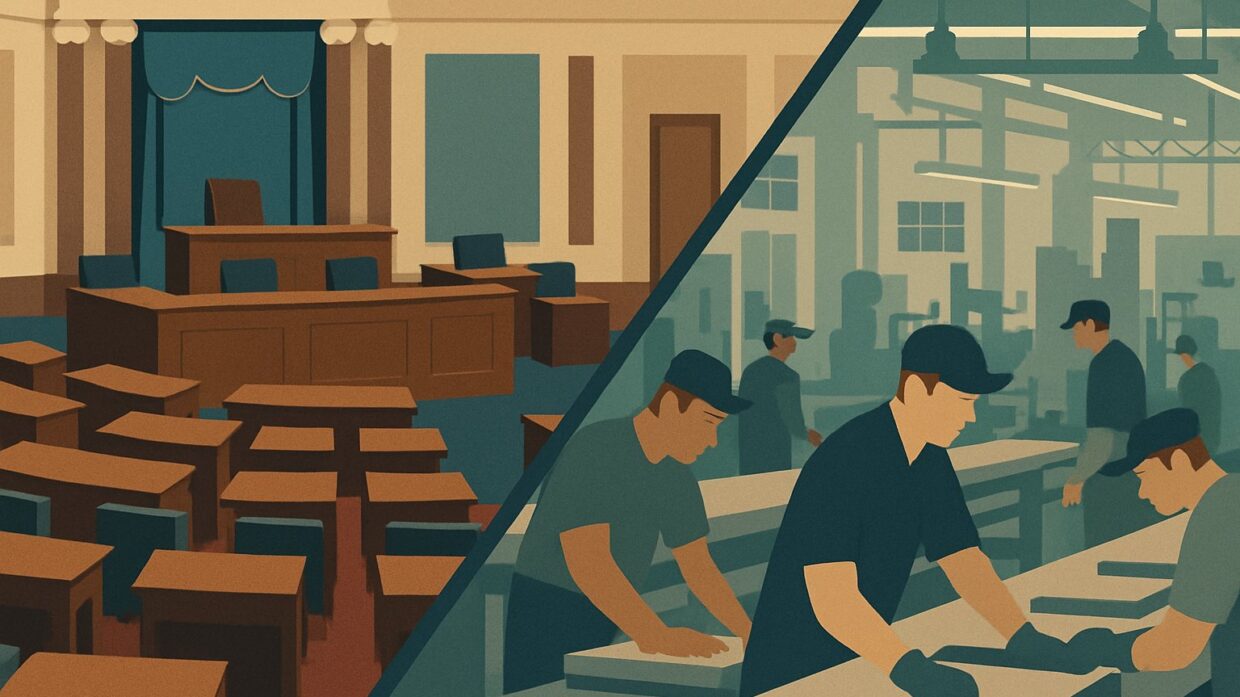
What neither side foregrounds is the structural question: Brown lost in a state that has moved significantly rightward, not because he suddenly became unpopular with union voters, but because Trump's appeal to working-class Ohioans outweighed Democratic advantages on labor issues. The 2024 result was not a referendum on Brown's career length or his union alignment. It was a referendum on Trump's appeal in a state where manufacturing jobs remain economically central and where Trump's messaging on trade and manufacturing reached voters Brown had previously held. If Brown runs again, he is betting that this shift was temporary or that union voters will re-prioritize labor issues over Trump's other appeals. Moreno is betting they will not.
The unresolved question is whether the 2024 result reflected a durable realignment in Ohio's working-class vote or a Trump-specific phenomenon. That answer will determine whether Brown's comeback strategy is viable or whether he is running into a structural headwind that another campaign structure cannot overcome. Neither the left's coalition narrative nor the right's character attack addresses this directly.
Brown's 2026 rematch will serve as the clearest test of whether Trump's 2024 gains among Ohio's working-class voters were durable or circumstantial. His 2024 loss occurred not despite his labor credentials but alongside them, suggesting union alignment alone cannot recover voters who shifted toward Trump on trade and manufacturing messaging. If Brown loses again, it signals that Democratic strength on labor issues can no longer anchor Ohio's electoral coalition, forcing a fundamental recalibration of how the party contests Rust Belt states. The outcome will determine whether Democratic Senate strategy in manufacturing-dependent regions needs restructuring or whether Ohio has become safely Republican territory regardless of candidate profile. Moreno's character attacks obscure this structural reality, but the 2026 results will not.