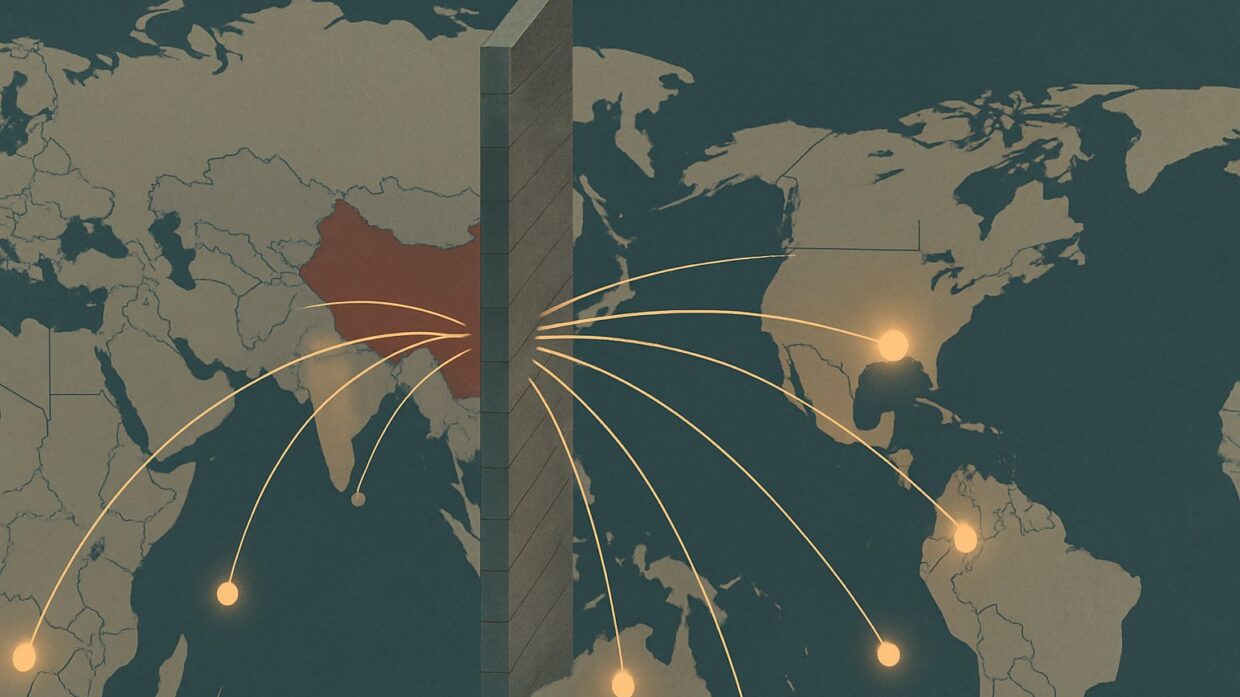
Photo: Well This Is News
AI proliferation without guardrails: How corporate tech expansion mirrors surveillance capitalism
China's Huawei aggressively challenges U.S. AI dominance in critical emerging markets
China's Huawei expands AI chip exports to nine nations as U.S.-China tech competition intensifies
The Analysis
Two separate stories are being told about the same underlying reality, and both are conveniently leaving out the decade-long policy decisions that created the conditions for this moment.
Huawei's rapid expansion into nine major developing economies—Singapore, Thailand, Indonesia, Brazil, Mexico, Saudi Arabia, the UAE, South Africa, and Turkey—represents the first demonstrable breach of what U.S. officials had predicted would be a contained Chinese semiconductor industry. The Daily Wire reports this as a geopolitical breakthrough for China; The Atlantic's framing treats AI proliferation itself as the threat, whether it comes from Allbirds sneakers or state-backed Chinese companies. Neither mentions the specific U.S. policy that created the opening.
In October 2022, the Biden administration imposed the most comprehensive semiconductor export restrictions in decades: the Commerce Department banned advanced chip sales to China with Foreign Direct Product Rule provisions that extended the ban to any foreign company using American technology in their manufacturing. The stated goal was containment. What actually happened: China accelerated domestic chip development timelines, and companies previously dependent on U.S. supply chains—including manufacturers in Singapore, Thailand, and Indonesia—began sourcing alternatives. Huawei, facing an existential supply squeeze, invested $15 billion across its chip subsidiaries, including HiSilicon and Kirin divisions. The prediction that Chinese tech would remain contained assumed no substitution effect. It was wrong.
The right frames this as strategic failure—a collapse of American technological leadership and proof that sanctions miss their target when China controls its own supply alternatives. The Daily Wire's language ("major move," "rapidly expanding," "did not occur as predicted") emphasizes surprise and velocity, making the story feel like sudden strategic loss. This framing omits that the U.S. imposed these restrictions knowing China would pursue domestic alternatives; the question was always whether containment was worth the cost of accelerated Chinese innovation. The administration made that trade-off explicitly. The right treats it as accidental.
The left frames AI expansion as the real threat—a story about surveillance capitalism and consumer control that applies equally to American and Chinese tech. The Atlantic's framing ("tyranny everywhere") treats AI proliferation itself as the fundamental problem, which conveniently sidesteps the question of whether restricting U.S. companies' exports while China exports freely represents effective policy. By treating all AI as equally dystopian, this framing doesn't address whether losing market share to Chinese competitors actually reduces surveillance or just changes the company doing the surveilling.
What neither side acknowledges: The 2022 restrictions were not a surprise attack on China. They were the culmination of fifteen years of escalating trade confrontation—the 2018 tariff regime under Trump, expanded and maintained under Biden; the 2020 Huawei telecom restrictions; the 2021 Taiwan semiconductor policy concerns. At each step, the U.S. chose containment over integration. China chose substitution. Those choices have now intersected. Huawei's expansion into nine new markets isn't a geopolitical surprise or a surveillance threat appearing from nowhere. It's the predictable result of a decade of mutual economic decoupling, where both sides stopped assuming shared interests and started building parallel infrastructure.
The actual headline: After ten years of escalating U.S.-China tech restrictions, China has demonstrated it can manufacture competitive AI semiconductors domestically and export them to developing nations—exactly what policy architects said would happen, and now both sides are pretending they didn't see it coming.