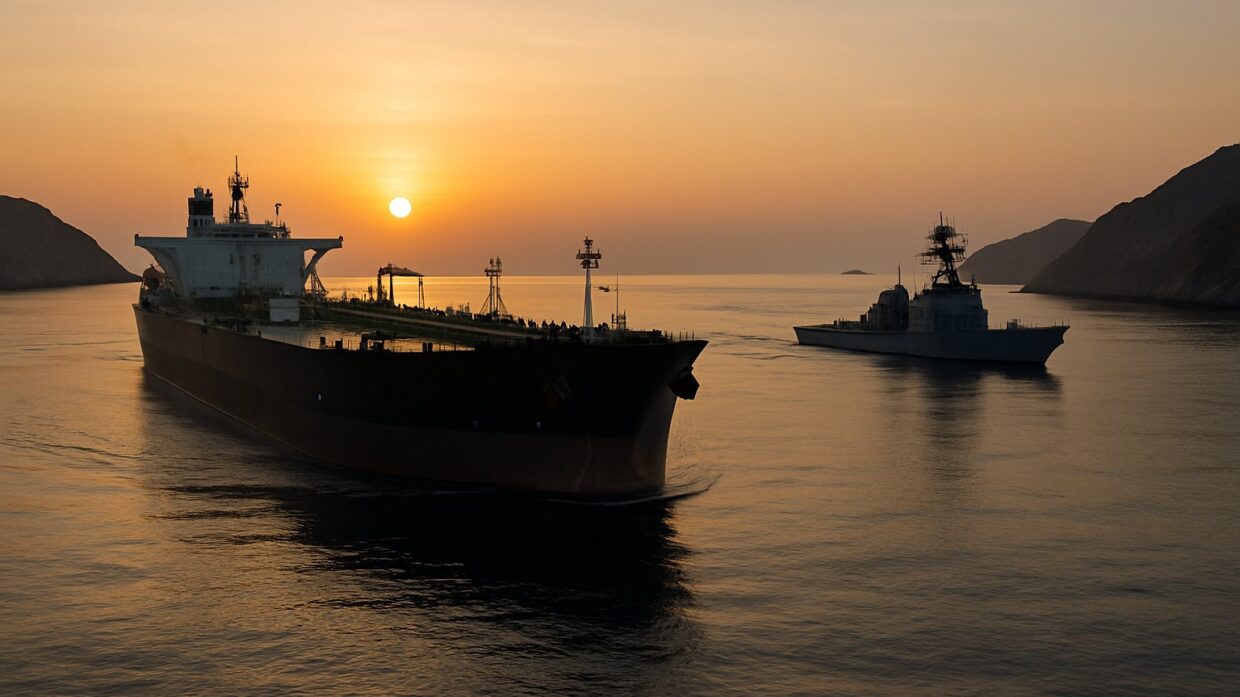
Photo: Well This Is News
U.S. Navy Secures Global Oil Flow While Managing Iran Tensions
Ironclad Blockade: 1 Billion Barrels Move Through Hormuz, Iran Exports Zero
CENTCOM Reports 1 Billion Barrels Through Hormuz as Iran Sanctions Persist
Key Takeaways
- Iran's zero oil exports result from sanctions imposed in 2018, not from Admiral Cooper's recent operations, making it unclear whether his announcement describes new enforcement achievements or existing policy outcomes.
- The 1 billion barrel figure measures routine global commerce that flows through Hormuz continuously, not a security operation exclusive to recent U.S. military activity.
- Admiral Cooper's statement functions primarily as a messaging exercise about American regional presence rather than establishing what new operational effects CENTCOM has actually produced.
The Analysis
Admiral Brad Cooper's announcement that 1 billion barrels of crude moved through the Strait of Hormuz while Iran exported zero represents a milestone claim that requires careful parsing, because the framing conceals questions both about what the numbers mean and what conditions actually produced them.
The verified facts: CENTCOM released a statement Saturday announcing that U.S. forces had supported the passage of more than 1 billion barrels of crude oil through the Strait of Hormuz in what Cooper described as 'the last couple of months.' The same statement noted that Iran has exported zero barrels of oil under current U.S. sanctions. Cooper used the phrase 'ironclad blockade' to describe the enforcement mechanism. These are the specifics both outlets reported. What neither outlet examined closely is what the 1 billion barrel figure actually measures and what structural factors produced the zero Iranian export number.
The right-leaning framing, exemplified by Breitbart, treats the billion-barrel milestone and the zero Iranian exports as dual proof of American enforcement success. The language 'ironclad blockade' comes directly from Cooper's own statement, making it a direct quote rather than editorial interpretation. This framing leaves out the role of global oil markets in determining the flow through Hormuz. The Strait of Hormuz handles approximately 21 percent of global petroleum traded internationally, meaning the billion-barrel figure may primarily reflect normal global commerce rather than exclusive evidence of U.S. Navy enforcement. The framing also does not address whether Iranian zero exports result from the blockade itself or from prior sanctions architecture that has been in place since 2018, making it unclear whether Cooper's recent operations produced this specific outcome.
The center-left framing, represented by The Hill, emphasizes that U.S. forces 'supported' the transport while 'despite an ongoing exchange of strikes with Iran' remained stable. This construction frames the passage as a security achievement under difficult conditions. The Hill's language is technically accurate but frames the 1 billion barrels as a security outcome rather than asking what portion of that flow represents routine commerce versus what portion required active protection. The phrasing also de-emphasizes the Iran dimension by noting 'ongoing exchange of strikes' without specifying what prompted those strikes or their frequency.
What neither outlet foregrounds is the historical context that makes both the billion-barrel claim and the zero-export claim potentially misleading. Iran's oil exports have been restricted since the 2018 U.S. withdrawal from the Joint Comprehensive Plan of Action, not because of recent CENTCOM operations but because of sanctions architecture that predates Cooper's command. The billion-barrel figure measures routine global commerce that has flowed through Hormuz continuously. Neither outlet asked whether Cooper's statement distinguishes between protecting normal passage and blocking Iranian-specific exports, or whether the milestone serves primarily as a reminder of CENTCOM's role in the region following recent military exchanges.
The underlying question is what operational effect CENTCOM claims to have produced. If the 1 billion barrels represents normal commerce and Iranian exports were already at zero before Cooper's statement, then the announcement functions as a messaging exercise about American presence rather than a report of new operational outcomes. The available coverage does not establish which interpretation is accurate.
CENTCOM's announcement collapses two separate metrics into a unified claim of enforcement success without distinguishing between protecting routine global commerce and imposing new restrictions on Iranian exports. The billion barrels likely represents normal oil traffic through Hormuz, which averaged 21 percent of global trade long before this operation, while Iran's zero exports stem from sanctions imposed in 2018, not from recent naval operations. Cooper's "ironclad blockade" framing obscures whether the Navy is preventing Iranian shipments specifically or merely maintaining presence during existing restrictions. This rhetorical bundling establishes a precedent for measuring military effectiveness through inflated milestones rather than discrete operational outcomes, making future CENTCOM announcements harder to evaluate against actual strategic impact rather than symbolic presence.