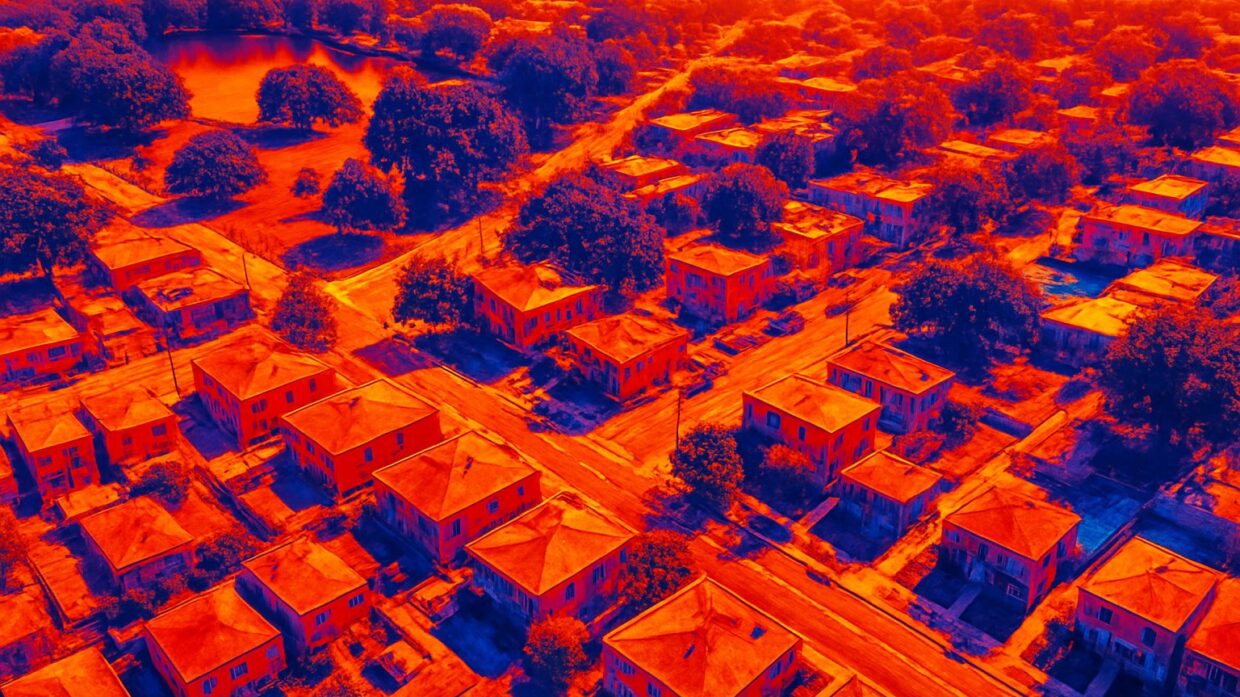
Photo: Well This Is News
AI Predicts Heat Danger But Fails to Protect Vulnerable Communities
AI Heat-Mapping Tools Proliferate as Climate Threatens Urban Health
Read More... from AI Heat-Mapping Tools Proliferate as Climate Threatens Urban Health
AI Heat-Mapping Tools Proliferate as Climate Threatens Urban Health
Key Takeaways
- Simultaneous exposure to heat waves and wildfire smoke now affects over 1 billion people annually, a sharp jump from the previous decade, but most cities still design cooling centers and air filtration systems separately rather than as integrated responses.
- The real bottleneck is not prediction but institutional response: AI can map heat risk at the block level, yet officials lack the coordinated systems to deploy resources and activate protective measures when that predicted danger arrives.
- Wildfire smoke intensifies heat danger in ways that standalone heat-response infrastructure does not address, meaning cities may need to redesign their protective strategies faster than the compounding threats are escalating.
The Analysis
Cities and researchers have built increasingly sophisticated AI systems to predict where extreme heat will strike and which populations face the greatest risk. The Axios reporting documents that this predictive capacity has expanded substantially, but identifies a critical gap: the technology is used far more to identify danger than to enable protective response. That distinction is not semantic. It marks the difference between knowing a crisis is coming and having institutional systems prepared to act when it arrives.
The evidence Axios establishes is specific. Researchers have developed AI models that map heat risk at granular geographic scales. These tools identify neighborhoods, even individual blocks, where vulnerable populations face severe exposure. But the reporting finds that while prediction has advanced, the institutional capacity to respond has not followed at the same pace. Officials know more precisely where danger exists but lack coordinated systems to move resources, open cooling centers, check on isolated residents, or execute other protective measures. The gap between prediction and protection is the actual story here, and it applies across jurisdictions.
The Inside Climate News study provides crucial context that neither framing fully addresses. The research, published in Science Advances, establishes that from 2010-2019, more than 1 billion people per year faced simultaneous exposure to heat waves and wildfire smoke. That represents a sharp increase from the previous decade. This is significant because wildfire smoke compounds heat danger in specific ways: it reduces air quality, blocks sun, and creates conditions that can be lethal for vulnerable populations. The combination intensifies risk beyond what either threat presents alone.
What the left framing emphasizes is correct: the capacity to predict has outpaced the capacity to protect, and this gap falls hardest on communities with fewest resources. But this frame leaves out what makes the situation genuinely difficult to solve. Prediction is a technical problem with a technical solution. Protection is a political and budgetary problem. It requires sustained funding, coordination across municipalities, and political will to prioritize infrastructure that sits idle most years. The Axios reporting does not establish that officials are indifferent to protection, only that prediction has advanced faster than protection systems have.
What neither framing captures fully is that the heat problem is intensifying through a specific mechanism: the simultaneous exposure to heat and smoke is rising. AI tools can predict this compound exposure, but the protective systems being built in most cities are still designed to handle heat or air quality problems separately. A cooling center addresses heat. Air filtration addresses smoke. Few jurisdictions have designed integrated protective responses that account for both threats occurring at once. The underlying question is whether cities can build that integration faster than the simultaneous threats escalate.
Heat prediction technology has become sophisticated enough to identify vulnerability at the block level, yet most American cities lack integrated response systems to act on that knowledge. The institutional failure is not ignorance but organizational fragmentation: cooling centers, air quality protocols, and emergency services operate on separate tracks while the threat they face is compound and simultaneous. Inside Climate News data showing 1 billion people annually exposed to combined heat and wildfire smoke demonstrates that the gaps between prediction and protection are no longer theoretical luxuries cities can address incrementally. Cities that continue treating heat and smoke as separate hazards will fail populations living in neighborhoods where both converge, and that failure will be measurable in preventable deaths when the next extreme event arrives.