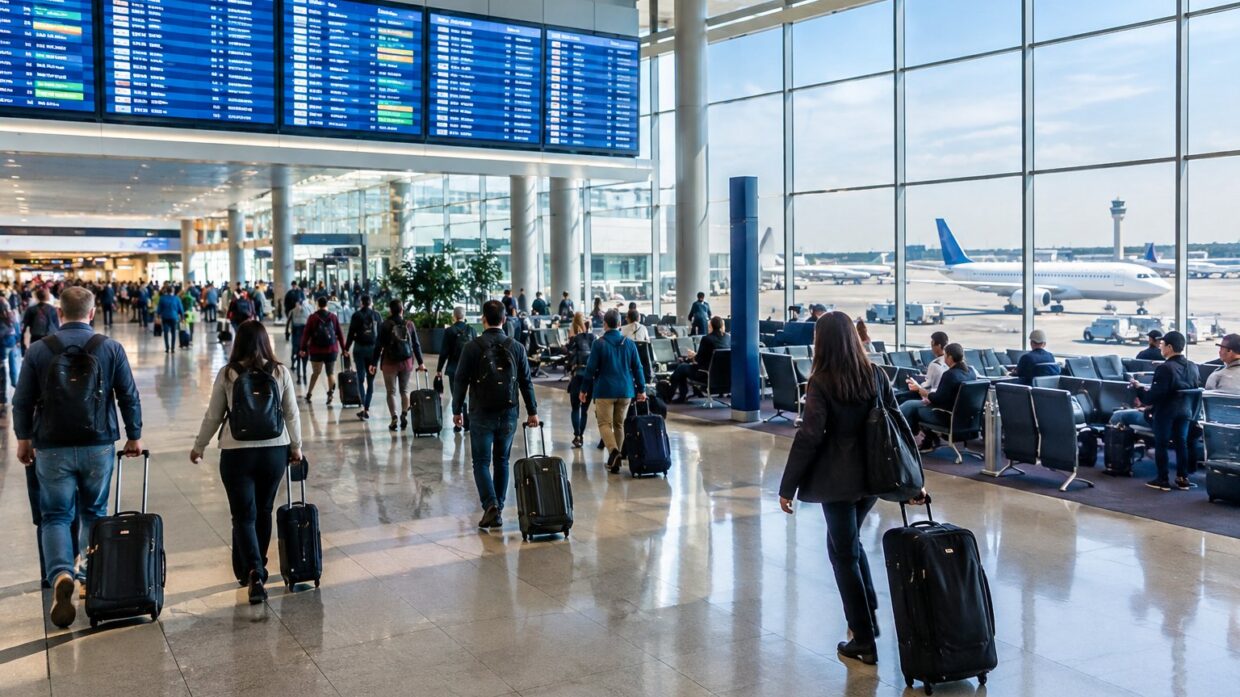
Photo: Well This Is News
We haven't found a left-leaning take on this story yet.
Breaking stories sometimes publish before every side has covered them. We'd rather show you that than invent a view.
Cleared for Takeoff: FAA Chief Says U.S. Air Travel Back to Normal Sunday
FAA Chief Declares U.S. Air Travel Returning to Normal After Three-Day Disruption
Key Takeaways
- Neither available source disclosed what caused the three-day ground stop, leaving passengers and industry unable to assess whether similar disruptions are likely.
- The FAA's declaration of normal operations on Sunday may reflect a recovery plan rather than real-time operational conditions, since other reporting indicated disruptions were still ongoing on day three.
- Airports and airlines may face significant backlog clearing and schedule disruptions even after the FAA lifts the ground stop, but neither source addressed how long full passenger operations would take to normalize.
The Analysis
The FAA has declared U.S. air travel returning to normal operations after a three-day ground stop, but the reporting splits on what that statement means about the disruption itself. The Breitbart framing emphasizes the resolution and the chief's official word that travel is cleared, while the Investing.com headline stresses that disruptions are continuing into day three, suggesting the recovery is incomplete.
What actually happened: A nationwide ground stop grounded hundreds of thousands of passengers across U.S. carriers and international flights on what sources identify as a three-day incident beginning November 12 or 13, 2026. The FAA issued a recovery directive stating operations would return to normal by November 15 (Sunday). The disruption affected both domestic routes and global air traffic patterns. Neither source provided the cause of the ground stop, leaving that critical fact unestablished in available reporting.
The right-leaning framing, represented by Breitbart's "Cleared for Takeoff" headline, centers on the FAA chief's official declaration as the resolution event. The language "cleared for takeoff" is operational terminology, shifting the frame from disruption to recovery. By emphasizing the chief's pronouncement and the specific day (Sunday) when normal operations resume, this framing treats the ground stop as resolved once the official statement is issued. It does not address whether airports, carriers, and passengers still face cascading delays or backlog clearing. The emphasis moves the reader from the disruption itself to the authority's confidence in return to normalcy.
The neutral-leaning Investing.com framing leads with "disruptions continue into third day," emphasizing ongoing operational problems rather than the recovery declaration. By highlighting that the third day still shows active disruption, this framing complicates the FAA chief's statement. It does not dismiss the recovery timeline but foregrounds the present-tense operational reality over the future-tense promise. The focus is empirical: what is still broken, not what an official says will improve.
What neither side establishes is the cause of the ground stop itself. The FAA chief's reassurance about return to normalcy does not explain what triggered the disruption. The available reporting does not specify whether this was a technical failure, a security incident, weather-related, or administrative. That omission matters because it shapes whether passengers and industry should expect similar incidents or whether a one-time event is now resolved. A reader from available headlines cannot distinguish between a systemic vulnerability and an anomaly.
The timing gap between the FAA's declaration (Sunday normal operations) and the Investing.com report (disruptions continuing on day three) suggests the sources may not be from the same moment. If the FAA statement came before Sunday's actual operations and the Investing.com reporting reflects Sunday itself, the framing reflects different temporal vantage points rather than disagreement about facts. That context reshapes the apparent contradiction: one source is reporting a plan, the other is reporting observable conditions.
What remains undisclosed is the scope of backlog clearing, passenger compensation, and whether airlines' schedules normalize within 24 hours or require extended recovery. The FAA declaration clears the airspace; it does not establish how quickly operations resume normal passenger loads and frequencies.
A three-day ground stop that immobilized hundreds of thousands of passengers leaves the aviation system vulnerable to a cascade of knock-on delays lasting weeks. Stranded aircraft sit in wrong cities, crew scheduling collapses, and connecting passengers miss downstream flights in a domino effect that standard airline recovery procedures struggle to contain. The FAA's declaration of "normal operations" clears the airspace for takeoff but does not address the backlog of passengers rebooking across already-full flights, the aircraft repositioning required to resume regional service, or the compensation liability airlines face. Without disclosure of what caused the ground stop, the industry and regulators cannot implement targeted safeguards against recurrence. If this was a technical failure, system redundancy is insufficient. If security-related, vulnerability persists. The public faces weeks of flight delays and cancellations while the root cause remains buried in official statements that treat operational resumption as equivalent to disruption resolution.