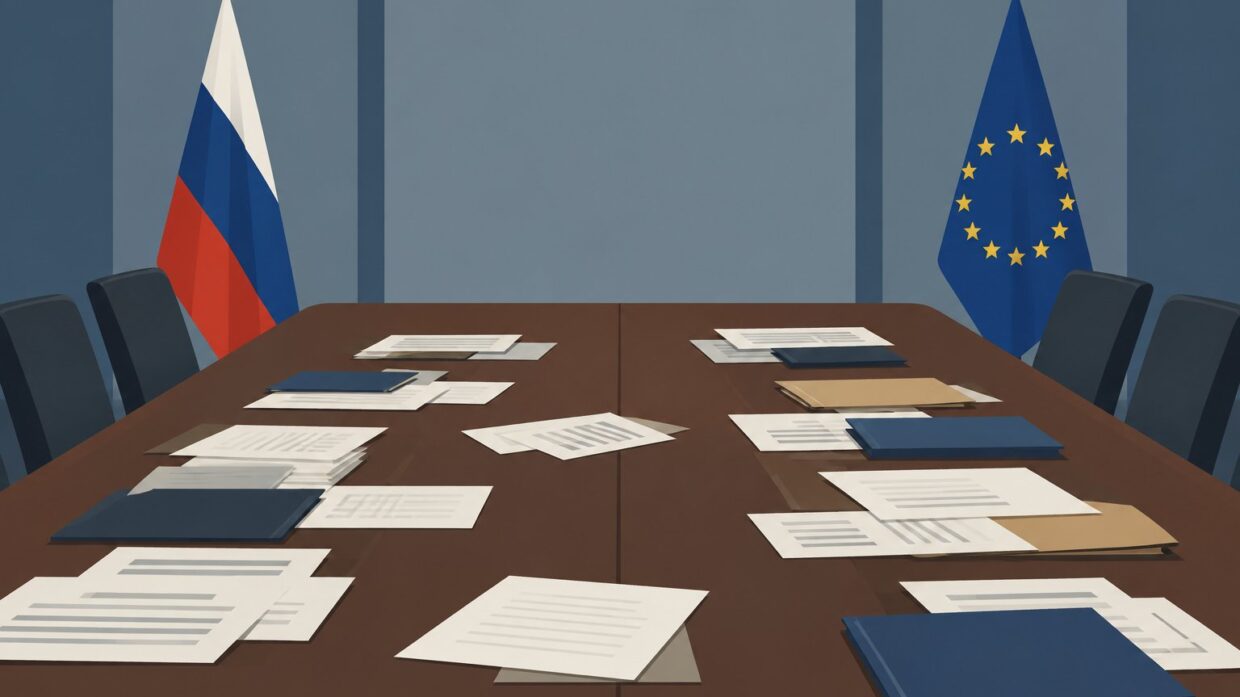
Photo: Well This Is News
EU warns against Russia's 'traps' in Ukraine negotiations as Moscow exploits divisions
We haven't found a right-leaning take on this story yet.
Breaking stories sometimes publish before every side has covered them. We'd rather show you that than invent a view.
Russia pushes European security demands in Ukraine peace talks, creating negotiation divisions
Key Takeaways
- The EU has not clarified whether Russia's security demands are preconditions to start talks, conditions for a final settlement, or opening negotiating positions meant to be traded away.
- Russia's current security demands continue a 30-year pattern dating to the Budapest Memorandum and 2008 NATO Bucharest commitment, not a new tactical gambit invented to distract from invasion.
- Europe faces a fundamental strategic choice between rejecting Russia's security concerns as a negotiating trap or engaging them as legitimate preconditions for any peace agreement.
The Analysis
Russia has introduced demands about European security arrangements into Ukraine peace negotiations, and European leaders are now divided over whether to engage with these conditions or treat them as a negotiating tactic designed to delay or complicate talks focused on Ukrainian sovereignty. The question appears straightforward in framing but reveals two fundamentally different interpretations of what Russia is actually doing and what Europe should do in response.
Kaja Kallas, the EU's foreign policy chief, used the specific phrase "walking into the traps that Russia is setting" in her warning to other European leaders. She framed Russia's security demands as a deliberate diversion from Moscow's military aggression in Ukraine. The language of "traps" carries a specific accusation: that Russia knows it cannot achieve its military objectives and is now attempting to shift the negotiation framework toward issues where it has leverage over European states. Bloomberg reports that these security demands are "exposing divisions within the continent," which suggests that not all EU members view Kallas's framing as correct or persuasive.
The left-aligned reporting emphasizes Moscow's strategic intent. The Guardian frames this as Russia attempting to exploit the negotiation process itself, placing emphasis on what Russia wants to avoid discussing (its continued military position) rather than what it wants to discuss (European security architecture). This framing asks readers to view Russian demands as a negotiating tactic rather than a legitimate issue. It treats the sequence of negotiations as strategically important: if Russia gets to set the agenda or sequence, according to this logic, it wins even if the talks fail.
What Bloomberg reports but neither Kallas nor the left-aligned coverage foregrounds is the substantive question: are European security arrangements actually relevant to a Ukrainian peace settlement? Russia's nuclear arsenal, NATO's eastern border positions, and European defense commitments are not abstract concerns from Moscow's perspective. A reader following only the "trap" framing might not understand that Russia has legitimate structural security interests, separate from whether its current demands are negotiating leverage or genuine preconditions.
The reporting does not establish whether Russia's security demands are preconditions for any talks to begin, conditions for a settlement, or opening positions designed to be traded away. That distinction matters enormously for evaluating whether Kallas's warning is about bad-faith negotiation or about refusing to acknowledge Moscow's security concerns at all.
What neither side fully addresses is the prior context: the 1994 Budapest Memorandum, NATO's 2008 Bucharest commitment to future Ukrainian membership, the 2014 Crimea annexation, and the 2015 Minsk agreements. Russia's current demands to discuss European security arrangements appear as a sudden tactical gambit in the current reporting. In context, they represent a continuation of Moscow's longstanding position that NATO expansion constitutes an existential threat. That history does not vindicate Russia's invasion, but it explains why Moscow frames security architecture as non-negotiable while Europe frames it as a distraction.
The real story is that Europe must choose between two negotiating theories: reject discussions of European security as a Russian trap, or engage with Russia's structural security concerns as a condition for any settlement. Neither approach is obviously correct, and that choice will determine whether negotiations are possible at all.
Russia's security demands are fracturing European unity precisely when consensus matters most. If Kallas and other hardliners succeed in treating Moscow's concerns as negotiating theater to be dismissed, they eliminate the only common ground where settlement becomes conceivable. Conversely, if Europe engages these demands seriously, it risks legitimizing Moscow's claim that NATO expansion justified its invasion. The Budapest Memorandum framework that Ukraine relied on is already broken, leaving European leaders to decide whether acknowledging Russia's security architecture concerns strengthens or weakens Ukraine's negotiating position. This choice determines whether talks collapse over procedural disputes or advance toward actual settlement terms.