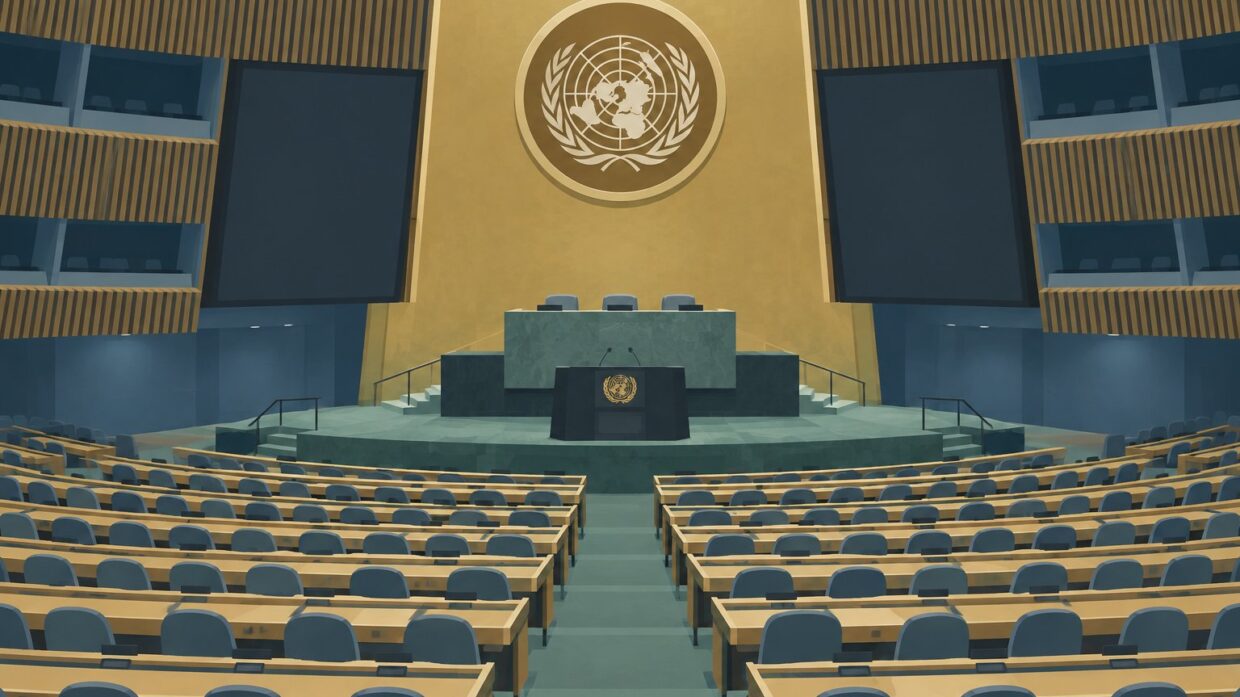
Photo: Well This Is News
We haven't found a left-leaning take on this story yet.
Breaking stories sometimes publish before every side has covered them. We'd rather show you that than invent a view.
UN renews Iran's committee seat amid war with US, drawing backlash over 'morally bankrupt' decision
We haven't found a neutral take on this story yet.
Breaking stories sometimes publish before every side has covered them. We'd rather show you that than invent a view.
The Analysis
The UN's reconfirmation of Iran's committee seat this week exposes a fundamental tension in how the international body balances diplomatic inclusion against security accountability, and it occurs precisely as Iran has extended its complete blackout of UN nuclear inspectors.
The recorded facts are these: The UN voted 144-0 (with abstentions) to reconfirm Iran's seat on the committee, according to Fox News. Simultaneously, Bloomberg reports that Iran extended what it calls a "blackout" of UN nuclear inspectors, preventing international access to its uranium enrichment facilities. The prospect of new US-Iran nuclear negotiations has receded, according to Bloomberg's reporting. Canada, Australia, and unnamed US lawmakers opposed the renewal.
The right-leaning framing emphasizes the word "morally bankrupt" and focuses on the vote total as a measure of international isolation, 144 votes for Iran despite active US-Iran conflict. Fox News structures this as a contradiction: the UN rewards committee membership to a state that is simultaneously blocking inspectors. The frame treats the committee seat as a form of legitimacy that Iran does not deserve while it maintains nuclear secrecy. This framing omits why the UN maintains committee membership for most countries regardless of current diplomatic disputes, and it does not establish what specific committee this is or what powers it holds. The absence of that detail makes the vote appear more consequential than the reporting establishes.
The center-right framing in Bloomberg emphasizes what Iran's inspector blackout actually prevents: international knowledge of Iran's uranium stockpile. This is a more technically grounded concern. Bloomberg does not primarily discuss the committee vote; instead it leads with what matters operationally, inspectors cannot verify what Iran is enriching. Bloomberg's framing leaves out the vote itself and the political backlash, focusing instead on the asymmetry of information. Neither frame addresses what prompted Iran to extend the blackout now, what the previous terms of inspector access were, or whether Iran's refusal follows a pattern established before the current US-Iran tensions.
What neither side fully captures is the institutional history. UN committee memberships are typically automatic renewals for member states unless explicitly revoked by the body. The 144-vote reconfirmation is not a referendum on Iran's behavior; it reflects standard procedure. What has changed is that Iran's nuclear non-cooperation has deepened (the inspector blackout), while the US-Iran relationship has deteriorated. The reporting does not establish whether Iran extended the inspector blackout in response to US actions, or whether this blockade preceded the current conflict. The underlying question is whether the UN's procedural legitimacy can survive when it formally includes a state actively preventing the verification of nuclear activity, and whether blocking inspectors signals Iranian intent to advance weapons capability or reflects tactical leverage during a conflict.
Neither source directly answers: what are the mechanics of Iran's blackout, and what does blocking inspectors actually prevent the UN from knowing? The absence of that technical detail leaves readers uncertain whether this represents a new capability threat or an intensification of existing non-compliance.
Iran's extension of its inspector blackout while retaining its UN committee seat creates an institutional precedent that other non-compliant states will likely cite when facing accountability pressure. The UN reconfirmed Iran's seat through procedural routine, but Iran's simultaneous refusal to grant inspectors access to uranium enrichment facilities means the international body has now formally validated a member state's right to participate in UN governance while actively obstructing the verification mechanisms that justify such participation. This fracture between membership and transparency obligations will hollow out future enforcement efforts against nuclear proliferation, since any state can now claim procedural entitlement to committee seats even while preventing the inspections that measure compliance. The immediate consequence: inspectors cannot track Iran's uranium stockpile levels or enrichment rates, eliminating the international community's ability to detect whether Iran is advancing toward weapons-grade material before a threshold moment arrives.