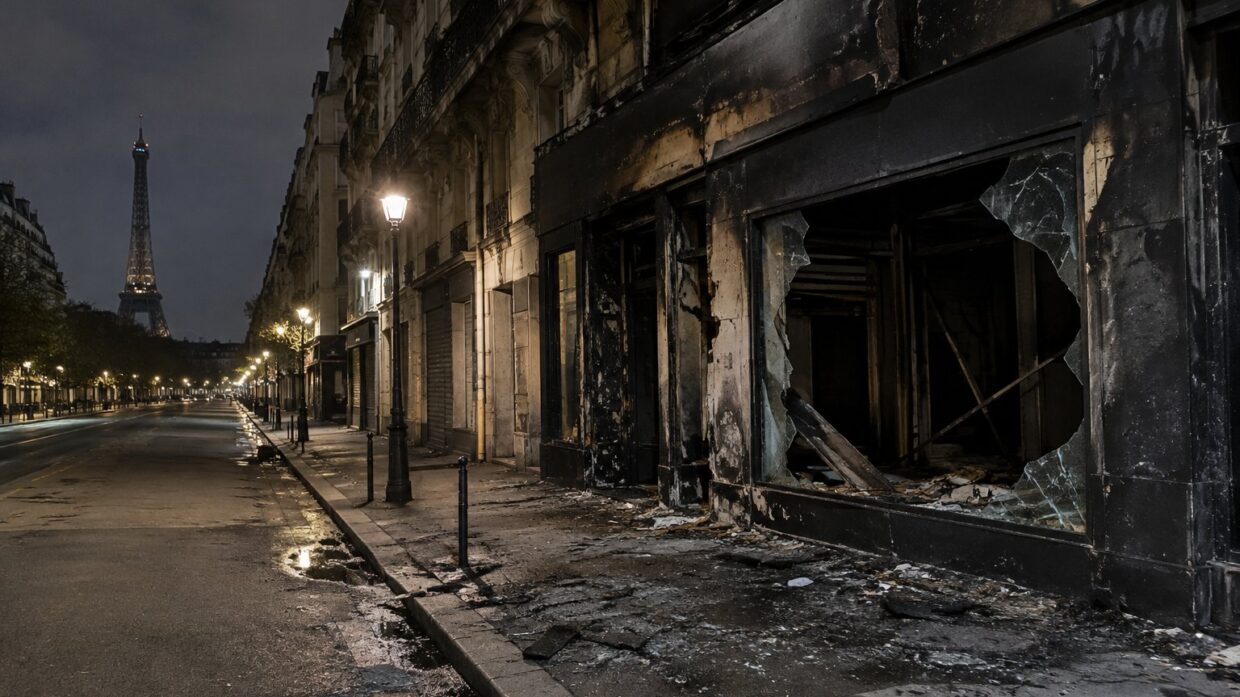
Photo: Well This Is News
Youth-led street violence erupts across European cities as Halloween protests turn violent
Attempted murder probe launched after Molotov cocktail thrown at Paris police during riots
We haven't found a neutral take on this story yet.
Breaking stories sometimes publish before every side has covered them. We'd rather show you that than invent a view.
The Analysis
French authorities have opened an attempted murder investigation after a Molotov cocktail was thrown at police during Halloween-related street violence in Paris, with coordinated incidents reported across five European countries. The precise facts of the attack and the identities of those responsible remain undisclosed in available reporting.
What the record establishes is straightforward: a Molotov cocktail was thrown at police officers during riots on Halloween. French officials classified the incident as attempted murder rather than assault or reckless endangerment. The violence was not confined to France. The Guardian reported incidents in Germany, Switzerland, Portugal, and Albania. Germany's interior minister called for harsh penalties, though the reporting does not specify which official or quote the exact language used. The investigation remains open, meaning charges have not yet been filed and the investigation's findings are not yet public.
The Guardian's framing emphasizes that the protests were initially peaceful and youth-led before escalating into violence. This language serves to establish that the violence was a deviation from the intended action rather than the action's defining feature. The Guardian places the attempted murder investigation second in the headline, after establishing the protest context. That ordering suggests the protest narrative is primary and the violence is secondary. The reporting does not address what the protests were demanding, who organized them, or why Halloween was chosen as the date.
Breitbart's framing leads with the attempted murder investigation and the Molotov cocktail attack, then contextualizes the incident as occurring during riots. The word choice differs deliberately: The Guardian says youth-led protests that turned violent. Breitbart says Halloween rioters. That language choice reflects a different emphasis on causation and intent. Breitbart does not address whether the broader protest activity was peaceful before violence erupted. The reporting emphasizes the threat to police rather than the protesters' stated grievances.
What neither framing fully addresses is the investigative status and what it reveals. An attempted murder investigation means French authorities have determined that throwing a Molotov cocktail at police meets the legal threshold for attempted homicide. That classification is significant because it carries different evidentiary and sentencing implications than assault charges would carry. The reporting does not establish whether any suspect has been identified, whether video evidence exists, or what prompted authorities to classify this as attempted murder rather than another offense.
The coordinated nature of the incidents across five countries also remains largely unexamined. The reporting does not clarify whether these were related actions, whether a common organizing principle connected them, or whether they were coincidental Halloween-related disturbances that happened to become violent in multiple locations simultaneously. That distinction matters for understanding whether this represents emerging protest infrastructure or dispersed incident.
The most honest reading of this story is that a serious attack on police occurred during multi-country Halloween disturbances, but the available reporting does not establish the protesters' demands, the attack's investigation status, suspect identification, or the relationship between the incidents across countries. Both framings emphasize the incident itself while leaving out the structural context that would explain what produced it.
French authorities' decision to classify the Molotov cocktail attack as attempted murder rather than assault establishes a legal precedent that will shape how prosecutors charge similar violence against police across Europe and potentially influence sentencing guidelines in countries examining coordinated Halloween riots. This classification carries sharply different evidentiary burdens and prison terms than assault charges, meaning prosecutors must prove the thrower intended to kill rather than injure. That higher bar affects not only the immediate case but how national police agencies justify force escalation during future protests. The coordinated incidents across Germany, Switzerland, Portugal, and Albania suggest either emerging transnational protest infrastructure or law enforcement's working hypothesis of one, which will determine whether European intelligence agencies treat these as related cells requiring surveillance coordination or as separate local disturbances. The investigation's findings will directly inform which enforcement model prevails.