Photo: Well This Is News
European protests expose police escalation as demonstrations spread across region
French relief as riots ease, but German cities face escalating violence from activist groups
We haven't found a neutral take on this story yet.
Breaking stories sometimes publish before every side has covered them. We'd rather show you that than invent a view.
The Analysis
Two European countries experienced sharply divergent protest trajectories over the same weekend, and the framing of each tells a distinct story about how movements, violence, and state response get narrated depending on which side of the Atlantic is doing the reporting.
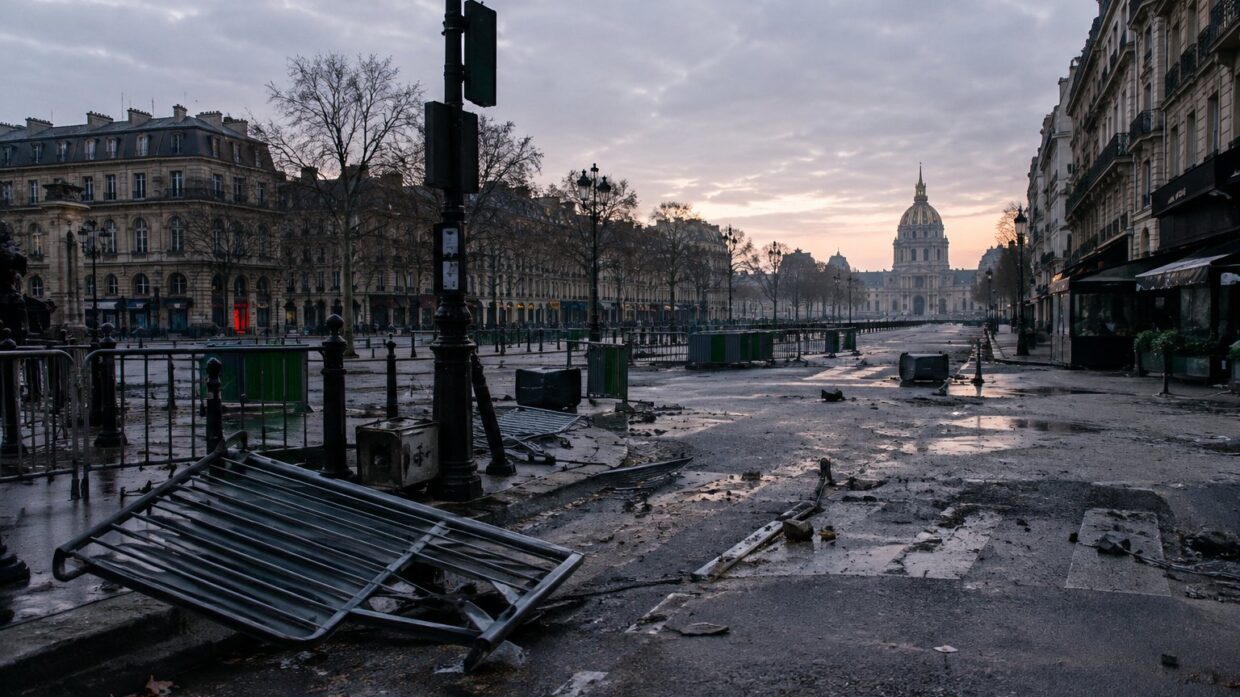
What actually happened: French authorities reported Sunday that weekend protests over rising living costs produced less violence than previous demonstrations. The Washington Examiner reports that police "expressed relief," suggesting a de-escalation from prior weeks. Bloomberg reports separately that German mass demonstrations "passed largely peacefully on Saturday" but "erupted in violence as night fell," with documented clashes in Frankfurt, Cologne, Hamburg, and Berlin. The timing and geography diverged significantly: France saw a general decrease in disorder; Germany saw a transition from daytime calm to nighttime confrontation.
The right frame, represented by the Washington Examiner, emphasizes police relief and the normalization of reduced violence as a positive development in France, while framing German violence as a discrete phenomenon. The headline construction "French protest violence eases and scattered riots hit Germany" treats the two countries as separate stories rather than linked movements. This framing prioritizes state relief and treats violence as something that emerges from specific "activist" or "rioter" groups rather than as a response to policing or conditions. The word "scattered" applied to German riots suggests disorder without coordination, and the emphasis on police expectations of "more action" when schools reopen frames the movement as cyclical disruption rather than as persistent pressure from organized constituencies.
The left frame, represented by Bloomberg, emphasizes the pattern of escalation and police confrontation. The headline "German Protests Turn Violent as Activists Clash With Police" centers the clash itself as the story. The structural observation that demonstrations "passed largely peacefully" before erupting at nightfall raises a specific question the right framing avoids: what changed between day and night? Bloomberg's phrasing "as night fell and rioters faced off" suggests a temporal and tactical pattern rather than spontaneous disorder. This framing implies that police presence, tactics, or conditions may have triggered or intensified the violence, whereas the right frame treats violence as something activists bring to otherwise orderly space.
What neither side is fully capturing requires attending to what the reporting leaves unstated. The available summaries do not establish whether France and Germany are responding to identical or different conditions. Are the living cost pressures comparable? Are the protest organizers and tactics the same? The reporting also does not explain the temporal shift in Germany: what specific incident or police action triggered the transition from daytime peace to nighttime violence? Without that detail, both frames remain incomplete. The left frame risks implying police responsibility without evidence of specific provocation. The right frame risks dismissing violence as activist choice without context about state action that may have preceded it.
The underlying question both framings obscure is whether these are comparable movements or distinct ones. The French protests are framed around a specific economic grievance with measurable momentum (authorities tracking violence levels week to week). The German reporting offers no equivalent economic anchor. That difference suggests either that German protests serve different purposes, or that the reporting has not yet made that connection clear. What remains undisclosed is whether German rioters were part of the same living cost movement that mobilized France, or whether Germany faced a distinct phenomenon that coincidentally overlapped.
France's declining protest violence has become a metric of state success, but Germany's nighttime eruptions reveal how temporal framing obscures causation. When demonstrations transition from peaceful daytime assembly to violent nightfall confrontation, the shift itself is data. Police tactics, crowd control measures, and containment strategies deployed during afternoon hours create the conditions that manifest hours later. By treating French de-escalation as administrative relief and German violence as activist pathology, reporting misses the operational reality: both countries are managing the same economic grievance through different enforcement approaches that produce different temporal patterns. The consequence is institutional amnesia about what generates protest cycles. If European governments understand their success metrics as lower reported violence rather than addressing underlying living cost pressures, they optimize for containment theater while structural conditions worsen, guaranteeing larger demonstrations that no policing strategy can suppress indefinitely.