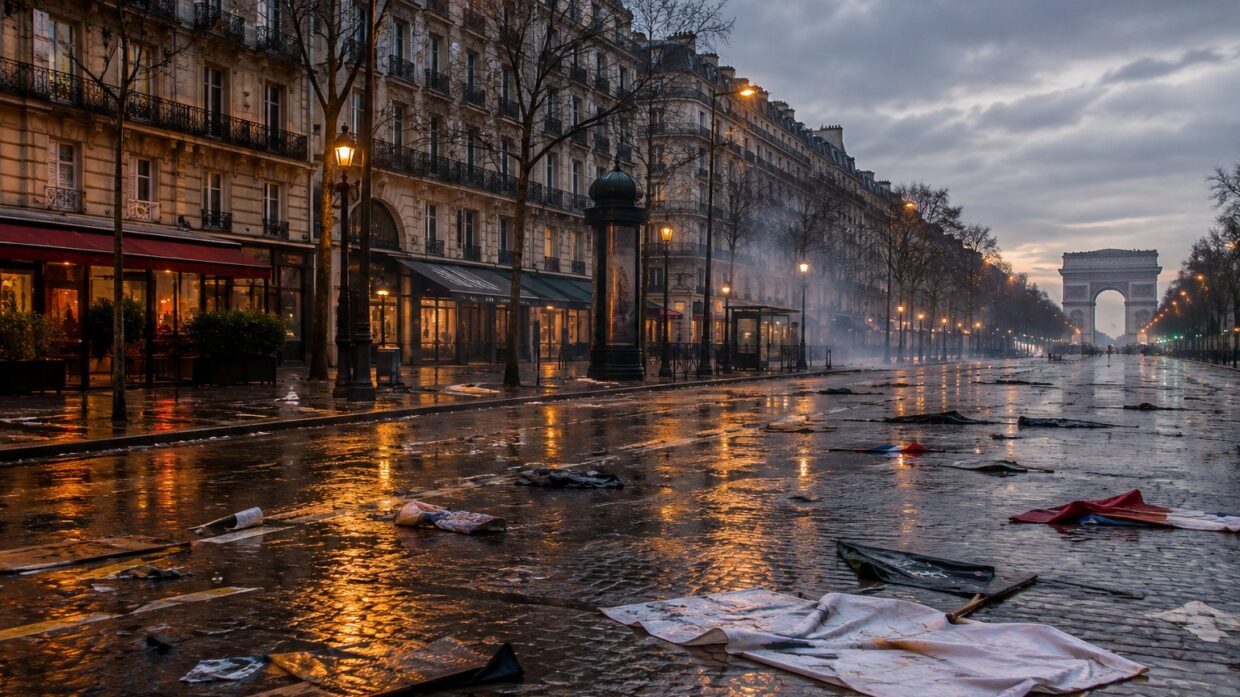
Photo: Well This Is News
Macron's government faces mass challenge as police crack down on cost-of-living protesters
We haven't found a right-leaning take on this story yet.
Breaking stories sometimes publish before every side has covered them. We'd rather show you that than invent a view.
French police deploy tear gas as 100,000+ protest living costs and school funding in Paris
Key Takeaways
- No reporting discloses what triggered the tear gas and water cannon deployment or whether police or protesters initiated the escalation.
- France has experienced repeated cost-of-living protests since 2018, including the yellow vest movement, but this reporting does not establish whether Saturday's march represents escalation or a continuation of longstanding protest cycles.
- The size of the demonstration and police response could indicate genuine political instability or routine friction in French democracy, but available reporting cannot distinguish between them.
The Analysis
Police deployed tear gas and water cannons against a Paris march of more than 100,000 people protesting school funding and living costs, but the available reporting does not disclose whether police initiated the escalation or responded to specific acts by protesters. The framing around this event already diverges sharply depending on which detail a news outlet chooses to foreground.
NBC News led with the police response as the primary action: the tear gas and water cannons appear first in the headline and opening, positioning police action as the main event of the day. The word "challenging" appears in NBC's headline, attributing agency to the protesters for confronting Macron's government. Bloomberg's framing inverted that emphasis. Bloomberg's headline places police action second, subordinate to the fact that demonstrations "began," and adds context that was absent from NBC: that police were explicitly "seeking to avoid repeat of violence." That single phrase reframes police conduct from aggression to restraint.
Neither outlet specified what triggered the tear gas deployment. Bloomberg noted it occurred "near the end of the protest," but did not report whether police fired first, whether protesters threw objects, or what sequence of events preceded the chemical dispersal. NBC made the same omission. This gap is significant because it shapes how readers interpret the police action. If police fired gas at peaceful marchers at the demonstration's end, the framing suggests suppression. If police responded to property damage or projectiles, the framing suggests riot control. The public reporting does not establish which.
The left framing emphasizes state force against citizens exercising democratic rights. NBC's language selection, "challenge," "crack down," the pairing of tear gas deployment with a government facing popular opposition, constructs a narrative where police action appears punitive rather than procedural. The narrative leaves out whether any violence or property destruction occurred and does not contextualize how French police have managed large demonstrations historically.
The center framing emphasizes police restraint amid risk. Bloomberg's reference to avoiding a "repeat of violence" assumes readers know what that prior violence was, and suggests current police conduct should be read against that baseline. That framing leaves out what that prior violence consisted of and when it occurred. Bloomberg also does not report whether Saturday's march itself remained entirely peaceful.
What neither outlet fully captures is the sustained pattern of French protest and police response around cost-of-living crises. French workers have protested Macron's economic policies repeatedly since 2018, including the "yellow vest" movement. The reporting does not establish whether this Saturday demonstration represents escalation from previous marches, continuation of existing patterns, or a new constituency entering established protest cycles. Without that context, readers cannot assess whether the scale (100,000+) or police response signals genuine political instability or routine democratic friction.
The real headline is that tens of thousands of French citizens mobilized against government economic policy, and police used chemical dispersal at an unspecified point in the demonstration, but the public record does not establish whether the escalation reflected new violence or routine dispersal tactics applied to a large crowd.
French police's deployment of tear gas against 100,000 protesters signals how Macron's government manages dissent over economic policy, yet without clarity on what triggered the escalation, citizens cannot evaluate whether their government treats mass opposition as legitimate grievance or security threat. This matters because France's tolerance for street-level protest shapes whether workers feel heard through demonstrations or pushed toward more disruptive action. The gap in reporting obscures a crucial institutional question: does French policing distinguish between peaceful assembly and property destruction, or does crowd size alone justify chemical dispersal? That distinction determines whether large marches remain viable democratic pressure or become counterproductive confrontations that discourage future participation.