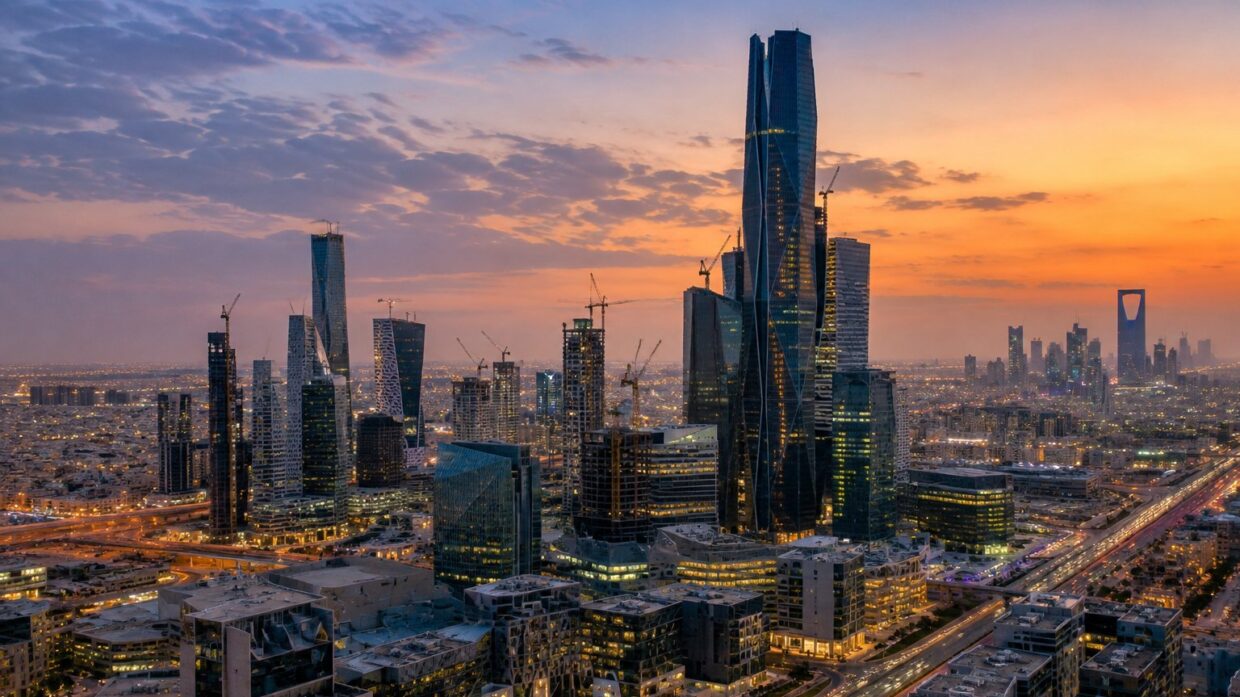
Photo: Well This Is News
We haven't found a left-leaning take on this story yet.
Breaking stories sometimes publish before every side has covered them. We'd rather show you that than invent a view.
We haven't found a right-leaning take on this story yet.
Breaking stories sometimes publish before every side has covered them. We'd rather show you that than invent a view.
We haven't found a neutral take on this story yet.
Breaking stories sometimes publish before every side has covered them. We'd rather show you that than invent a view.
The Analysis
Saudi Arabia's decision to postpone its Future Investment Initiative conference from its scheduled date until 2027 follows a direct military attack on Riyadh airport by Houthi forces, an outcome that reveals how regional proxy conflicts are now producing immediate economic consequences for major regional powers.
The documented facts are specific. On an unspecified date described as "earlier this month" by Vox, Houthi militants launched what Vox characterizes as "the worst attack in over a decade" on a Saudi Arabian airport in the capital, killing at least 13 people and wounding more than 300. The Hill reports that organizers at the Future Investment Initiative Institute responded by postponing the conference, which the outlet notes is colloquially known as "Davos in the Desert," to 2027. The timing creates a direct causal line: attack, then postponement.
The left framing, represented by Vox, emphasizes causation through state attribution. By describing this as "the Iran war" and identifying the Houthis as "Iran-backed," Vox establishes Tehran as the ultimate agent of Saudi Arabia's economic disruption. The headline construction "How the Iran war is ruining Saudi Arabia's plans" assigns agency upward to a state-level conflict rather than to the specific militant group carrying out the attack. This framing serves a narrative function: it simplifies a complex regional proxy dynamic into a direct Tehran-to-Riyadh threat, making the story legible as great power competition. What this framing leaves out is the operational independence of Houthi decision-making, the Yemeni civil war's distinct grievances, and whether the timing of this specific attack reflects Iranian strategic direction or autonomous Houthi operational choices.
The right perspective, as represented in the sources provided, does not offer a direct counter-analysis to this story. The Daily Wire headline about U.S. bombing Iran and Iranian protests does not engage with the Saudi economic consequence or the Houthis specifically, leaving that lane vacant in the available material.
What neither side's framing fully addresses is the underlying vulnerability this reveals about Saudi Arabia's economic model. The cancellation of a marquee investment summit signals that foreign investors now calculate increased risk in the kingdom during periods of military tension. This is not new, the 2019 attack on Saudi oil facilities by Houthis (also described as Iranian-backed) produced similar effects, but the scale of this economic disruption suggests Saudi Arabia's regional security position has shifted. The conference postponement also occurs against the backdrop of Saudi Arabia's economic diversification strategy, which depends on foreign direct investment to reduce oil-sector reliance. A conference postponement may appear tactical, but it functions as a visible signal of diminished investor confidence.
The sequence of events raises a question the available reporting does not resolve: whether Saudi Arabia's tolerance for regional military escalation has genuine limits or whether this postponement reflects diplomatic signaling rather than actual security concerns. The timing to 2027, nearly four years away, suggests either a calculation that regional tensions will have resolved by then or a decision to weather the current conflict rather than abandon the conference outright. That distinction matters for understanding Saudi Arabia's actual assessment of its regional position.
Saudi Arabia's decision to postpone its marquee investment conference until 2027 exposes the fragility of the kingdom's economic diversification strategy. Foreign direct investment is central to Vision 2030, Saudi Arabia's plan to reduce oil dependence and build non-energy sectors. When a single military attack forces organizers to cancel the "Davos of the Desert" and push the event four years into the future, it signals to global capital that political risk in the kingdom has risen materially. Investors already weigh geopolitical instability; a postponement of this magnitude becomes a self-fulfilling prophecy, dampening capital flows precisely when Saudi Arabia needs them most to execute its economic transformation. The kingdom is betting that regional tensions will subside by 2027, but each attack that forces postponement strengthens the perception that Saudi Arabia cannot guarantee investor safety during periods of escalation.