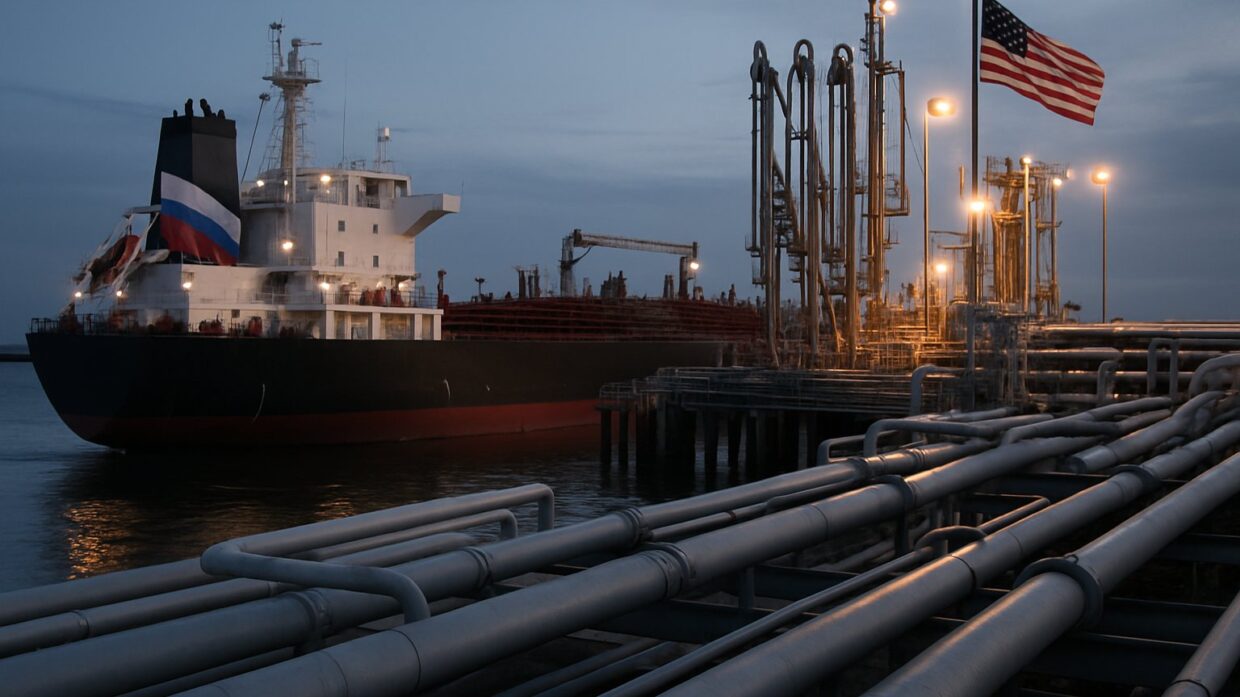
Photo: Well This Is News
GOP senator says Trump's Russia fuel deal may violate law, raising Ukraine concerns
Trump announces Russian fuel deal as senator questions legal compliance with sanctions framework
Trump announces Russian fuel deal as senator questions legal compliance with sanctions framework
Key Takeaways
- Trump has not publicly disclosed which specific sanctions authorities he claims permit the fuel arrangement, making it impossible for independent reviewers to verify whether existing law supports his decision.
- Congress was apparently not consulted before the fuel deal announcement, as evidenced by Sen. Tillis's surprised public criticism suggesting the Republican Senate was not briefed in advance.
- The reporting frames the legality question as disputed opinion rather than a question answerable by examining the statutory text of sanctions law and executive authority.
The Analysis
President Trump announced a deal permitting Russian diesel fuel into global markets by easing sanctions restrictions, and within his own party, Sen. Thom Tillis publicly stated the arrangement may violate existing federal sanctions law. What remains unclear is whether Trump consulted Congress before the decision, what specific sanctions authorities he claims to invoke, and whether the fuel arrangement includes conditions on Russian military expenditure.
The factual record establishes this: Trump announced a fuel deal with Russia. Tillis, a Republican senator from North Carolina, used the phrase "may be breaking the law" when discussing the sanctions easing. NPR's reporting frames the announcement as one that raises questions about consistency between Trump's recent sanctions signature and the new fuel arrangement, without resolving whether the deal legally complies with existing restrictions. NBC News emphasizes Tillis's concern about Ukraine implications, quoting his statement directly but not reproducing Trump's legal justification for the decision.
The left frame, as represented by NBC News, leads with Tillis's legal criticism and Ukraine concern. The framing emphasizes party dissent, suggesting Trump's own allies question his compliance with law. The emphasis shifts attention toward institutional guardrails (senator as check on executive power) and alliance commitment (Ukraine support as measure of seriousness). The coverage does not foreground what legal authority Trump claims, whether sanctions law permits discretionary waivers for fuel arrangements, or whether prior administrations used similar mechanisms. The omission of Trump's stated legal rationale leaves readers with criticism but not with the administration's defense.
No right-leaning source was provided in the materials above, so no right-wing framing analysis is possible from the given sources.
What neither source fully addresses is the statutory question: does existing sanctions law grant the executive explicit authority to permit fuel imports from sanctioned countries, or did Trump's decision require Congressional approval under the International Emergency Economic Powers Act? The reporting treats the legality question as disputed rather than settable by reference to statute. Additionally, neither source names the specific sanctions authorities Trump invoked, making independent verification difficult. The fuel price implications are absent from both framings, though the likely consequence of adding Russian diesel to global markets would be downward pressure on fuel costs for American consumers and allied nations.
The underlying structural question is whether the Trump administration consulted with Congress before the decision and, if not, whether it believes it has unilateral executive authority to ease sanctions on fuel exports specifically. Tillis's public statement suggests at minimum that the Republican-controlled Senate did not uniformly endorse the approach beforehand, or was not briefed in advance. The sequence raises questions about whether the fuel deal reflects a strategic shift in Russia policy or a narrow energy-market arbitrage presented as diplomatic negotiation.
Permitting Russian fuel into markets without clear Congressional consultation establishes a precedent for unilateral executive authority over sanctions architecture that Congress spent decades constructing. If Trump's legal justification rests on discretionary waivers rather than explicit statutory grants, future administrations inherit a weakened sanctions regime where fuel, food, or financial flows can be redirected through executive decree. Tillis's public dissent signals the Republican Senate itself lacks confidence in the legal foundation, meaning even a party-aligned Congress views this as exceeding delegated power. The institutional consequence is immediate: sanctions law loses its character as binding constraint on executive conduct and becomes instead a negotiable framework. Fuel price suppression globally follows, but the more durable impact is that sanctions enforcement shifts from legal-statutory ground to presidential whim.