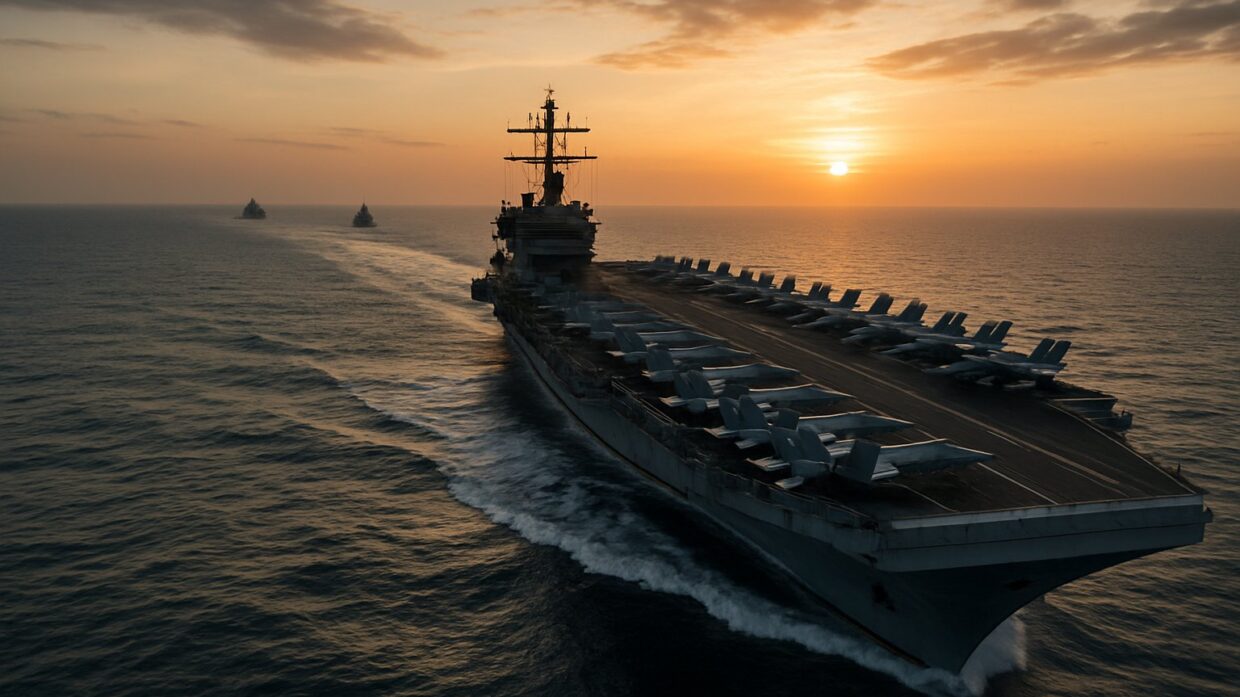
Photo: Well This Is News
Trump Escalates Iran Tensions: Third Carrier and Thousands of Troops Deployed as New Strikes Loom
US Builds Military Strength in Mideast as Trump Prepares Options Against Iran Threat
Pentagon Deploys Third Carrier, 10,000 Troops to Persian Gulf as Trump Signals Possible Iran Strikes
Key Takeaways
- The administration pursued talks with Iran first, then expelled negotiators and deployed military reinforcements after negotiations stalled, but the reporting does not explain what Iran's position was or whether the breakdown reflected real incompatibility.
- Trump stated that new strikes on Iran are possible rather than imminent or planned, leaving unclear whether these public statements are meant as deterrence signals or indicators of actual military planning.
- The deployment expands American military options in the region while all diplomatic channels remain severed, yet the administration has not disclosed what military objectives would justify using this force or what conditions would lead to de-escalation.
The Analysis
The Pentagon is deploying a third aircraft carrier and 10,000 additional troops to the Persian Gulf while President Trump has explicitly stated that new military strikes on Iran are possible, yet neither the administration nor its critics have articulated a defined military objective or exit condition for escalation. This gap between capability and strategy is the actual story the news is reporting around.
The documented facts are precise. According to US officials cited by Bloomberg, an additional aircraft carrier strike group and 10,000 sailors and Marines are being sent to the Persian Gulf. The USS Theodore Roosevelt departed San Diego, though the reporting does not establish its final destination. Trump stated that additional strikes on Iran are possible but framed it as contingent, using the word possible rather than imminent or planned. Separately, Marco Rubio ordered Iranian negotiators to leave the United States after what Fox News describes as talks that stalled.
The left framing, represented by HuffPost and Democratic candidate Bale Dalton, emphasizes that this deployment signals escalation toward war and describes the situation as a deepening forever war with no strategic value or defined end state. This language does important work: it directs reader attention toward the absence of diplomatic off-ramps and frames military expansion as inherently destabilizing. What the left framing leaves out is any examination of what triggered the deployment, what specific Iranian actions prompted the reinforcement, or what objective conditions changed between previous deployments and this one. The framing assumes escalation is the problem rather than treating escalation as a response to something.
The right framing, represented by the Washington Examiner and Fox News, emphasizes deterrence and American strength. The language deployed here is that the military presence gives commanders more options and that the administration is demonstrating resolve. This framing leaves out the detail that Trump explicitly discussed the possibility of future strikes rather than merely maintaining existing posture. It also does not address what diplomatic off-ramps exist if Iran changes behavior, or what conditions would trigger the administration to reverse course and de-escalate.
What neither side fully addresses is the actual operational question. According to the reporting, the deployment occurred after Iranian negotiators were expelled from the US and talks collapsed. The sequence suggests the administration pursued negotiations first, then abandoned them when they stalled. But the available reporting does not establish what Iran's negotiating position was, what the US demanded, or whether the breakdown reflected fundamental incompatibility or tactical miscalculation by either side. The record also does not disclose whether Trump's public statements about possible strikes are intended as deterrence signaling or as indication of actual decision-making.
The most honest version of this headline captures what the deployment actually is: a tactical reinforcement that expands military options while diplomatic channels have been severed, executed by an administration that has not publicly articulated what military objectives would justify its use or what conditions would conclude it.
Military deployments without defined objectives create institutional drift that compounds costs over time. The Pentagon is now operating three carrier strike groups in a region where neither the administration nor Congress has authorized specific military targets or established conditions for withdrawal. This creates a structural problem: commanders will inevitably face pressure to justify the presence through action, while the absence of public exit criteria means escalation becomes self-perpetuating rather than purposeful. When administrations deploy massive force without articulating what victory looks like, military bureaucracies tend to expand missions indefinitely. The last three decades of Middle East operations prove this pattern. This deployment will likely become permanent infrastructure, consuming resources and generating incidents that themselves justify further deployments, all without requiring any formal authorization or strategic debate.