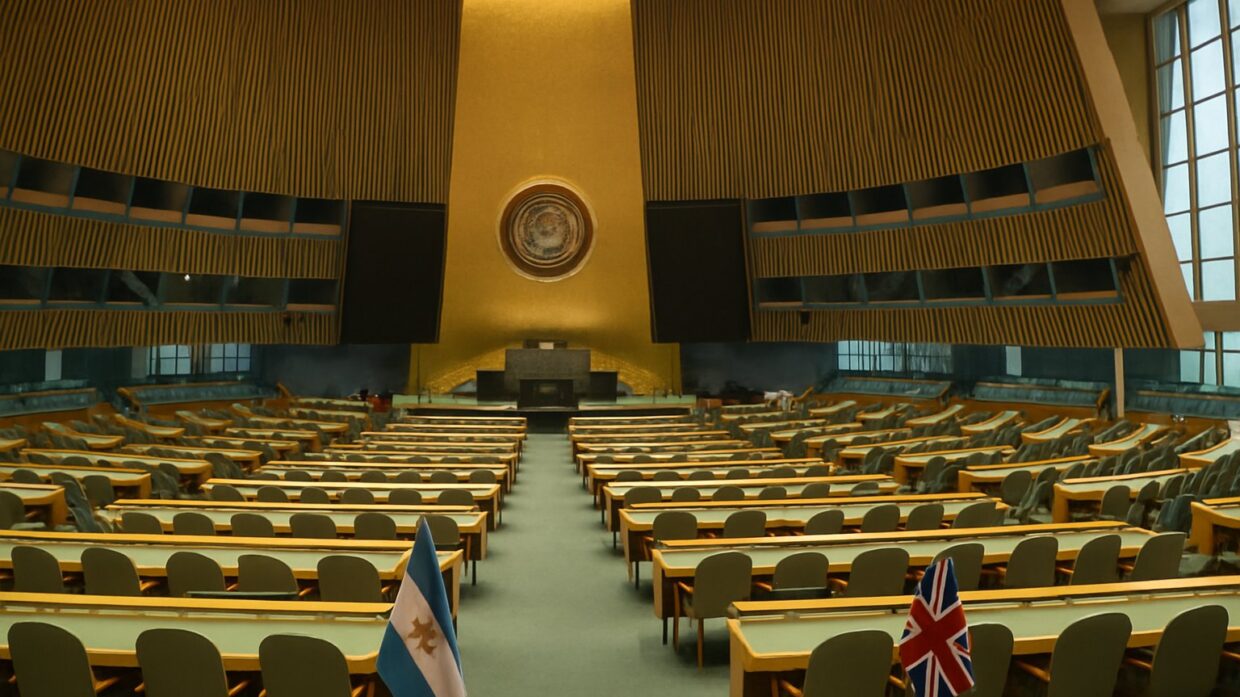
Photo: Well This Is News
Argentine president threatens unilateral Falklands action, condemns UN as filled with parasites
Milei scorches UN as useless body of fatally arrogant parasites in blistering General Assembly speech
Milei delivers fiery UN address, attacks organization as 'useless' and raises Falklands dispute
Key Takeaways
- The phrase 'taking matters into our own hands' could mean military action, unilateral legal claims, or simply abandoning UN negotiations, yet coverage across all outlets never clarified which interpretation Milei intended.
- Milei's Falklands position is not new to Argentina, but coverage fails to establish whether his UN speech signals an actual change in strategy toward Britain or is primarily a domestic political gesture for Argentine audiences.
- Milei's UN critique may reflect either libertarian principle applied consistently to international institutions or tactical use of the UN platform to advance Argentina's territorial claim, and the sources do not distinguish between these motivations.
The Analysis
Javier Milei's September 23 UN General Assembly speech used identical language across three right-leaning outlets and one left-leaning outlet, yet the framing of what he said and why diverges sharply. What everyone quoted accurately was the phrase 'fatally arrogant parasites' applied to UN leadership. What neither side fully clarified is what specific UN actions or inactions prompted the language, or whether the Falklands escalation represents a genuine strategic shift or rhetorical theater.
The Guardian framed Milei's speech as a 'bellicose' threat on the Falklands and positioned the UN criticism as secondary context for that threat. The emphasis was on the word 'matters into our own hands,' which the outlet treated as language suggesting military or coercive action Argentina might pursue outside UN channels. The piece underplayed the scope of Milei's UN critique, treating it largely as an instrument for advancing the Falklands claim rather than as a coherent libertarian argument about international institutions.
Breitbart, Fox News, and The Daily Wire inverted the hierarchy. They led with the UN critique itself, quoted 'fatally arrogant parasites' and 'useless' directly, and expanded the scope to include Milei's condemnation of pandemic lockdowns and his claim that the UN sheltered dictatorships. The Falklands dispute appeared in these accounts but as one example of UN dysfunction rather than the primary story. The right-leaning framing presented Milei as ideologically consistent, a libertarian attacking supranational bodies on principle, not merely opportunistic in using the UN platform for a territorial dispute.
What neither framing addressed is Milei's actual track record with the Falklands claim. Argentina's sovereignty position on the islands has remained consistent across administrations. Milei did not invent the dispute or Argentina's long-standing objection. What the record does not establish from these sources is whether Milei's threat to take 'matters into our own hands' represents a change in Argentina's diplomatic posture or a restatement of existing grievance in sharper language. The phrase could mean military action, unilateral legal claims, or simply abandoning further UN negotiations. The sources do not clarify which.
The phrase 'fatally arrogant parasites' itself appears verbatim across all outlets, suggesting Milei used this exact language in his prepared remarks. What the coverage does not examine is whether Milei was criticizing the UN's failure to resolve the Falklands claim specifically or making a broader libertarian critique of international governance that would apply regardless of the Falklands outcome. These are distinct claims with different policy implications.
The left-leaning outlet treated the speech as a threat and escalation. The right-leaning outlets treated it as principle. What remains undisclosed is whether Milei's government has coordinated a change in strategy toward Britain or the UN regarding the dispute, or whether the speech was primarily a domestic political gesture aimed at Argentine audiences who view the Falklands as occupied territory. Without access to Milei's strategic communications or statements to British officials, the public record does not establish the actual intention behind the rhetoric.
Argentina's Falklands dispute is a decades-old frozen conflict that has cost lives and consumed diplomatic resources without resolution. If Milei's "matters into our own hands" language signals a shift from UN-channel negotiation to unilateral action, it could trigger a new military or legal confrontation with Britain, fracture Argentina's relationships with Commonwealth allies, and pull regional attention away from economic recovery that most Argentines care about far more than territorial claims. The speech's vagueness about intention matters because it allows both domestic audiences and international observers to project their preferred interpretation onto the same words, creating space for miscalculation. Whether Milei meant to signal genuine strategic change or simply consolidate nationalist support at home, the ambiguity itself becomes a policy problem if Britain or other nations respond defensively to perceived escalation.