Photo: Well This Is News
Dutch Riot Police Break Up Violent Far-Right March as Extremists Throw Projectiles
Police Shut Down Legitimate Anti-Immigration Protest Amid Disputed Violence Claims
Dutch Police Disperse Far-Right Protest in The Hague After Violence Erupts
Key Takeaways
- Neither the left nor right accounts explain whether this protest had official sanction, whether it was previously banned, or how similar far-right gatherings have been handled in the past.
- Both sides omitted the police's own account of what triggered the violence, what warnings were issued beforehand, and whether officers themselves threw projectiles, leaving the complete escalation sequence undocumented.
- The fundamental question of whether violence was incidental to a lawful protest or central to its character remains unanswered because reporting focused on what happened to officers rather than the full dynamics of the gathering.
The Analysis
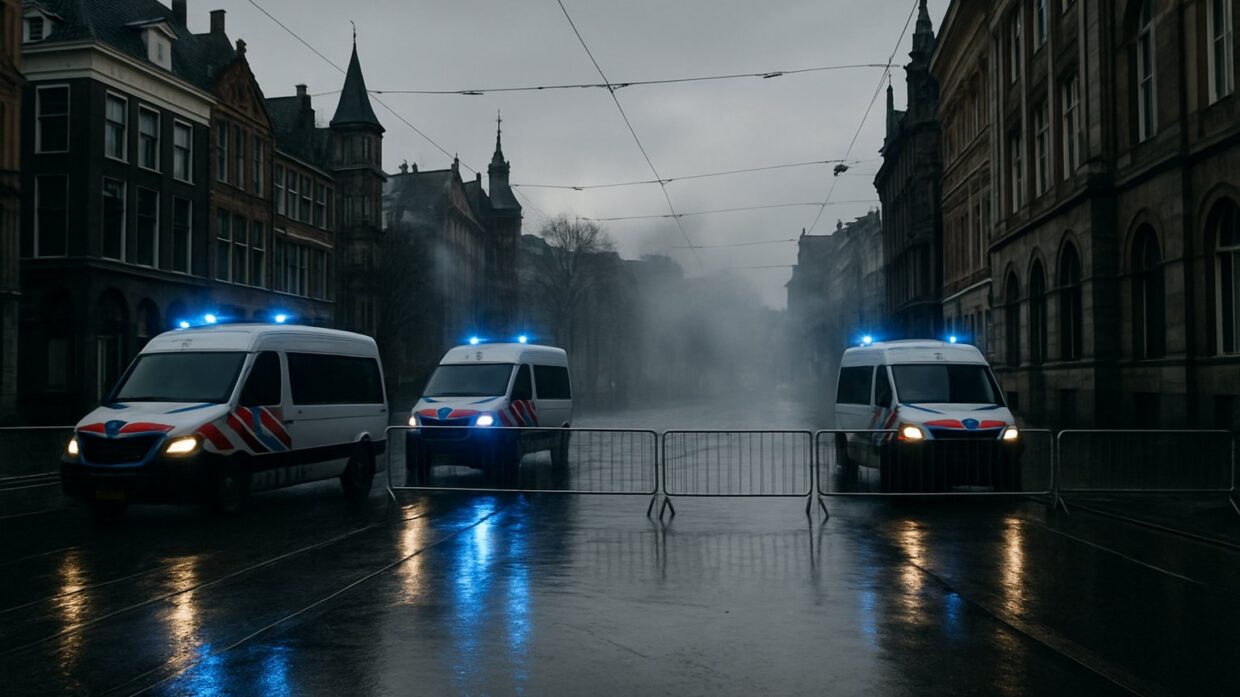
Dutch police dispersed a far-right protest in The Hague on Saturday after fireworks and projectiles were thrown at officers, prompting local authorities to ban a planned anti-immigration march. Both The Guardian and Bloomberg report the same core sequence of events, yet the framing diverges sharply on what the violence signifies and who bears responsibility for it.
The documented facts are limited. Police responded to a gathering of several hundred protesters in the city center. Objects including fireworks were thrown at officers. As a result, authorities banned the march and dispersed the crowd. The available reporting does not establish whether protesters initiated the projectile throwing or whether police actions preceded it, nor does it name specific injuries, arrest numbers, or provide chronological detail about the escalation sequence.
The Guardian's framing emphasizes the protesters' conduct, leading with the fact that "violence erupted" and describing projectiles as something "thrown at officers." The word choice "riot police" appears in the headline, establishing the severity of the police response before readers learn what the protesters were doing. The Guardian does not provide quotes from protest organizers or explain what the march was intended to accomplish beyond "against immigration." This framing serves a narrative function: it positions police action as reactive enforcement against disorder, not as a political decision to suppress a lawful assembly.
Bloomberg uses nearly identical language but without the "riot police" designation in the headline, opting instead for the simpler "police." Bloomberg similarly does not establish who initiated the violence or provide the protesters' stated purpose. Bloomberg's summary is more neutral in tone but equally sparse on context that would let readers assess whether this was a proportional response or a suppression of political speech. Neither outlet quotes Dutch officials explaining why the march was banned or what threshold of violence triggered that decision.
What neither framing addresses is the political context. The Netherlands has experienced sustained anti-immigration sentiment, and far-right parties have won electoral support in recent years. The available reporting does not establish whether this particular protest had official sanction, whether it was previously banned, or whether similar gatherings have occurred without violence. The reports also do not disclose whether the fireworks and projectiles came from all protesters, a subset of them, or counter-protesters. The Guardian's language implies the protesters threw them; Bloomberg's phrasing is ambiguous.
The omission of police perspective is striking in both accounts. Neither outlet includes a statement from the police explaining what preceded the violence, what warnings were issued, or whether officers themselves threw projectiles. This absence does not mean officers did nothing wrong; it means the public record from these sources does not establish the complete sequence of escalation.
The underlying question is not whether violence occurred but whether it was incidental to a lawful protest or central to the event's character. The available reporting does not establish this. That gap reflects an editorial choice by both outlets to report what happened to officers rather than what happened at the protest itself.
Netherlands authorities now face pressure to clarify the threshold for banning political assemblies, as this dispersal sets precedent for future far-right gatherings. Without established facts about who initiated violence or whether counter-protesters were present, Dutch law enforcement has effectively demonstrated that declaring a march illegal mid-event requires no public justification. This creates operational permission for authorities to preemptively suppress similar gatherings by citing disorder risk rather than actual conduct, fundamentally weakening the distinction between responding to violence and preventing political expression before it occurs. Subsequent far-right demonstrations will inevitably test whether police consistently apply the same standard or whether selective enforcement becomes the norm.