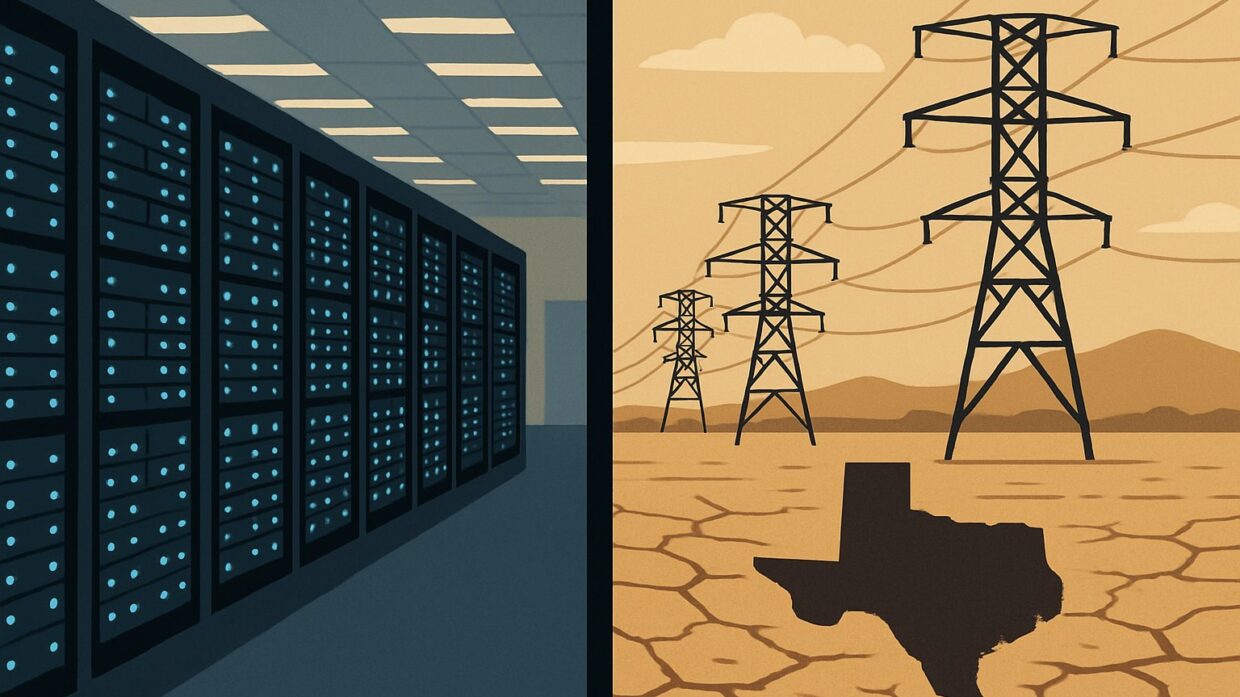
Photo: Well This Is News
Abbott abandons climate concerns to placate anti-tech voters ahead of midterms
Abbott rightfully reins in data centers after industry ignored community concerns
Abbott's Texas data center moratorium divides Republicans as Trump backs AI expansion
Key Takeaways
- Trump and Abbott are now publicly at odds over data center expansion despite both being Republicans, indicating the issue has become genuinely contested within the GOP rather than a settled party position.
- Abbott's audit announcement does not clarify whether the moratorium addresses specific grid reliability concerns from the 2021 blackouts or reflects general community anxiety about technological change.
- The split between state-level executives constraining AI infrastructure and national Republican leaders defending it suggests this may be a tactical disagreement masked as principle rather than a durable policy realignment.
The Analysis
Gov. Abbott's data center moratorium and his characterization of developers as having "dug their own grave" represents a significant pivot that has split the Republican party on AI infrastructure policy, with Trump publicly defending expansion while the Texas governor constrains it.
The documented facts are straightforward. Abbott announced a moratorium on new data center development pending a state regulatory audit. In an ABC News interview with Jonathan Karl, Abbott blamed technology companies for failing to secure community support before development. Trump, in a separate interview with former fixer Michael Cohen, defended data center expansion as economically necessary. The sources do not disclose what specific audit findings Abbott is awaiting or whether the moratorium is permanent or temporary.
The left framing emphasizes that Abbott abandoned earlier enthusiasm for data centers once local constituencies mobilized against them. This narrative casts Abbott as opportunistically adopting environmentalist and community-control language to win midterm votes rather than from principle. The framing leaves out context about what changed Abbott's cost-benefit calculation: whether he genuinely shifted on the merits or whether political pressure from local grassroots movements simply exceeded political pressure from tech industry donors. The Axios coverage notes that Democratic candidates are "dodging" Bernie Sanders' push for a full AI development pause, suggesting the issue cuts across party lines in ways neither partisan frame captures.
The right framing, primarily through the Washington Examiner, presents Abbott as holding developers accountable for ignoring community input. This narrative places responsibility on tech companies for failing to build political consensus before expanding operations. The framing leaves out whether local opposition arose primarily from documented environmental or infrastructure concerns, or from generalized anxiety about technological change. It also does not establish whether the same communities would accept data centers that met specific environmental or land-use conditions.
What neither side adequately addresses is the underlying institutional question: who decides whether data center expansion proceeds, and on what grounds. Abbott's moratorium asserts state authority to impose an audit before permitting new development. This is consistent with a pattern of state-level executives constraining AI infrastructure after initial welcomes, as the Axios reporting suggests with references to other Democratic candidates facing similar pressures. The reporting does not establish whether Abbott's moratorium reflects a genuine policy shift on energy infrastructure or a tactical response to midterm electoral dynamics. The divergence between Trump's public support for expansion and Abbott's public opposition, both within the same Republican party, suggests that the issue has become genuinely contested within conservative ranks rather than settled consensus.
A fuller picture requires noting that data center power consumption has emerged as a concrete point of local resistance in Texas, where grid reliability remains a politically salient concern following 2021 winter blackouts. The sources do not disclose whether Abbott's audit will focus on grid impact specifically or on broader community relations. What remains unclear is whether this moratorium represents a durable policy position or a midterm positioning statement. The subsequent behavior of both Abbott and Trump in the 2026 cycle may clarify whether the party is genuinely splitting on AI infrastructure or whether this represents tactical disagreement masked as principle.
Abbott's moratorium exposes a genuine fracture in Republican economic doctrine that will reshape state-level infrastructure permitting for years ahead. When the party's presumptive 2024 kingmaker and a sitting governor publicly contradict each other on whether an entire industry class should expand, subordinate officials face competing signals about which faction they should appease. Texas counties and municipalities will interpret Abbott's regulatory pause as permission to impose their own local constraints, fragmenting what was previously uniform state encouragement for data center investment. This decentralization of AI infrastructure decisions, now blessed by a major Republican executive, establishes precedent for environmental and capacity concerns to override development permitting in ways that previous Republican administrations actively prevented. The audit's findings, whenever released, will either validate aggressive local opposition or expose Abbott's position as electoral theater, but either outcome locks in a new political cost for data center proposals that developers cannot overcome through prior lobbying alone.