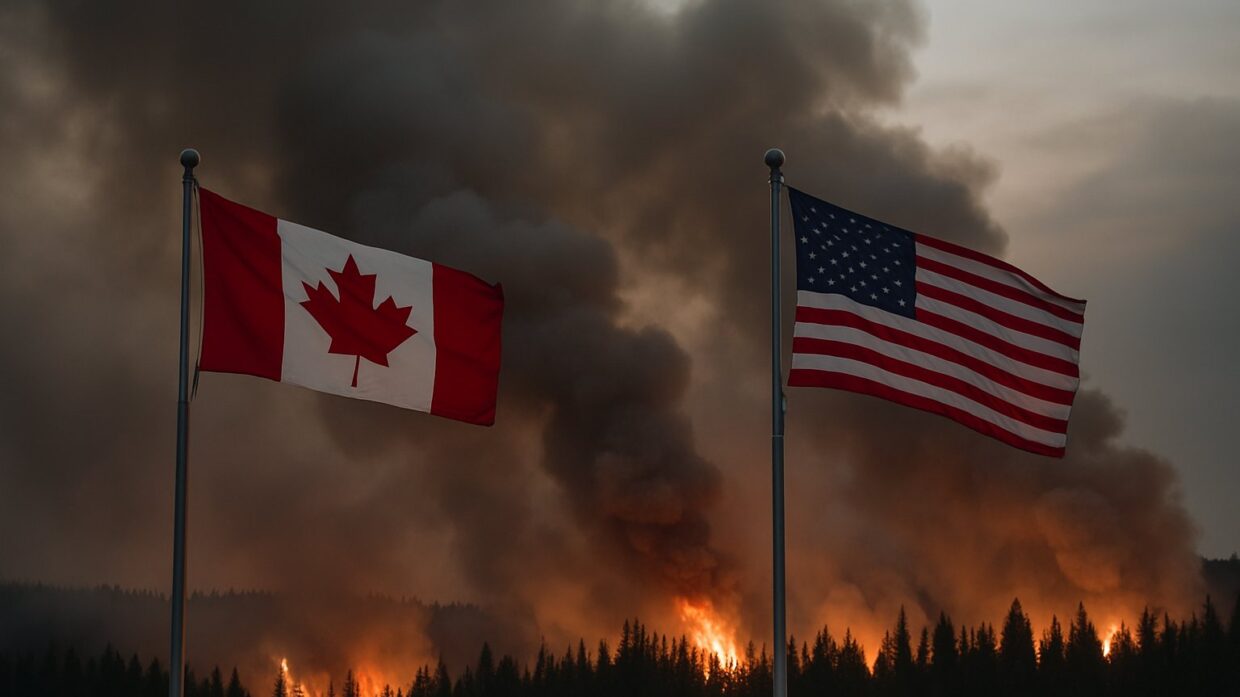
Photo: Well This Is News
Trump weaponizes wildfire crisis to blame Canada while scientists warn of climate reality
Carney threatens retaliation as Trump demands Canada control cross-border fire smoke
Canada signals tariff response as Trump administration links wildfires to trade negotiations
Key Takeaways
- Trump introduced the wildfire complaint after announcing tariffs, suggesting he may have used the air quality issue as a negotiating tactic rather than raising it as an independent environmental concern.
- Cross-border air pollution between the U.S. and Canada has historically been resolved through environmental agreements, not trade threats, making Trump's approach to this issue unprecedented in bilateral relations.
- Neither Carney nor Trump has addressed what specific measures Canada could actually take to reduce wildfire smoke crossing the border or whether such measures exist within the limits of climate science.
The Analysis
Trump has linked a natural disaster to trade negotiations, and Carney has responded by treating the trade threat as the primary dispute rather than the climate event. What neither framing addresses is why wildfire smoke crossed the border in the first place and whether that pattern is negotiable.
The documented sequence is this: Trump threatened 50 percent tariffs on Canadian goods. Carney then said Canada would respond to those tariffs. Trump separately accused Canada of failing to control wildfires that produce smoke affecting U.S. air quality. The left has emphasized Trump's "blame game," interpreting his wildfire complaint as a rhetorical device to justify tariffs on unrelated grounds. The right has presented Carney's tariff response as a threat in reaction to Trump's legitimate demand that Canada address cross-border air pollution. What the left emphasizes is that scientists describe wildfires as a symptom of climate conditions, not a policy failure a national government can simply "stop." What the right leaves out is that Trump appears to have introduced the wildfire issue after announcing tariffs, not before.
The Guardian reported Trump told Carney "you got to stop these fires from coming in," framing it as a control problem. Scientists quoted in the story called this framing a "blame game" and emphasized that wildfires are "a symptom of the climate crisis." That language choice is significant: it positions wildfire frequency as driven by global climate patterns, not Canadian forest management policy alone. Breitbart's headline described the wildfire mention as a "fiasco," attributing it to Canada, and quoted Carney's "everything is on the table" phrase without initial context. The Hill reported the tariff threat and Carney's response without leading with the wildfire accusation, treating them as a trade negotiation rather than a climate dispute.
What neither side fully addresses is the policy question underneath: whether cross-border air pollution constitutes a legitimate trade negotiation point, or whether Trump has reframed a climate issue as a trade lever. The record does not establish Trump's internal reasoning for mentioning wildfires at the moment he did. What it shows is the sequence: tariff threat announced, then wildfire complaint introduced, then Carney responded to the tariff threat. That sequence matters for evaluating whether the wildfire issue is a genuine environmental concern or a negotiating tactic. It also matters whether wildfire smoke crossing state and national borders is scientifically preventable through the domestic policies any single country can implement.
The missing context is that cross-border air pollution has been a recurring issue between the U.S. and Canada for decades, typically addressed through bilateral environmental agreements rather than tariffs. Trump's connection of wildfire smoke to trade obligations appears to lack precedent in U.S.-Canada relations. That does not make it wrong, but it does make it unusual. What remains unclear is whether the tariff threat preceded or followed Trump's focus on the wildfires, and whether Canada's response should address the air quality concern separately from the trade negotiation.
The real headline is this: Trump has introduced a climate-related complaint into a trade dispute, and Carney has responded by treating the trade threat as the substantive issue, leaving the air quality question unresolved. Neither framing requires Canada to explain what measures it could actually take to reduce wildfire smoke crossing the border, or what the scientific limits are on those measures.
Trump has weaponized a transboundary environmental problem by embedding it within trade negotiations, fundamentally altering how cross-border air pollution disputes will be handled between the U.S. and Canada. For four decades, smoke and pollution crossing the border were resolved through bilateral environmental agreements outside trade frameworks. By linking wildfire management to tariff threats, Trump has established a precedent that allows any future U.S. president to convert climate events into leverage in commercial negotiations, forcing Canada to negotiate environmental outcomes as trade concessions rather than through established environmental diplomacy. Canada's tariff response concedes this new framework rather than challenging it, leaving the actual question of what pollution controls are scientifically feasible completely unaddressed in policy discussions that will now occur between trade negotiators, not environmental agencies.