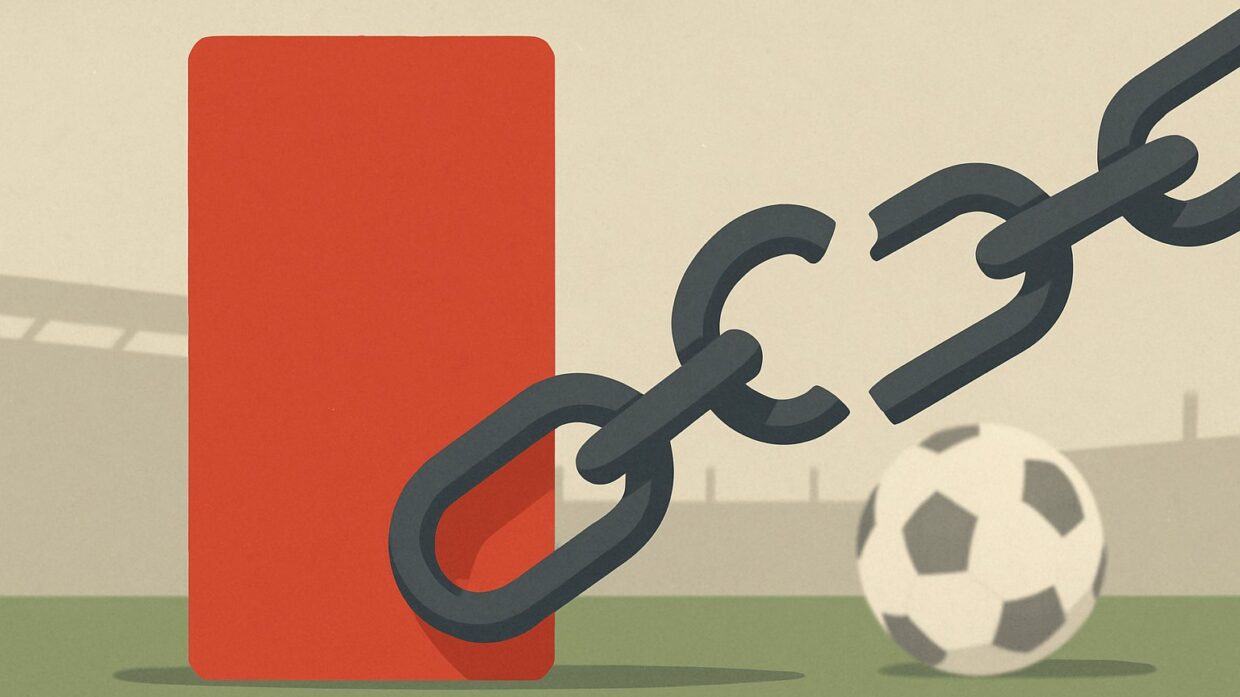
Photo: Well This Is News
FIFA suspends U.S. striker's ban, reversing controversial red card decision
FIFA overturns ban on U.S. soccer star in massive World Cup boost for America
FIFA suspends Balogun's red card ban for World Cup match vs Belgium after administration request
Key Takeaways
- FIFA's Disciplinary Committee originally upheld the red card as justified, meaning the reversal overturned its own officials' judgment rather than correcting a lower-level error.
- The Trump administration's request for review followed a presidential call to FIFA's leader, but the public record contains no documentation of what was discussed or whether it influenced FIFA's decision-making process.
- FIFA announced the suspension on a probationary basis without publicly explaining its reasoning for reversing the decision or whether this creates a precedent for future disciplinary appeals involving political intervention.
The Analysis
FIFA suspended Folarin Balogun's one-game red card ban on Sunday, allowing the U.S. striker to play against Belgium in Monday's World Cup round of 16 match, but the decision's legitimacy rests on contested grounds: whether the penalty was proportionate to the offense, and whether a Trump administration request influenced FIFA's review process.
The documented sequence is this: Balogun received a red card in the July 2 match against Bosnia and Herzegovina for stepping on the foot of defender Tarik Muharemovic. FIFA's Disciplinary Committee initially upheld the ban. On Wednesday, according to the Washington Examiner, President Trump called FIFA President Gianni Infantino. A Trump administration official subsequently requested that FIFA review the red card decision, according to Axios. On Sunday, FIFA announced it was suspending the ban on a one-year probationary period, clearing Balogun to play. The Royal Belgian Football Federation responded with a statement saying it was astonished by the decision.
The left-leaning framing, as presented by NPR, emphasizes the factual reversal and Belgium's official objection without foregrounding the Trump administration's request. This framing allows readers to focus on the substantive question of whether the red card was justified, treating FIFA's reversal as a correction of an error. The coverage does not emphasize the political dimension or the appearance of executive pressure on an international sports body. NPR uses the word astonished to capture Belgium's reaction but does not explore what that astonishment might suggest about the process itself.
The right-leaning framing, as presented by The Daily Wire and Breitbart, emphasizes the political benefits to the U.S. team and presents the reversal as vindication for a player treated unfairly. The Daily Wire calls it a major World Cup boost. Breitbart uses language like shocking reversal and mammoth implications. This framing treats the red card as clearly controversial and FIFA's suspension as a correction of an unjust decision. The coverage celebrates the outcome for American interests without substantively engaging the question of whether Trump's call to Infantino influenced the decision or whether such influence would be appropriate.
What neither side fully addresses is the structural problem: FIFA's Disciplinary Committee initially upheld the ban, meaning the first-instance decision was not made in error according to FIFA's own officials. A reversal on a probationary basis is unusual and appears to require a second institutional act after the first decision stood. The reporting does not establish FIFA's stated reasoning for reversing course. Additionally, the Washington Examiner reports Trump called Infantino on Wednesday, but the public record does not disclose what was said in that call, whether it constituted pressure, or whether it materially influenced FIFA's subsequent decision. The coincidence between a presidential call and a reversal in America's favor is noteworthy, but the causal chain remains undocumented.
What makes this significant is that it exposes a tension in FIFA's governance: whether a red card decision can be revisited at the president's discretion, and whether direct communication between national political leaders and FIFA's leadership should precede disciplinary reversals. The available evidence does not establish FIFA's internal reasoning or whether the reversal sets a precedent for future politicized requests. The underlying question is whether this was a correction of a genuinely excessive penalty or a demonstration that sufficient political pressure can alter FIFA's sporting decisions.
FIFA's suspension of Balogun's red card ban, following a documented presidential call to FIFA's leadership, establishes a precedent that international sports disciplinary decisions can be revisited through direct executive pressure rather than formal appeals processes. The Disciplinary Committee had already upheld the ban, making FIFA's reversal on probationary grounds a second institutional reversal without published reasoning. If this becomes normative, future bans and suspensions will hinge not on consistent standards but on whether disputing nations can mobilize political leverage at the highest levels. Belgium's official objection signals that smaller federations now understand FIFA decisions are negotiable through channels outside the sporting framework itself. This fractures the appearance of rules-based authority in international competition and invites similar requests from other nations, transforming FIFA governance into a forum where political capital outweighs disciplinary consistency. The absence of disclosed reasoning for the reversal compounds the damage, ensuring all future controversial decisions will be examined