Photo: Well This Is News
Vanilla Ice and Trump's competing visions of American greatness
Trump launches Great American State Fair celebrating nation's 250th birthday
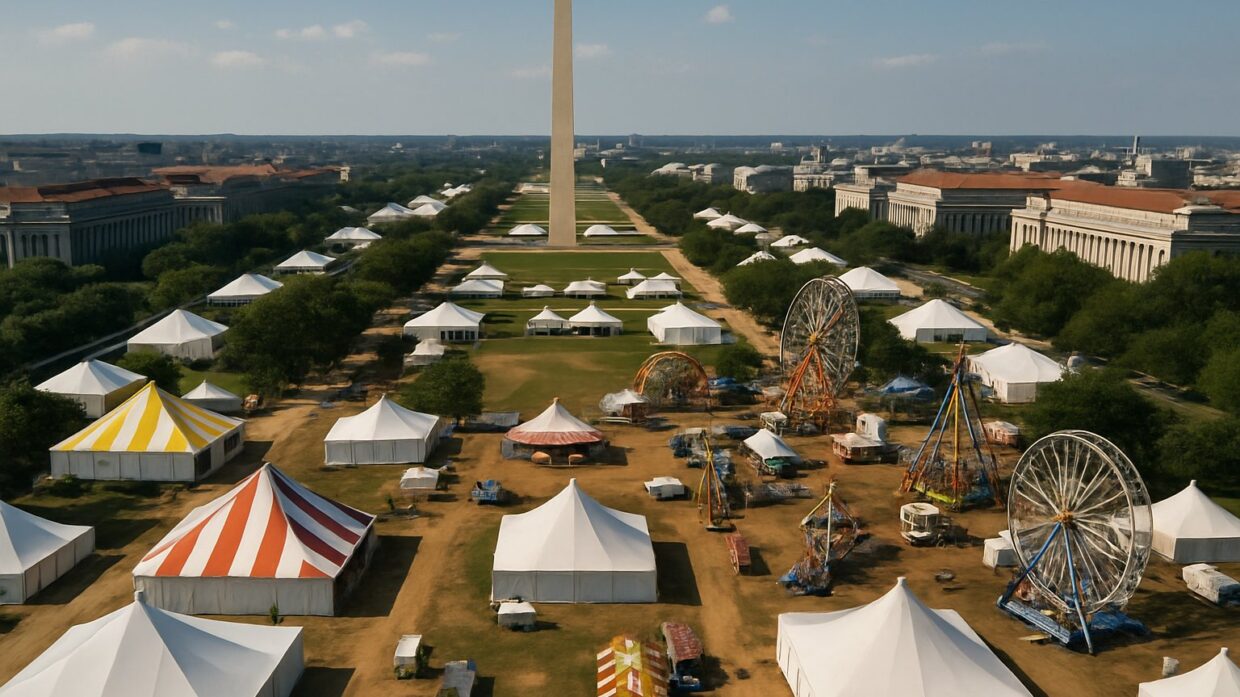
Trump opens 16-day Great American State Fair on National Mall for 250th anniversary
Key Takeaways
- Both sides are fighting over whether American identity should be formally defined by government institutions or left open to individual and cultural interpretation, but neither acknowledges this is the actual disagreement.
- The competing visions reveal that no federal commemoration can truly be politically neutral, since the decision to mount an official celebration is itself a political choice that some constituencies may experience as exclusionary.
- Neither approach actually resolves fundamental questions about what America's 250 years represent, meaning the fair's existence may simply make partisan tensions over national identity more visible rather than reduce them.
The Analysis
The Great American State Fair opening reveals a fundamental disagreement about what American commemoration should look like, though the framing from each side leaves out the institutional reality underlying both visions. Trump's event, according to Fox News, emphasizes comprehensive geographic representation through all 50 states and territories with over 150 exhibits on U.S. history. The Atlantic's coverage, by contrast, foregrounds Vanilla Ice's nostalgia for a specific idealized American past, framing the anniversary as an opportunity to "transport us to another decade." What neither coverage adequately addresses is that both framings are fundamentally about control over national narrative.
The left's framing, evident in The Atlantic piece, treats the 250th anniversary as a cultural moment open to reinterpretation and personal memory. By featuring Vanilla Ice, a figure whose 1990 hit "Ice Ice Baby" became shorthand for a particular era's optimism, the magazine implicitly argues that American greatness is subjective, generational, and bound up in individual experience. The choice to profile the rapper rather than, say, a historian or policy leader serves a specific function: it depoliticizes the celebration by rooting it in popular culture rather than government action. What this framing underplays is that official commemorative events, by their nature, impose a single narrative.
The right's framing, evident in Fox News coverage, emphasizes institutional comprehensiveness and geographic inclusion. The language "all 50 states and territories" appears in the headline and sets up a picture of national unity achieved through Trump's event. This framing implicitly argues that America's greatness is proven through its diversity of places, its institutional structures, and its capacity to organize a nationwide celebration. The choice to emphasize the scale of the event, the number of exhibits, and the duration of the fair serves a different function: it suggests that official government action, when properly executed, can produce consensus. What this framing does not foreground is that a state-by-state exhibition does not resolve disagreements about what America's 250 years actually represent.
The Hill's reporting, by acknowledging that the fair opens "against a backdrop of partisan fighting and public fallouts," signals what both sides are carefully omitting: there is no consensus on what the 250th anniversary should celebrate. The left's cultural approach and the right's institutional approach are not competing versions of the same event. They are competing answers to a prior question: whether a national milestone should be defined by government-organized exhibits or by citizens' individual nostalgia and reinterpretation. Neither framing addresses whether it is possible for a federal event to be politically neutral, or whether the very act of mounting an official celebration is itself a political choice that some constituencies will experience as exclusionary.
What makes this significant is not the disagreement itself but the specific form it takes. The left does not argue the fair should not exist. The right does not argue that cultural figures have no role in national commemoration. Instead, each side is operating from a different assumption about whether American identity should be formally defined or left open to interpretation. The public record does not yet establish whether the Fair's contents or messaging will resolve this tension or simply make it more visible.
The opening of the state fair exposes a deeper institutional question about who controls national narrative during moments of collective commemoration. Trump's exhibition approach treats American identity as something to be comprehensively cataloged and displayed through government organization, while cultural framings position it as inherently subjective and tied to personal memory. Neither side questions whether a federally-mounted celebration can remain politically neutral, revealing that the real dispute concerns the legitimacy of official events to define national meaning at all. This matters because every future 250th-anniversary event will either reinforce or challenge the precedent that such commemorations belong to whichever administration is in power, potentially reshaping how Americans experience moments meant to transcend partisan boundaries.