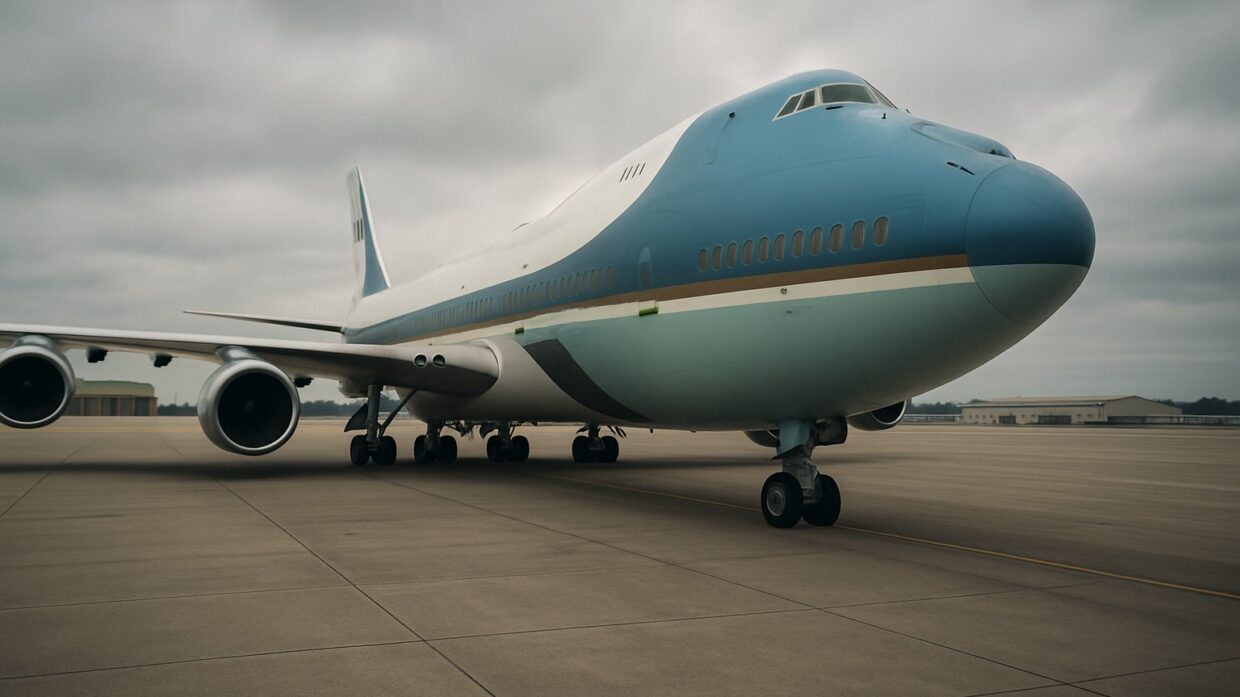
Photo: Well This Is News
U.S. accepts $400M luxury jet from Qatar, raising foreign gift concerns
Trump debuts upgraded Air Force One with superior capabilities
Trump unveils Boeing 747 gifted by Qatar as new Air Force One
Key Takeaways
- No reporting reveals whether the State Department, Defense Department, or White House Counsel's Office conducted a formal ethics review before the aircraft was accepted, leaving the internal vetting process entirely opaque.
- Qatar hosts the largest U.S. military base in the Middle East, houses U.S. Central Command headquarters, and recently mediated negotiations on Israeli-Palestinian tensions, but coverage does not establish whether the $400 million gift relates to these existing strategic interests or creates new obligations.
- The mechanics of how a foreign government aircraft integrates into U.S. military operations, who pays for maintenance and upgrades, and how security and classification protocols apply to the jet remain completely unreported.
The Analysis
The Trump administration accepted a Boeing 747-8i valued at $400 million as a gift from the Qatari government, unveiled it as the new Air Force One on Friday at Joint Base Andrews, and announced it would lead a July 4th flyover of Washington, D.C. What the coverage splits on is whether this signals diplomatic achievement or raises unprecedented ethics concerns about foreign gift-giving to U.S. officials.
The documented facts: Qatar gifted the aircraft to the U.S. government in 2025. The jet replaced a Boeing 747-200 that had served as Air Force One for 36 years and completed its final flight from the G7 in France on Thursday. Trump described the new aircraft as larger, with greater range and luxury features. The $400 million valuation appears in NPR's reporting. No U.S. law explicitly prohibits foreign governments from gifting aircraft to the federal government, though the Foreign Gifts and Decorations Act of 1966 requires disclosure of gifts to federal employees valued above a threshold. The mechanics of acceptance and review remain unreported.
The left framing, most clearly in NPR, leads with "one of the biggest foreign gifts ever received by the U.S. government" and flags the gift as "controversial." This language does three things: it elevates the magnitude relative to historical precedent, assigns negative valence upfront, and implies that controversy exists without naming who raised it or what specific ethical concern applies. NPR does not report whether ethics officials reviewed the gift, whether conditions were attached, or what the Qatari government's strategic interest might be. The frame suggests opacity without establishing it.
The right framing, most clearly in Breitbart and the Daily Wire, treats the aircraft as a logistical upgrade and frames the timing narratively: a 36-year-old plane's final voyage followed by the unveiling of its replacement. This avoids the gift question entirely and repositions the story as capability and renewal. The Washington Examiner mentions the jet will "fly over DC on July 4," anchoring it to patriotic spectacle. The right sources do not engage with whether acceptance of the gift carries diplomatic implications or sets a precedent for future foreign generosity to U.S. officials.
What neither framing adequately addresses is the prior diplomatic context. Qatar hosts the largest U.S. military base in the Middle East (Al Udeid Air Base), houses the U.S. Central Command headquarters, and has been a critical partner in the Afghanistan withdrawal and subsequent regional stability operations. The Qatari government also recently mediated negotiations involving Israeli-Palestinian tensions and U.S. interests in the Gulf. A reader of the coverage would not know whether this gift represents a culmination of existing alliance-building, a down payment on future cooperation, or a gesture of goodwill with no strategic calculation attached. The reporting does not establish what, if anything, the U.S. government offered or promised in return.
The unresolved question is whether acceptance of a $400 million aircraft from a foreign government without public disclosure of internal review processes sets a precedent for future executive gift-taking. The record does not show whether the State Department, Defense Department, or White House Counsel's Office conducted formal ethics review. Neither side addresses the mechanics of how a foreign government aircraft is integrated into U.S. military operations, who bears maintenance costs, or how classification and security protocols apply. A more complete picture would separate logistical fact from diplomatic meaning and name what the public does not yet know.
Qatar's $400 million aircraft gift to the presidency establishes a precedent for direct foreign government transfers to the executive branch without demonstrated ethics review. The absence of reported internal vetting by State Department, Defense, or White House counsel suggests either such review occurred silently or acceptance proceeded without formal scrutiny. Because Al Udeid Air Base hosts U.S. Central Command and Qatar mediates Middle East negotiations involving U.S. interests, this gift's strategic dimensions remain unreported. Whether conditions were attached, what the U.S. offered reciprocally, and how security protocols apply to a foreign-built presidential aircraft are institutional questions the reporting has not addressed. Future administrations will reference this acceptance when justifying acceptance of comparable gifts from allied governments.