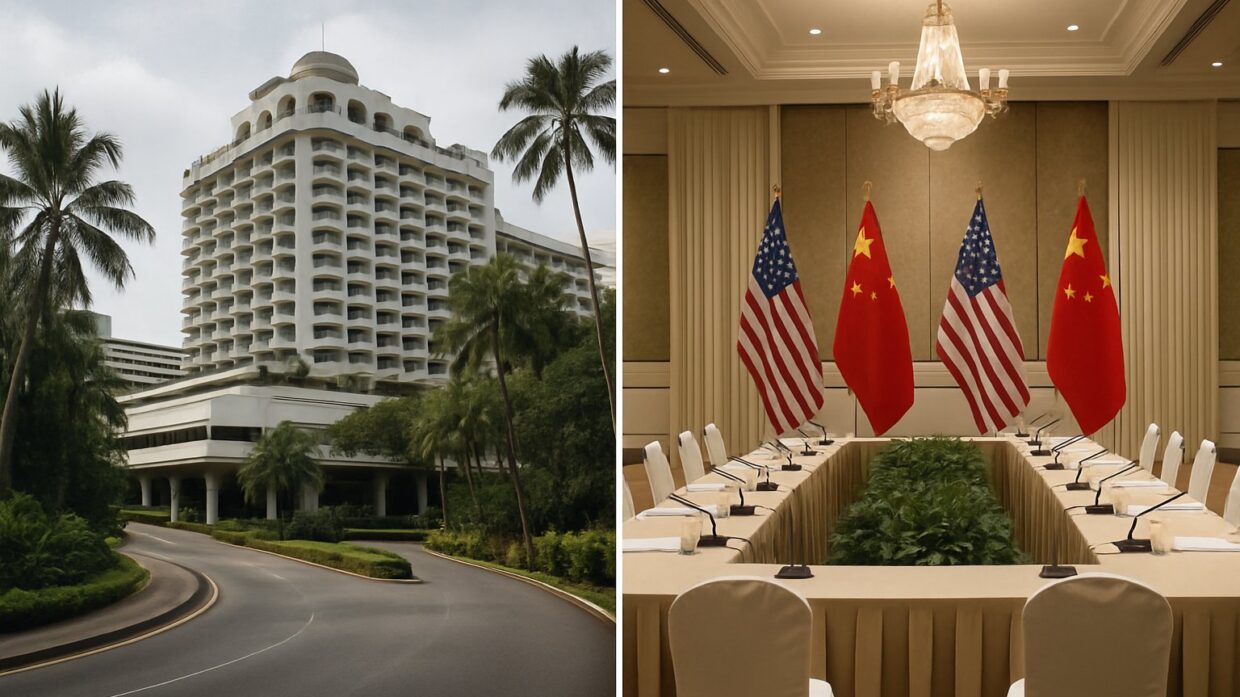
Photo: Well This Is News
US defense chief warns of China military threat while urging Asian allies to boost spending
Hegseth softens China rhetoric and avoids Taiwan after Trump's Beijing diplomatic engagement
Hegseth strikes moderate China tone at Asian summit weeks after Trump's Beijing visit
Key Takeaways
- Hegseth completely avoided mentioning Taiwan despite it being central to every other country's regional security calculation, suggesting the administration cannot simultaneously promise both deeper China engagement and stronger Taiwan commitments.
- The Philippines defense chief at the same conference explicitly called for closer Taiwan military coordination against China, but Hegseth did not amplify or acknowledge this allied position, revealing a gap between what partners expect and what the administration will commit to.
- The administration appears to be testing whether it can reduce emphasis on Taiwan security through tactical silence rather than announcing a strategic shift, leaving regional allies uncertain about actual US policy direction.
The Analysis
Defense Secretary Pete Hegseth delivered remarks at Singapore's Shangri-La Dialogue that contained a measurable shift in tone from earlier warnings about China, arriving just two weeks after President Trump's state visit to Beijing. The contrast between what Hegseth said and what he deliberately left unsaid reveals an administration navigating between conflicting signals about whether it seeks deterrence or accommodation with China.
Hegseth told Asian leaders there is "rightful alarm" about China's military buildup, a phrase that frames regional concern as justified while stopping short of treating Beijing as an existential threat. He urged Asian allies to boost their own military spending to "share the burden" of regional security, a formulation that emphasizes coalition responsibility rather than US containment strategy. But the most consequential detail in his remarks was the complete absence of Taiwan, a country that sits at the intersection of US treaty obligations to Japan and South Korea, China's stated red line, and the flashpoint that shapes every other regional security calculation. NPR noted this omission explicitly; the Washington Examiner framed the silence as evidence of softer US posture; Bloomberg reported Hegseth's "newly stable ties" language as evidence of warming relations.
The left framing, represented by NPR, treats Hegseth's call for allied military spending as the primary news, using language like "rightful alarm" to validate regional concern about China's military expansion. This framing emphasizes coalition-building and deterrence. It does not address why Taiwan was absent from a security address in a region where Taiwan's security status directly affects every other country present. The Philippines defense chief, speaking at the same conference, explicitly called for closer Taiwan ties and military coordination against China's "nefarious plans" according to Bloomberg reporting. That Hegseth did not amplify or even acknowledge this framing suggests something about the administration's actual priority.
The right framing, via the Washington Examiner, leads with the softened rhetoric and the Taiwan silence as evidence of diplomatic reorientation toward Beijing. This reading treats Hegseth's word choices ("newly stable ties," moderated warnings) as a deliberate recalibration. It connects the speech directly to Trump's recent Beijing visit and interprets the sequence as evidence of the administration choosing engagement over confrontation. This framing omits any discussion of what Asian allies themselves are saying they need, treating the alliance burden-sharing call as secondary to the China tone shift.
What neither framing directly addresses is the structural tension Hegseth was attempting to navigate. Bloomberg's reporting on China's former US ambassador reveals that Beijing explicitly rejects Trump's preferred "Group of Two" framework with the US, insisting instead on multipolarity. Hegseth's emphasis on allies bearing their own military burden and his silence on Taiwan may reflect the administration's recognition that it cannot simultaneously promise both deeper China engagement and stronger Taiwan security commitments. The allies present, particularly the Philippines, are publicly stating they expect the latter. The public record shows Hegseth chose not to commit on that point.
The meaningful shift is this: an administration that enters office with stated willingness to engage Beijing is now testing whether it can dilute its Taiwan emphasis without explicitly disowning it. The Shangri-La remarks suggest the answer is tactical silence rather than strategic clarity. Regional allies are watching this gap between what Hegseth said and what he refused to say.
Hegseth's deliberate omission of Taiwan from a regional security address fundamentally alters how Asian allies calculate their own defense spending and diplomatic alignment. When the Philippines defense chief explicitly calls for Taiwan coordination at the same conference and receives no acknowledgment from the US Defense Secretary, countries like Japan and South Korea face a concrete question: does the US security guarantee extend to the flashpoint that triggers every other regional contingency? The administration is testing whether it can soft-pedal Taiwan commitments without formally abandoning them, but silence from a Defense Secretary carries institutional weight. Military planners in Tokyo and Seoul must now budget for scenarios where Taiwan's status becomes negotiable, which means redirecting resources and reconsidering which partnerships offer reliable deterrence. Trump's Beijing visit followed by Hegseth's moderated tone signals to both China and US allies that Washington may accept a deal Beijing has already rejected, but the cost of that ambiguity falls on countries that depend on clarity about