Photo: Well This Is News
China stages carefully choreographed diplomacy as Putin's war leaves Moscow dependent on Beijing
Trump meets Xi while America trains Chinese AI students; Massie's primary loss shows Trump's endorsement power
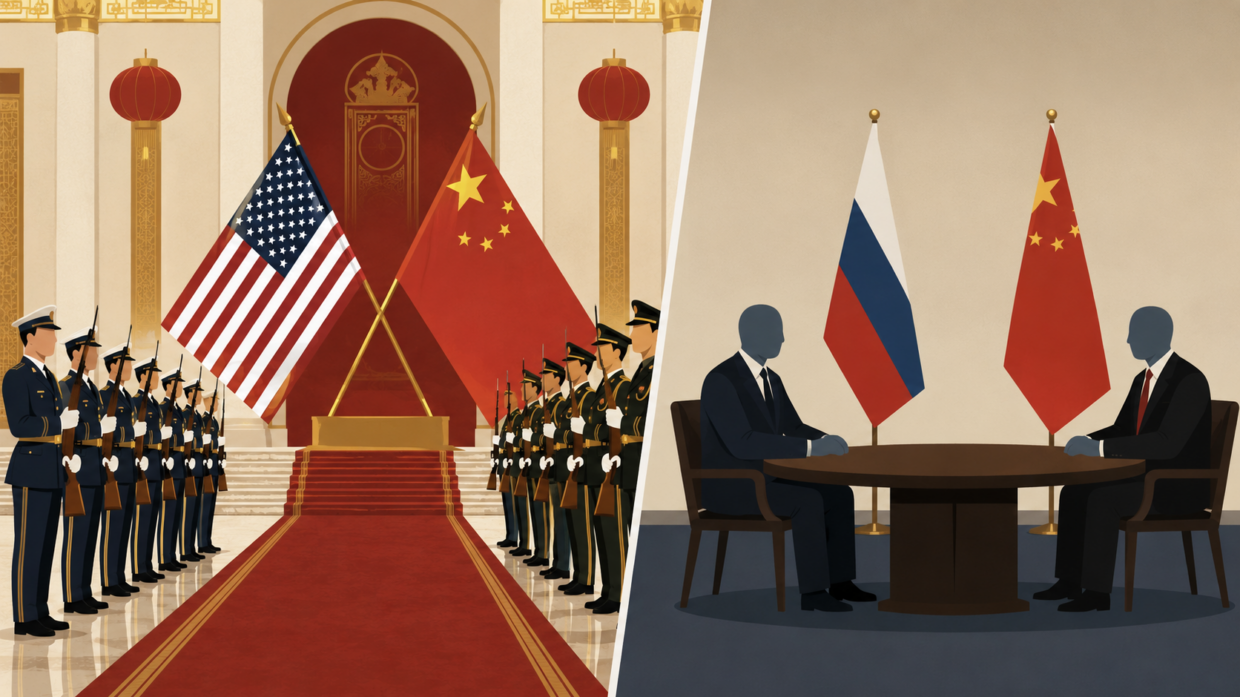
Trump visits Beijing, Putin follows; Xi calibrates ceremony to signal hierarchy amid Ukraine war
Key Takeaways
- Xi's ceremony choreography reflects China's decades-old diplomatic protocol rather than a new strategic move, meaning the ceremonial differences between Trump and Putin's visits reveal little about actual leverage or shifting power dynamics.
- Chinese students have attended American universities for decades across multiple administrations, but both sides framed the AI training issue as either a novel security crisis or a Trump-era problem rather than acknowledging the long-standing policy continuity and economic trade-offs involved.
- Trump's endorsement influence in Republican primaries follows the established 2016-onward pattern of his base determining outcomes, but both sides presented Massie's loss as either evidence of Trump's unique power or separated it entirely from the broader narrative about his relationship to the party.
The Analysis
Trump visited Beijing and received a military band welcome, then Putin arrived days later to notably different ceremonial treatment. What neither framing addresses is that the choreography itself was the message, and both sides chose to interpret it differently based on what served their existing narratives about U.S.-China relations and Russian leverage.
The Guardian's reporting emphasizes Xi's deliberate staging of unequal honors, citing the "pomp and pageantry" for Trump against Putin's reception as evidence of a power hierarchy favoring Washington. The language choice matters here: "pomp and pageantry" suggests theatricality deployed intentionally, framing Xi as coolly managing optics to signal that Russia's Ukraine war has made Moscow subordinate to Beijing. This serves the left's broader narrative that Trump's diplomacy with Xi is distinct from and possibly superior to Putin's position, despite the war. What this framing omits is any acknowledgment that Trump also came to Beijing as a supplicant of sorts, seeking commercial deals and reset relations after his first term's trade conflict with China.
The Federalist's coverage splinters across multiple stories, declining to treat the Xi-Trump-Putin sequence as connected. Instead, it flags the AI student issue and Massie's primary loss as separate Trump-era developments. The piece on Chinese AI students frames the problem as a security vulnerability: America is training the strategic competition while beating China at AI remains the stated priority. This language, "training their students at our universities," positions the United States as inadvertently arming its rival. What this framing leaves unstated is that Chinese students have attended American universities for decades under multiple administrations, that restricting that access carries economic and diplomatic costs, and that the Trump administration has taken few concrete steps to curtail it despite rhetoric claiming this as paramount.
The Massie loss piece uses Trump's endorsement withdrawal as evidence of Trump's continued dominance of Republican primaries. This is factually accurate: Trump backed Ken Paxton, who defeated Massie, suggesting Trump's endorsement remains consequential in deep-red districts. But the framing avoids explaining why Massie, a libertarian-leaning Republican, lost support, focusing instead on Trump's power rather than voters' actual shift. The Federalist names Cornyn's failure to support "the SAVE Act" as the reason Trump withdrew backing, tying it to immigration enforcement priorities that motivate Trump's base. This is specific and verifiable, though it omits that Cornyn still won his primary race.
What both sides avoid is the historical context: Xi's careful calibration of ceremony reflects decades of Chinese diplomatic protocol, not a novel move. Putin's visit follows from economic necessity created not by recent events but by the 2022 Ukraine invasion, which Trump warned about but did not prevent during his first term. And Massie's loss reflects Republican primary voters choosing Trump-aligned candidates, a pattern consistent since 2016, not a new expression of Trump's power. The real headline is that ceremonial differences in Beijing reveal little about actual leverage, that American universities have always trained foreign students including Chinese ones, and that Trump's endorsement matters most in races where his base determines the outcome. None of these facts is hidden, but all are buried beneath the frameworks each side preferred.
Xi's choreographed reception for Trump versus Putin exposes a calculation that will reshape how authoritarian states position themselves in Washington's orbit. By staging unequal ceremony, Xi signaled that Russia's Ukraine invasion has degraded Moscow's standing while simultaneously keeping commercial negotiations with Trump alive, a double move that demonstrates Beijing's ability to recalibrate alignment without abandoning either power. This matters because it establishes a new template: authoritarian leaders now understand that military adventurism triggers realignment from other authoritarian partners, not isolation that pushes them closer together. That institutional shift undermines the assumption of a unified autocratic bloc and creates pressure on Putin to make concessions to regain status, while offering Trump tangible evidence that great power management requires offering carrots to competitors rather than isolation. The precedent Beijing just set will constrain Putin's options for years regardless of which American administration follows.