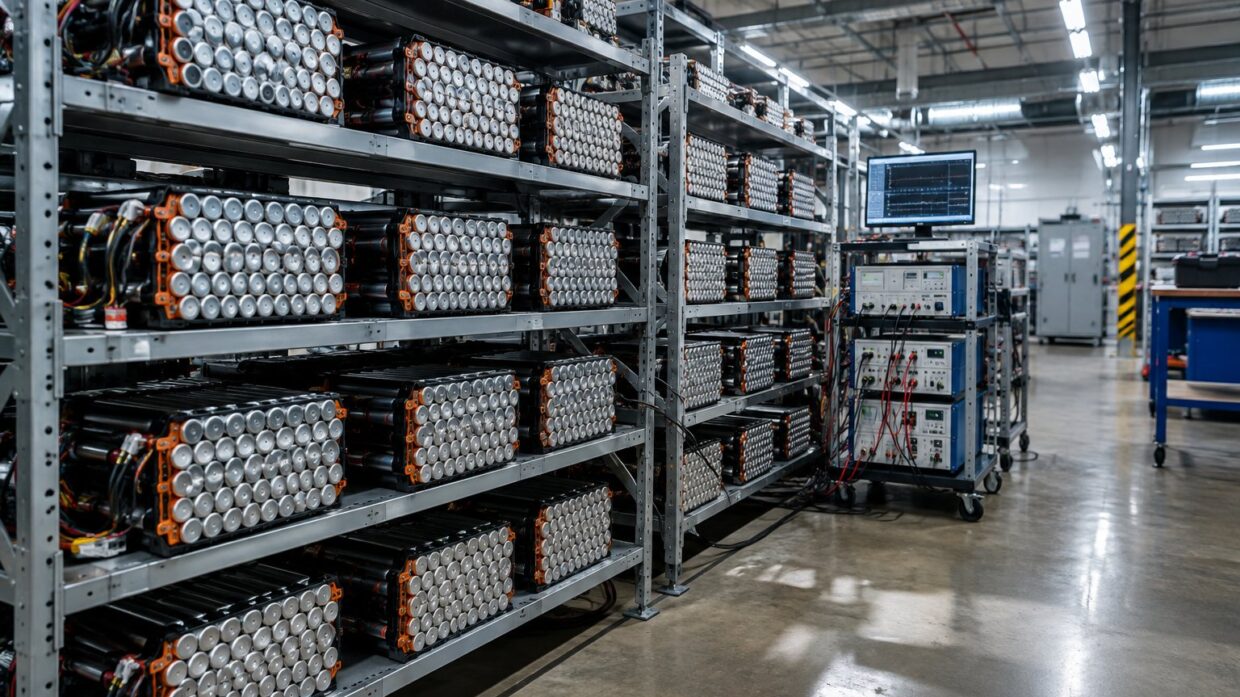
Photo: Well This Is News
Electric Vehicle Batteries Could Power Data Centers, If Companies Invest in Reuse Infrastructure
We haven't found a right-leaning take on this story yet.
Breaking stories sometimes publish before every side has covered them. We'd rather show you that than invent a view.
Used EV Batteries Poised for Reuse as Data Centers Expand Power Demands
Key Takeaways
- Data centers are projected to consume 3-4% of US electricity by 2030, but no one has quantified whether available used EV batteries could actually match that growth.
- Used battery reuse presents a classic coordination problem: no single company wants to build collection and testing networks alone, and regulatory frameworks to incentivize shared infrastructure do not exist in the US or UK.
- Battery reuse economics could shift dramatically if renewable energy capacity expands and grid electricity becomes cheaper, a scenario neither the opportunity advocates nor local opponents address.
The Analysis
Electric vehicle batteries retain 70-80% of their original storage capacity after automotive retirement, and data center operators are beginning to recognize this supply as potentially cheaper and more flexible than grid power or new battery production. The Atlantic's framing emphasizes this opportunity as a straightforward resource match: aging EV batteries could directly replace expensive new installations. But the reporting does not establish what systems would actually collect, test, and integrate these batteries at scale, or who would bear those upfront costs.
The left's narrative focuses on environmental upside and supply abundance. The Atlantic's core claim appears designed to appeal to climate advocates: decoupling data center growth from new battery manufacturing would reduce mining pressure, lower emissions from new production, and extend battery life cycles. The language choice of 'gold rush' explicitly frames this as economically attractive, not merely acceptable. But the article's emphasis on possibility leaves unexamined the financial incentives that would make reuse happen. Used batteries are only cheaper than new ones if collection and certification systems already exist. Those systems currently do not operate at meaningful volume.
The Inside Climate News coverage of Britain's data center expansion introduces an omitted dimension: local environmental and infrastructure resistance that the battery-reuse framing sidesteps entirely. Residents in Slough oppose the Microsoft facility because of noise, cooling water demands, and cumulative site density. A used battery system does not address these concerns. The reporting quotes Ambily Banerjee, a resident who chose the area for 'good schools and green spaces.' Her objection is not to data center power sourcing but to data center presence itself. The left's framing assumes acceptance of data center proliferation and asks only how to power it cleanly. The right's frame, absent from the provided sources, would likely emphasize local planning authority and property rights, arguing that community opposition should constrain expansion regardless of battery sourcing.
What neither side addresses directly is the underlying power demand curve. Data centers consumed approximately 1% of US electricity in 2024 and are projected to reach 3-4% by 2030. Used EV batteries could theoretically supply some portion of this growth. But the math requires both rapid EV adoption to create battery supply and simultaneous deployment of reuse infrastructure that does not yet exist. The Atlantic does not quantify whether available used batteries could match projected data center growth. Inside Climate News does not estimate whether switching to used batteries would satisfy local opposition or merely reduce one complaint while others remain. Neither source establishes how battery reuse economics change if grid electricity becomes cheaper as renewable capacity expands.
The documented constraint is institutional: reuse infrastructure requires upfront investment before returns materialize. This is a classic coordination problem. No single company wants to build collection and testing networks alone. Regulatory frameworks that might incentivize consortium approaches, extended producer responsibility, or utility involvement do not yet exist in the US or UK. The Atlantic frames this as an opportunity waiting to happen. Inside Climate News demonstrates that the opportunity exists alongside serious friction that money alone may not resolve.
Used EV battery reuse for data centers will force a reckoning between supply-chain theory and regulatory reality. The environmental case is sound: steering retired automotive batteries into data centers reduces demand for new battery manufacturing and its associated mining footprint. But this pathway requires collection, testing, and integration infrastructure that currently operates at negligible scale and demands substantial upfront capital with no single investor bearing full responsibility. The real constraint is not environmental feasibility but institutional coordination. Without regulatory frameworks mandating extended producer responsibility or creating financial incentives for consortiums, companies will continue choosing cheaper grid power or new batteries rather than investing in nascent reuse systems. Data centers will expand regardless, and communities like Slough will continue opposing them on land-use and infrastructure grounds that battery sourcing cannot address. The battery-reuse narrative obscures this: it positions a logistical problem as an environmental solution.