Photo: Well This Is News
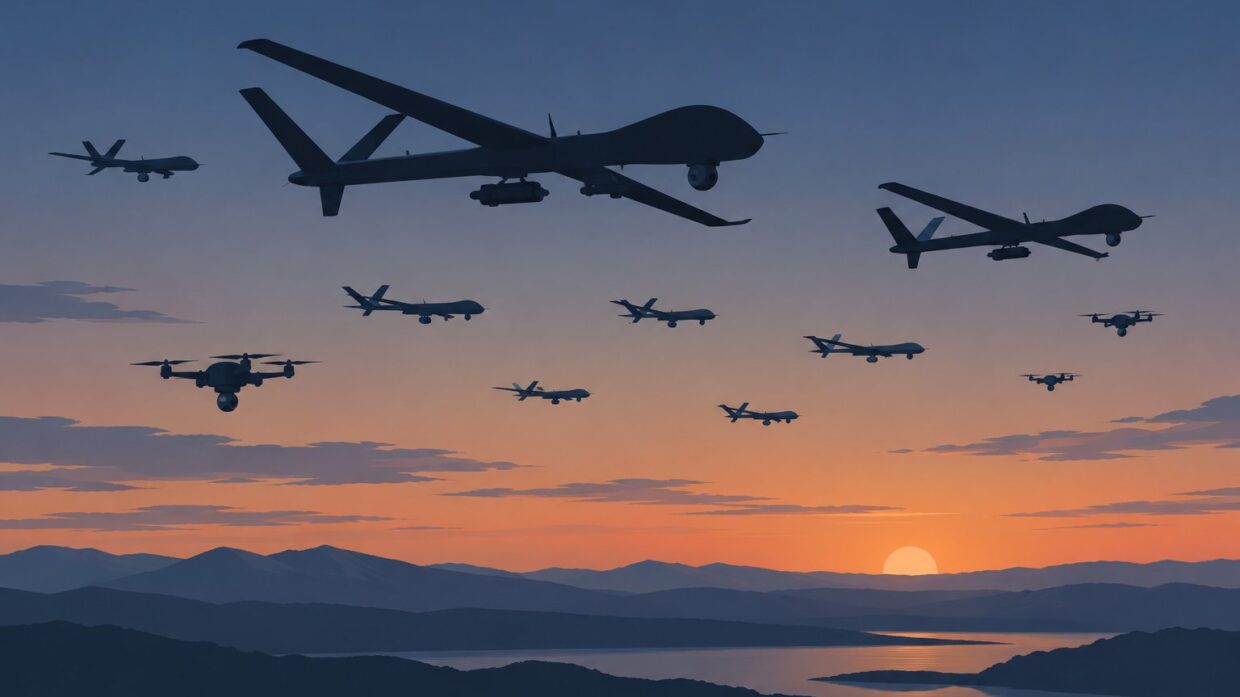
AI drones are reshaping Ukraine war as Zelenskyy warns of autonomous battlefield decisions
We haven't found a right-leaning take on this story yet.
Breaking stories sometimes publish before every side has covered them. We'd rather show you that than invent a view.
Ukraine and Russia deploy AI-enhanced drones as Moscow reports record interceptions
Key Takeaways
- Russia's claim of intercepting 1,200 drones lacks verification of whether these represent actual destroyed systems, temporarily disrupted attacks, or inflated counts, making it impossible to assess the true impact on Ukrainian drone capacity.
- Both nations have deployed drones since at least 2014-2015, so current AI integration reflects evolutionary military improvement rather than a sudden technological breakthrough that suddenly threatens human control.
- Zelenskyy's one-year timeline for autonomous battlefield decisions may reflect genuine technical progress or a politically useful urgency claim designed to pressure Western nations into AI governance agreements now.
The Analysis
Russia's claim that it intercepted more than 1,200 Ukrainian drones in a single night, reportedly the highest total on record, surfaces a specific military fact that both sides are framing through opposing technological narratives. The left side emphasizes AI capability and risk; the right side remains silent; what neither framing adequately addresses is what these interception numbers actually tell us about the war's trajectory.
The NPR reporting establishes that artificial intelligence is making drones faster and more capable on both sides. Zelenskyy's specific warning appears in the coverage: he has stated that AI could lead decisions on the battlefield as soon as next year. This is a named claim from a named official with a stated timeframe. The left framing takes this warning as the headline and treats it as evidence that the technological escalation is already outpacing human oversight capacity. That narrative emphasizes risk and the urgency of the problem.
Bloomberg reports the Russian claim without editorial comment about what it means. Russia said its air defenses intercepted the drones. The reporting does not establish whether these interceptions represent Ukrainian drone losses, Russian air defense success, a shift in Ukrainian drone deployment strategy, or some combination of these factors. An interception claim is not the same as a disabled threat, and neither publication establishes what percentage of Ukraine's drone capacity these 1,200 units represent, or whether the number reflects more drones being sent, better detection, or improved Russian defenses.
The left frame centers on AI as a transformative military technology and frames Zelenskyy's warning as urgent evidence that humans are losing control over battlefield decision-making. This serves a narrative about technological risk and the need for international agreements on autonomous weapons. What this framing leaves out is the prior military and industrial context: drones have been central to Ukraine's strategy precisely because they are cheaper than crewed aircraft, can be produced domestically or rapidly acquired, and allow asymmetric warfare against a numerically larger force. AI enhancement accelerates existing capabilities; it does not create the fundamental dynamic.
What neither side addresses is the specific history preceding this moment. Ukraine has relied on drone warfare since 2014 in the Donbas conflict. Russia has been using drones in Syria since 2015 and has developed significant drone capabilities. The current escalation in both drone numbers and AI integration reflects a predictable military evolution, not a sudden shift. The coverage also does not establish whether Russia's reported interception rate reflects actual drone destruction, temporary disruption, or inflated claims. Military claims about interceptions are historically unreliable without independent verification.
The real question is not whether AI drones are reshaping the war, they are, but whether Zelenskyy's warning reflects a near-term technical inevitability or a longer-term policy concern that allows him to call for Western AI governance agreements now. His timeframe of next year is politically significant: it justifies urgent action. What the record does not yet establish is whether autonomous targeting is technically mature in either military's hands or whether both sides remain dependent on human operators for decision approval.
Russia's claimed record drone interceptions obscure rather than clarify the war's technological pivot. The specific numbers tell us nothing about whether Ukraine is losing capacity, Russia is improving defenses, or both sides are simply deploying more units as asymmetric warfare becomes drone-dependent across both militaries. Zelenskyy's warning about autonomous targeting decisions within a year carries political weight precisely because it remains unverified as imminent technical reality rather than justified policy urgency. Ukraine's decade-long reliance on cheaper, domestically producible drones reflects strategic necessity against numerical disadvantage, not sudden technological revolution. Without establishing whether either military actually deploys autonomous targeting or merely enhances operator-controlled systems, the coverage treats AI integration as transformative inevitability while missing the institutional fact: whoever masters drone production scaling and repair logistics wins this war regardless of autonomous capability. That industrial capacity problem receives no analysis.