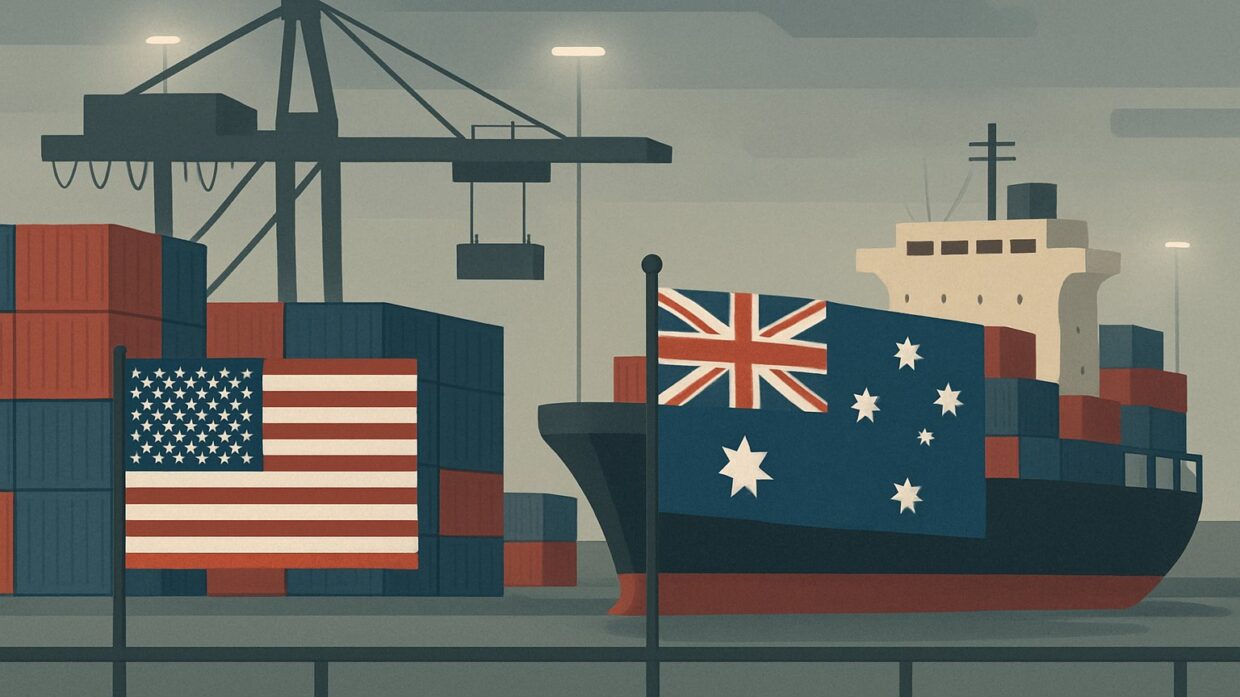
Photo: Well This Is News
Trump's tariff regime threatens Australian households with rising prices and interest rates
Trump Takes Action Against Unfair Trade Practices as Australia Faces New Tariff Regime
Trump tariffs on Australia escalate amid claims of forced labour, drawing trade agreement challenge
Key Takeaways
- The specific forced labour practices that triggered the Australian tariffs remain completely unexplained in public reporting, along with which Australian industries or companies are actually targeted.
- Trump's tariff revenue under the new regime generates less money than tariffs the Supreme Court previously struck down as illegal, suggesting the administration is restructuring tariffs for legal rather than strategic reasons.
- The Trump administration has announced sequential tariffs across over 80 countries using different stated justifications, but no public record shows whether labour standards enforcement or negotiating leverage is the actual driving motivation.
The Analysis
Trump has imposed tariffs on Australian exports under the justification of forced labour concerns, a claim that Australia's Trade Minister Don Farrell has called unjustified and inconsistent with the existing US-Australia free trade agreement. The specific tariff rates and affected product categories remain incompletely reported in available coverage, but the move is part of a documented campaign targeting over 80 countries. The Trump administration appears to be using labour standards as a tariff rationale distinct from traditional trade protectionism arguments.
The left-leaning coverage frames this primarily through household economic impact. The Guardian emphasizes connection between Trump's tariffs and inflation pressure, linking the tariff story to broader economic headwinds including Middle East geopolitical tensions pushing crude oil above $100 per barrel. The framing leaves out the Trump administration's stated labour standards justification, focusing instead on inflationary consequences. Economists cited in the Guardian coverage warn of potential interest rate increases and petrol prices exceeding $2 per litre, though the reporting does not establish whether this projection reflects only tariff pressure or includes other commodity market factors.
Right-leaning coverage, represented by Daily Wire reporting on similar EU tariff threats, frames Trump's action as protective enforcement against unfair trade practices. The Daily Wire quotes Trump's accusation that the EU treats America like a "PIGGYBANK," characterizing tariff action as defensive response to what Trump claims are discriminatory regulatory fines on US companies like Google. This framing emphasizes reciprocity and accountability rather than punitive tariffs, though it does not address Australia's specific forced labour claims or whether those claims are substantiated.
What neither side foregrounds is the actual evidence basis for forced labour allegations against Australia. The available reporting does not establish what specific forced labour practices triggered the tariff designation, which Australian industries or companies are targeted, or whether this claim aligns with findings from labour rights organisations. The US-Australia free trade agreement language around tariff justification also remains undisclosed in these reports. Additionally, Axios reporting indicates that Trump's new tariff regime generates less revenue than tariffs the Supreme Court struck down as illegal, suggesting the administration is searching for alternative legal tariff mechanisms rather than pursuing a coherent trade strategy. This detail appears in neither left nor right framing.
The underlying question is whether Trump's tariff pattern reflects genuine concern about labour standards enforcement or functions primarily as a revenue mechanism and negotiating tool. The public record does not establish Trump's internal reasoning. What the available reporting does show is sequential tariff announcements across multiple countries using different stated justifications, tariff revenue shortfalls requiring legal restructuring, and trade agreement partners like Australia characterising the claims as pretextual. A reader who only knew the left's coverage would assume pure economic punishment; a reader who only knew the right's framing would assume principled enforcement. The actual record suggests neither fully captures the mechanism or the justification gap between stated rationale and documented labour conditions.
Trump's tariff campaign using forced labour claims as legal cover creates precedent for bypassing established trade agreements whenever a president faces domestic political pressure. If Australia successfully challenges these tariffs under the US-Australia free trade agreement's dispute mechanisms, it either forces Trump to withdraw or escalates the conflict into open trade war with a key Pacific ally. If the challenge fails, every future US administration gains a template for invoking labour standards as pretextual justification for protectionist measures, fundamentally degrading the enforceability of trade agreements. The fact that tariff revenues under this new structure fall short of previously struck-down tariffs reveals the administration is optimizing for legal cover rather than fiscal purpose, meaning the policy persists regardless of economic harm because withdrawal admits the labour standard justification was false.